Brass vs Steel Air Compressor Fittings: Which Should You Choose?
For most home garages and shops, brass is the better pick because it resists corrosion and seals well on tapered threads. Steel is tougher against dings and drops, but plated steel can rust if the coating wears through. Whichever you choose, match the thread size and coupler profile first, since those decide whether a fitting works at all.
 Ailbiuko aircoupler_plug-iron-45pcsBest overall
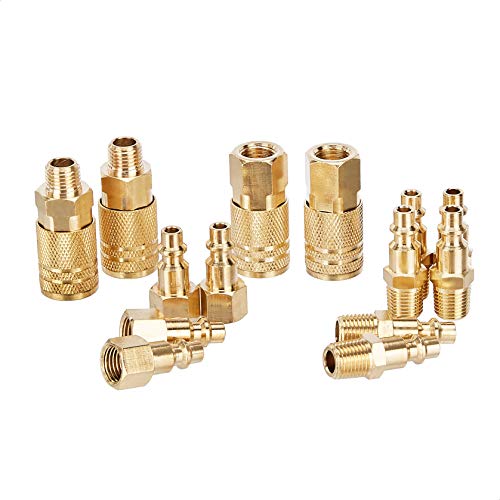 Amazon Basics A140001Brass starter set
 SOKOSEY 20SMmutou2packsReplacement M/D couplers
Brass vs steel at a glance
Brass does not rust the way iron or steel does. That matters on an air system, because compressed air carries moisture and that moisture sits inside your fittings. Brass is also softer, which helps it seal against mating threads and parts.
Steel is harder. It shrugs off dents, drops and scraping on a concrete floor better than brass does. The trade-off is rust. Plated or coated steel resists it well until the plating is scratched or worn, and then the bare metal underneath can corrode.
Our best air compressor fittings page lists mostly solid brass kits, plus a few that mix brass and plated steel. That fits the general picture: brass is the common choice, and steel shows up where makers want extra hardness.
How the two metals compare
The table below sums up the practical differences. These are general traits of the materials, not ratings for any one product.
| Trait | Brass | Steel (plated or coated) |
|---|---|---|
| Rust resistance | Does not rust in the usual sense | Good while plating is intact, weaker once scratched |
| Hardness | Softer, can dent or wear sooner | Harder, handles knocks well |
| Thread sealing | Seals well with tape or sealant | Seals well too, usually needs tape or sealant |
| Overtightening | Threads can deform or crack | More forgiving, but can still gall or strip |
| Best fit | Humid garages, general use | Rough handling, frequent drops |
What the product data shows
Material choice shows up clearly in the kits we compare. The Amazon Basics 14-piece kit and the WORKPRO 16-piece kit are both listed as solid brass. The WORKPRO kit weighs 0.97 lb and the Amazon Basics kit weighs 1.28 lb.
The Ailbiuko 45-piece kit is listed as brass and plated steel. Its listing says most of the fittings are iron with a copper layer for corrosion resistance, while the hex coupler and nipple are brass. That kit weighs 3.22 lb, which reflects its size: 8 couplers and 28 plugs.
Pressure ratings are separate from material. Several kits on that page list 300 psi, including the Ailbiuko kit and the WORKPRO kit, and some makers do not publish a rating at all. A missing number is not proof of a weak fitting, but it is a gap worth noting.
What are the two types of air compressor fittings?
The two basic types are couplers and plugs. A coupler is the socket that connects to the hose or the compressor. A plug, sometimes called a nipple, is the part that pushes into the coupler. You need one of each to make a connection.
Both come in male and female thread versions, which is where the confusion starts. The thread type describes how the fitting screws onto your hose or tool. It is separate from whether the part is a coupler or a plug.
Some kits sell only one half. For example, two M-style couplers with no plugs, or ten plugs with no couplers. Those are useful as refills but will not work alone.
Common types and standard sizes
The most common thread size is 1/4 in NPT. Every top-ranked kit on our fittings page lists it. NPT threads are tapered, so they seal by wedging together, and they need thread tape or sealant. Fittings with a different thread will not seal on NPT ports.
Next comes the coupler profile, which is the shape of the plug and socket. In the US, the usual profiles are:
- Industrial (M/D): the most widespread profile, and the one most kits here list. It is meant to interchange across brands.
- Automotive (T): a different plug shape that does not mix with Industrial couplers.
- ARO (A): another profile you will see on some tools and hoses, also not interchangeable with the others.
- Push-to-connect couplers: some kits use a push-in design with locking balls, so you push the plug in rather than pulling back a sleeve.
How to choose for your setup
Start with the thread on your compressor outlet and hose. Then pick the coupler profile that matches your existing plugs. Only after that does the metal matter.
For a humid garage or a shed that sees temperature swings, brass is the safer default. If your hose gets dragged around a shop floor, a plated steel plug may take the abuse better, as long as you replace it once the plating wears.
Mixing metals is generally fine in an air system, but keep the fittings clean and dry. If you are also shopping for the compressor itself, see our best air compressor for home garage page, or the best air compressor for automotive shop page for heavier use.
A simple checklist before you buy:
- Confirm 1/4 in NPT, or whatever thread your gear uses.
- Confirm the coupler profile, such as Industrial (M/D).
- Look for a stated pressure rating that exceeds your compressor's working pressure.
- Count the couplers and plugs you need.
- Check whether thread tape is included.
Installing fittings safely
Wrap NPT male threads with tape in the direction of the thread, then snug the fitting by hand before using a wrench. Brass is soft, so stop once the joint is firm. Overtightening can crack a fitting or distort the threads.
Safety matters here because compressed air stores energy. Follow these steps every time:
- Turn off the compressor and unplug it before changing fittings.
- Release the tank and line pressure fully before you unscrew anything.
- Wear safety glasses, since a failed fitting or a loose plug can whip or spray debris.
- Use hearing protection when running a compressor or blowing air for long periods.
- Never exceed the lowest pressure rating in the system, whether that is the fitting, hose or tool.
- Replace any fitting that is cracked, badly corroded, or leaks after retaping.
Frequently asked questions
Can I mix brass and steel fittings in one air line?
Yes, in most air systems it is fine. Make sure the thread sizes and coupler profiles match, and keep the joints taped and clean.
Do I need thread tape on every fitting?
You need it on tapered NPT threads, which seal by wedging. Some kits include tape and some do not, so check the contents before you order.
Will an Industrial plug fit an Automotive coupler?
No. Industrial (M/D), Automotive (T) and ARO (A) profiles are different shapes, so plugs only work with couplers of the same profile.
Do bigger fittings give more airflow?
Generally yes, since a larger body and flow hole restrict air less. The 1/4 in size is common for general tools, but check your tool's needs.