Is a Measuring Wheel Accurate? Tips to Improve It
Yes, a measuring wheel is accurate enough for most layout, landscaping and property work. Most wheels on our comparison list 0.5% accuracy, which works out to about 6 inches of possible drift over 100 feet. Your technique, the ground and the wheel size often matter as much as the spec itself.
 zozen 002Best overall
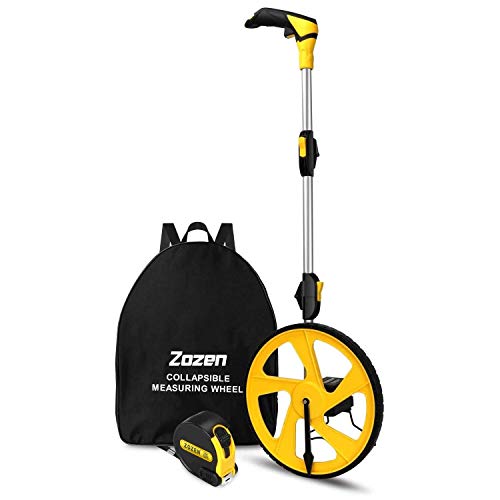 zozen Best mechanical wheel
 zozen hong-2Easiest to spot on site
What 0.5% accuracy means in real distances
Accuracy on a measuring wheel is a percentage of the distance you roll. A 0.5% rating means the reading could be off by up to half of one percent either way. Calculated Industries describes its DigiRoller Plus III as 99.5% accurate, which is the same margin written another way.
The error grows with distance, but the percentage stays the same. That is why a wheel feels very precise on a 200-foot fence line and less so on a 10-foot hallway. Here is what a 0.5% margin looks like at a few distances.
| Distance rolled | Possible drift at 0.5% |
|---|---|
| 10 ft | About 0.6 in |
| 50 ft | About 3 in |
| 100 ft | About 6 in |
| 500 ft | About 2.5 ft |
| 1,000 ft | About 5 ft |
Wheel or tape: which is better for the job
Wheels tend to shine on longer runs, where stretching a tape is slow and a tape can sag or shift. Over short distances, a tape measure is usually the better tool, because a few inches of wheel drift is a big share of a short measurement.
A simple rule works well. Use a tape for anything under roughly 20 feet or when you need exact fit, such as cabinets or cuts. Use a wheel for driveways, lot lines, fencing, paths and room-to-room layouts where being within a few inches is fine.
Why readings drift
Most errors come from how the wheel meets the ground, not from the counter. A wheel counts rotations, so anything that changes how far it travels per turn, or how many turns it records, shows up in the number.
Common causes include:
- Slipping or skipping on loose gravel, wet grass or slick surfaces
- Bouncing over bumps, cracks and clumps, which lifts the wheel off the ground
- Starting or stopping with the wheel not at the exact mark
- Drifting off a straight line, which makes the path longer than the true distance
- Pushing too hard, tilting the wheel, or letting it wobble from side to side
- Rolling backward carelessly. The counters we compare count down when you reverse, so a stray backward roll subtracts from your total
Tips to improve your accuracy
Small habits make a noticeable difference. Most of them cost nothing and take a few seconds.
Start by zeroing the wheel and lining its location marker or tire edge up with your starting point. Then walk at a steady, comfortable pace and keep the wheel upright, close to your side, and tracking in a straight line. Stop with the marker on your end point and read the display before you move the handle.
- Pick a wheel size that suits the terrain. The 12.5 in wheels on our list roll over grass, gravel and cracks with less bouncing than the 6 in and 4 in models.
- Use the kickstand, where the model has one, to hold the wheel upright while you write down a reading or place a flag.
- Break long runs into legs with a flag or marker at each turn, and write down each leg instead of relying on one giant total.
- Use the hold or pause function on digital models if you need to stop mid-run without adding extra distance. Zozen's digital model and the DEKOPRO digital model both list one.
- Roll the same line twice, once each way if you can, and compare. If the two numbers are close, trust them.
- Keep the tire clean. Mud, grass and small stones can change how the wheel grips and turns.
Can you calibrate a measuring wheel?
The simplest check is to roll the wheel along a known distance and compare. Lay a long tape on flat, smooth ground, such as 50 or 100 feet, and zero the wheel. Roll it along the tape and see how close the display lands.
If the number is within the listed margin, the wheel is behaving normally. If it is consistently off by more, check that the wheel is not rubbing on its frame, the tire is clean, and your technique is steady. The specs we compare do not list a user calibration setting, so check your manual before assuming a wheel can be adjusted.
It also helps to know the geometry. A 12.5 in wheel travels about 3.27 feet per full turn, so it records fewer turns than a smaller wheel over the same distance. Fewer turns and less bouncing is one reason larger wheels suit rough ground. Our best measuring wheel page lists wheel diameter next to accuracy so you can see both.
What to look for if accuracy matters to you
Start with the accuracy rating, but do not stop there. On our comparison, the Zozen 12.5in Digital, the Zozen Double Collapsible and the Zozen 12.5in Red all list 0.5% accuracy, and the DigiRoller Plus III lists 99.5%. The DEKOPRO 4V 12.5in Digital does not publish an accuracy rating, so you have no stated margin to compare.
Next, match the wheel to where you will use it. Compact wheels suit floors, sidewalks and rooms, while 12.5 in wheels are the better match for fields and yards. Then think about the display. A mechanical counter reads in feet and inches and needs no batteries. Digital wheels add metric units and saved readings. If you want a side-by-side look at these specs, see our measuring wheel comparison.
Safety notes
Watch where you are walking. Looking down at the display or behind you at the wheel is an easy way to trip on uneven ground, curbs or tools left on a job site.
If you are measuring along a road or driveway, stay out of traffic and wear high-visibility clothing when vehicles are nearby. Before staking or placing flags in a yard, find out where buried utility lines run. Take care folding and unfolding the handle so your fingers stay clear of the joints.
Frequently asked questions
Is a measuring wheel accurate enough for property lines?
It is fine for rough planning, estimating fence length and general layout. For legal boundaries, a licensed surveyor's work is what counts, so treat wheel readings as estimates.
Does walking speed affect the reading?
Not directly, since the wheel counts turns, not time. But a steady pace helps you keep the wheel straight, upright and in contact with the ground, which does affect the result.
Will a digital wheel be more accurate than a mechanical one?
Not necessarily. On our list, the digital Zozen and the mechanical Zozens share the same 0.5% rating. Digital mainly adds metric units, memory and a backlit screen.
How often should I check my wheel?
Check it against a tape whenever you start an important job, after it has been dropped, or if readings seem off. A quick check along a known distance takes only a minute or two.