Is a Jointer Worth It for a Home Woodshop?
Yes, a jointer is worth it if you buy rough or warped lumber, or build furniture that needs tight glue joints. It is the machine that makes one face flat and one edge square, and every later cut depends on that. If you only build with pre-surfaced boards or make small projects, you can probably skip it.
 CUTECH 401120HI-IFBest overall
 Jet JJ-6HHDXLongest 6 in tables
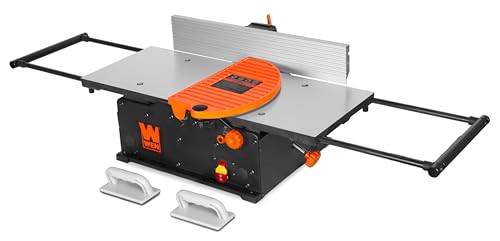 WEN JT1224HBest wide benchtop value
What a jointer actually does
A jointer flattens one face of a board and then squares an edge to that face. That sounds minor, but it is the foundation for everything that follows. A flat face and a square edge give you a true reference to work from.
Other machines cannot do this job in the same way. A thickness planer makes the second face parallel to the first, but it presses the board flat while it cuts. A warped board goes in warped and comes out thinner and still warped. The jointer is what removes the twist, cup or bow first.
A table saw also needs a straight edge to ride the fence. Without one, the cut wanders, and glue joints show gaps.
When a jointer is worth it
The case is strongest when you start with rough lumber. Rough boards are rarely flat, and a jointer lets you mill them yourself so you can choose your own thickness and grain layout.
It also pays off for any project with long glue-ups, such as tabletops, cabinet doors, and panels. Tight edge joints depend on both edges being straight and square.
- You buy rough or air-dried lumber and want to mill it yourself.
- You build tabletops, doors, or panels from several boards glued edge to edge.
- You already own a planer and are frustrated that it cannot flatten warped stock.
- You build furniture where square, flat parts affect how everything fits together.
When you can skip it
Not every shop needs one. If you buy boards that are already surfaced on all four sides, or you mostly build small pieces from plywood and trim, a jointer may sit unused. A jointer also takes floor or bench space, needs dust collection, and adds another machine to maintain.
There are workarounds, and some are good ones:
- A hand plane can flatten and square boards if you enjoy hand work and have time.
- A planer sled carries a board across a planer bed on shims, so the planer can flatten one face.
- A table saw jointing jig can straighten an edge, though it is slower and less precise on long boards.
- Buying lumber surfaced on all sides moves the work to the lumber yard, but it limits your choice of stock.
Choosing size and type for a home shop
Cutting width decides how wide a board you can flatten on one face. Table length decides how long a board stays supported while you work. Our best jointer comparison lists models from 6 in to 12 in wide, with tables from 23 in to 73 in long.
Benchtop machines weigh from about 21 lb to 112 lb and suit small shops. Stationary machines, such as the JET JJ-6HHDX at 237 lb and the Powermatic 60HH at 489 lb, are much heavier but offer longer tables. The JET has 56 in tables and the Powermatic has 73 in tables. Longer tables make it easier to straighten long boards accurately.
Here is how a few published specs compare.
| Model | Cutting width | Table length | Weight | Cutterhead |
|---|---|---|---|---|
| VEVOR 6-Inch Benchtop | 6 in | 23 in | 21.16 lb | Straight knife |
| WEN JT630H | 6 in | 30 in | 36.82 lb | Spiral |
| Cutech 8-Inch 40180HB | 8 in | 34 in | 55.1 lb | Spiral |
| WEN JT1224H | 12 in | 34 in | 102.8 lb | Spiral |
| JET JJ-6HHDX | 6 in | 56 in | 237 lb | Helical |
| Powermatic 60HH | 8 in | 73 in | 489 lb | Helical |
Cutterhead type matters too
Spiral and helical cutterheads use many small inserts set at an angle. They tend to leave a smoother surface in tricky grain, run quieter, and let you rotate an insert to a fresh edge instead of resetting long knives. Carbide inserts last longer than HSS.
The JET JJ-6HHDX, for example, has 27 carbide inserts, and you rotate a dull one 90 degrees to a new edge. A straight knife head, like the one on the VEVOR, is simpler, but it is more prone to tear-out in figured wood and the knives need to be set carefully.
Depth of cut is similar on most models here, at up to 1/8 in per pass. The Powermatic 60HH is listed at 1/2 in maximum depth, which suits heavier stock removal.
Safety and setup basics
A jointer has an exposed rotating cutterhead, so treat it with respect. Always use push blocks, keep your hands off the cutterhead, and never joint pieces that are too short to control. The JET manual-style specs, for instance, call for stock at least 8 in long, 3/4 in wide, and 1/4 in thick.
Wear eye and hearing protection, and avoid loose sleeves or gloves near the machine. Keep the guard in place and disconnect power before changing inserts or knives.
Check your electrical supply before buying. Larger machines may need 230V or a dedicated circuit; the JET JJ-6HHDX listing recommends a 20A circuit. Plan dust collection as well. That model's 4 in port calls for a collector rated at least 350 CFM, and fine dust is a health concern, so a respirator is wise.
Finally, check floor space and weight. A 237 lb machine needs a solid spot and ideally a mobile base, which is sold separately for the JET.
Our recommendation
If you mill rough lumber or build furniture, buy a jointer. A benchtop model with a spiral head covers most home shops, and a wider cutting width helps if you build panels. If you build mainly small projects from surfaced stock, start with a planer sled or hand plane and revisit the question later.
To see all the options on one spec sheet, browse our jointer comparison and match width, table length, and weight to your shop.
Frequently asked questions
Do I need a planer as well as a jointer?
Usually yes for milling rough lumber. The jointer makes one flat face and one square edge, and the planer then makes the opposite face parallel at a set thickness.
Can a jointer flatten a board wider than its cutterhead?
No. A jointer can only flatten boards up to its cutting width. For wider boards, rip them narrower, joint the pieces, and glue them back together, or use a planer sled.
Is a benchtop jointer accurate enough?
For boards a few feet long, often yes. Shorter tables support long boards less well, so a stationary machine with longer tables is easier for long stock.
How often do I change the inserts or knives?
When the surface gets rough or you see lines or nicks. On spiral and helical heads you rotate the affected insert to a fresh edge rather than replacing the whole set.