Is a Hex Key the Same as an Allen Key?
Yes. A hex key and an Allen key are the same tool, a six-sided driver that fits into a hex socket in a screw or bolt. "Allen" started as a brand name and became the everyday word, so the two terms are interchangeable, and so is "Allen wrench".
 ELEAD 70084Best overall
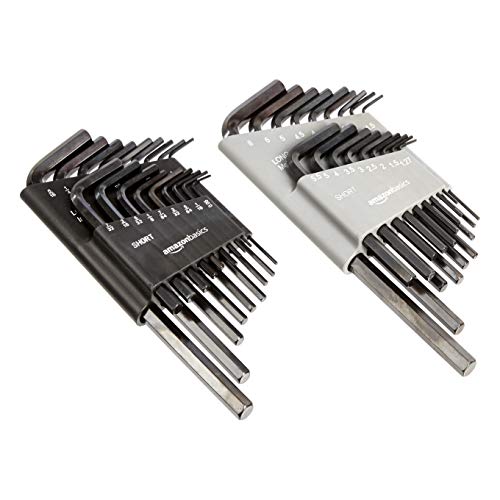 Amazon Basics DS-AMZ030Long-arm keys in two cases
 HORUSDY 94262Color-coded ball-end set
Hex key vs. Allen key: one tool, several names
A hex key is a simple driver with a six-sided (hexagonal) tip. It fits into a matching hexagonal recess in a fastener, often called a socket head or set screw. Turn the key and the fastener turns with it.
"Allen key" and "Allen wrench" are older, more casual names for the very same thing. The name began with a company that sold these tools, and it stuck the way some brand names do. Today, "hex key" is the neutral term you will see on most product listings, while "Allen key" is what many people say out loud.
There is no functional difference. A set sold as an "Allen wrench set" and one sold as a "hex key set" are shopped for and used the same way. You can see this in practice: the HORUSDY product we compare is titled an Allen Wrench Set, and the Amazon Basics 36-piece listing says outright that Allen wrenches are also known as hex keys.
Names you will run into
Different regions, brands and shops use different words. Here is how they line up.
| Name | Same tool? | Where you may see it |
|---|---|---|
| Hex key | Yes | Product listings, manuals, spec sheets |
| Allen key | Yes | Everyday speech, furniture instructions |
| Allen wrench | Yes | Hardware aisles, US shops |
| Hex wrench | Yes | Tool catalogs |
| Torx key | No | Star-shaped drive, a different tool |
The real differences are size and shape
If the names mean the same thing, what should you look at when choosing? The differences that matter sit in the tool itself, not in its name.
Size system is the first one. Hex keys come in metric sizes (millimeters) and SAE sizes (fractions of an inch). A metric key in the wrong size can feel close but will slip and round off the fastener. Many sets include both systems.
Key style is the second. The classic L-shape has a long arm for reach and a short arm for leverage. Folding keys tuck into a handle and travel easily. T-handle keys are easier to turn with comfort. Ball-end tips let you turn a screw at an angle, but a straight tip generally grips better when you need maximum force.
Finally, check the steel. Chrome vanadium is a common hex key material, and several sets add a black oxide finish for rust resistance.
- Size system: metric, SAE, or both
- Key style: L-shaped, folding or T-handle
- Tip type: straight hex or ball-end
- Material: chrome vanadium or other heat-treated steel
- Storage: indexed case, holder or folding handle
Hex keys are not Torx keys
One mix-up is worth clearing up. A Torx key has a six-pointed star tip, not a hexagon. It will not fit a hex socket properly, and a hex key will not fit a star recess.
Many sets bundle both so you are covered. The ELEAD 70084 is a 41-piece set that includes Torx keys from T9 to T50 alongside hex keys. The Amazon Basics folding set lists Torx sizes from T9 to T40. If your work includes star-drive screws, look for Torx in the piece list. If it does not, a hex-only set such as the Kraftek 22-piece set is enough.
How to choose a set
Since the name does not matter, shop by specification. Our best hex key set page compares published specs side by side, and these are the points that tend to matter most.
Start with the size range. The ELEAD 70084 and the EFFICERE 30-piece set both list 0.7 to 10 mm metric and 0.028 to 0.375 inch SAE. The Amazon Basics folding set tops out at 8 mm and 0.25 inch, which is compact but can miss larger bolts.
Next, think about how many pieces you need. The ELEAD set has 41, the HORUSDY set has 37 and the Amazon Basics 36-piece set has 36, with both long and short arm lengths. A higher count usually means more sizes or extra key types, so check what the pieces actually are.
Last, look at how sizes are identified. The HORUSDY set uses color coding, and the EFFICERE set has size-indexed slots in a foldable case. Tidy storage saves time on every job.
Using hex keys safely
Hex keys are low risk, but a few habits prevent skinned knuckles and damaged screws.
Push the key fully into the socket before turning. A half-seated key can round off the recess. Use eye protection when working on rusted or spring-loaded parts, since a slipping key or a flying fragment can hurt. Never slide a pipe over the key for extra leverage, because a stressed key can snap suddenly. If a fastener will not budge, step up to a longer-arm key or a torque handle rather than forcing a small one.
- Match the key to the fastener exactly, metric or SAE
- Seat the key all the way in
- Wear safety glasses on stuck or spring-loaded parts
- Do not use a pipe extension on the key
- Replace keys with rounded or twisted tips
Frequently asked questions
Can I use a metric key in an SAE socket?
Not reliably. Some sizes are close, but a near fit leaves play that can strip the socket and the key. Use the exact size in the matching system.
Why do some sets have ball-end keys?
A ball-end tip lets you turn a screw while the key is tilted. The HORUSDY listing mentions access up to a 25 degree entry angle. For the tightest fasteners, use the straight end.
What does a torque handle do?
It gives you a larger grip to turn a key with more force and reach. The ELEAD 70084 includes one.
Do I need long-arm keys?
They help when a screw sits deep in a recess. The Amazon Basics 36-piece and EFFICERE 30-piece sets both list long and short arm lengths.