Internal vs External Snap Ring Pliers: Which to Use
Use internal snap ring pliers for rings that sit inside a bore or housing, because they squeeze closed to shrink the ring. Use external pliers for rings that sit on a shaft or pin, because they spread open to expand the ring. If you work on both, convertible pliers switch between the two modes and cover most jobs with one tool.
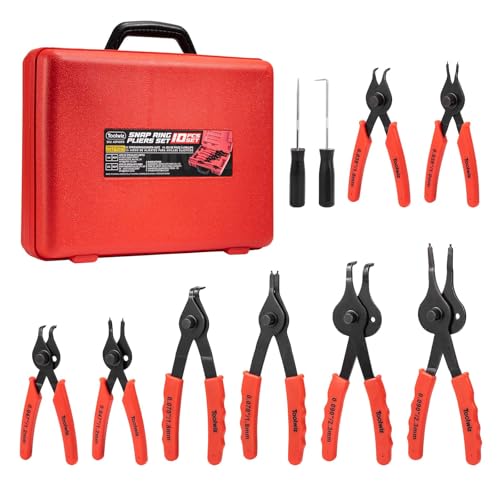 Toolwiz ASP40810Best overall
 Orion Motor Tech GSQ-A001-00Longest reach set
 KJE 12Pcs-Snap Ring PliersBest angle choice
The Quick Difference
The names describe where the ring lives, not how the pliers look. An internal ring sits in a groove inside a hole, such as a bearing bore. An external ring sits in a groove around the outside of a shaft, axle or pin.
The two ring types fight you in opposite directions. An internal ring is held in place by pressing outward against the bore wall, so you have to squeeze it smaller to pull it free. An external ring grips the shaft by squeezing inward, so you have to spread it wider to slide it off.
That is why the pliers work in opposite ways too. Internal pliers act like ordinary pliers: when you squeeze the handles, the tips move together. External pliers work in reverse: when you squeeze the handles, the tips move apart.
How to Tell Which Ring You Have
Look at where the ring sits. If it is inside a hole or housing, it is internal. If it wraps around a shaft, pin or axle, it is external. Most rings have two small holes, called lugs, where the pliers' tips go in.
Not every ring has lugs. Rings without them are harder to remove and often need a pick, a small screwdriver or a different style of tool. Pliers with lug-style tips are made for rings that have holes.
- Ring inside a bore or housing: internal pliers, tips close when you squeeze.
- Ring around a shaft, axle or pin: external pliers, tips open when you squeeze.
- Ring with no holes: you will likely need a pick or another tool, not standard pliers.
Internal vs External at a Glance
This table sums up the practical differences so you can match the tool to the job.
| Internal pliers | External pliers | |
|---|---|---|
| Ring location | Inside a bore or housing | On a shaft, axle or pin |
| Ring action to remove | Squeeze smaller | Spread wider |
| Tips when you squeeze | Move together | Move apart |
| Typical spots | Bearing bores, gear housings, cylinders | Axles, pins, shafts, spindles |
| Tip angle that helps | Bent tips for deep housings | Straight tips for open access |
When Convertible Pliers Make Sense
Convertible pliers let you flip one pair between internal and external mode, usually with a knob, button, tab or reversible joint. For a home garage, a lawn mower or a mix of small engine work, that saves you from buying and storing two full sets.
Several sets on our spec sheet use this approach. The Toolwiz 10-piece set uses reversible joints. The Orion Motor Tech 10-piece set uses an adjustable knob. The KJE 12-piece set uses a quick-release button. The SMOTIVEPRO 12-piece set uses a knob with a locking design. The PESIKO 8 in plier uses a flip tab. You can see how they stack up in our best snap ring pliers comparison.
Dedicated internal or external pliers still have a place. They can feel simpler for repeated work on one ring type, and they have no mode mechanism that could loosen. For most people, though, convertible is the practical default.
Choosing Tip Size and Angle
Once you know the ring type, match the tips to the ring. The tip must fit the ring's holes snugly. A tip that is too small can slip out, and one that is too large will not seat. Sets in our data run from about 0.038 in up to 0.090 in, and the common four sizes are 0.038, 0.047, 0.070 and 0.090 in.
Angle matters as much as size. Straight tips work when you can see and reach the ring head-on. Bent tips, such as 45 degree and 90 degree, help when the ring is recessed or the housing blocks a straight approach. The KJE and SMOTIVEPRO sets include straight, 45 degree and 90 degree options, while the Toolwiz and Orion sets offer straight and bent.
If you want fewer pliers, the PESIKO model takes a different route. It is a single 8 in plier with interchangeable tips, including 0.070 in straight tips and 0.029 in and 0.047 in tips in straight and bent styles. That suits occasional use, though a full set is quicker when you switch sizes often.
Using Them Safely and Correctly
Snap rings are under spring tension and can fly off at speed. Wear safety glasses or goggles every time, and keep your face away from the ring's path. Gloves help with grip and protect your hands from sharp edges.
Follow these steps for a smooth job:
- Identify the ring as internal or external and set the pliers to the matching mode.
- Pick tips that fit the ring's holes snugly, and seat them fully.
- Squeeze slowly and only as far as needed to clear the groove. Over-spreading a ring can bend it for good.
- Hold the ring with the pliers or cover the area with a rag as you lift it off.
- Inspect the ring before reuse. A bent, stretched or worn ring should be replaced.
Which Should You Buy?
If you only ever touch one ring type, a single dedicated pair in the right tip size is enough. If you do general repair on cars, mowers or small engines, a convertible set with a few tip sizes and both straight and bent tips is the safer bet.
If you also want a broader tool kit, our best pliers page covers other types worth having alongside snap ring pliers. Whatever you choose, check the tip range in the specifications first, since that decides which rings you can actually handle.
Frequently asked questions
Can I use external pliers on an internal ring?
Not in their normal mode, because the tips move the wrong way. A convertible pair solves this by switching the tip direction.
Do convertible pliers work as well as dedicated ones?
For most home and garage jobs, yes. Look for a mode switch that locks firmly so it does not shift while you squeeze.
Why do my pliers slip off the ring?
The tips are usually the wrong size or angle for the ring's holes. Try a snugger tip, or a bent tip if the ring is recessed.
Are snap rings and circlips the same thing?
Yes, in everyday use. Snap ring, circlip and retaining ring all describe the same kind of spring-style fastener.
Can I reuse a snap ring?
Sometimes, but only if it is still flat, round and springs back tightly. If it looks bent or loose, replace it.