How to Wear a Safety Vest Correctly
Wear a safety vest as the outermost layer, over your work clothes, with the reflective strips on your shoulders, chest, waist and back fully showing. Close it snugly at the front so it sits flat and does not flap, but leave enough room to move your arms freely. Check the label for the right ANSI/ISEA 107 class for your job before you wear it.
 JKSafety 51112LBest overall
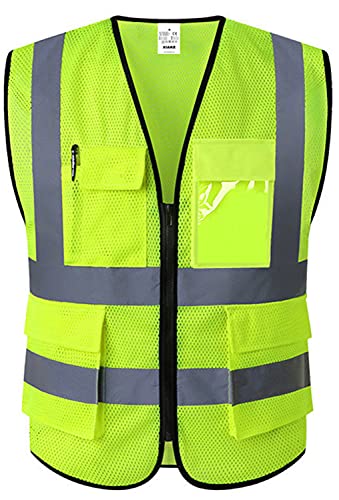 XIAKE 5MSVPlain breathable mesh
 HYCOPROT 162Most pockets listed
Start with the right vest
A vest only helps if it is the right one for your work. ANSI/ISEA 107 sets how much visible material a vest has, and your employer or site rules decide which class you need. Class 2 is the level listed by nine of the ten vests on our best safety vest page.
If you work on or beside a road, look for a vest that states both Class 2 and Type R, the roadway performance type. The label inside the vest should show the class. If it shows nothing, ask your supervisor before wearing it on a job site.
Pick the right size and fit
Fit matters as much as class. A vest that is too loose can snag on equipment or slide off your shoulders. A vest that is too tight pulls the reflective strips out of position and gets uncomfortable fast, and an uncomfortable vest tends to end up unworn.
Check the maker's size chart before you order. Some listings, such as the JKSafety JK150 and the XIAKE mesh vest, suggest ordering one or two sizes up if you want a looser fit. Size ranges vary a lot: the lightest vest on our comparison page, at 0.2 lb, comes in XS to 8XL, so there is often a size that fits without bunching.
How to put it on, step by step
Most vests go on the same way. Take your time the first few times so you build the habit.
- Put on your other layers first, such as a jacket, hoodie or tool belt harness, because the vest goes on top.
- Hold the vest open and slide your arms in, or pull it over your head if it has no front closure.
- Settle the shoulder straps or collar so the vest sits evenly on both sides.
- Close the front with the zipper or hook-and-loop strip, working from the bottom up.
- Adjust any side straps so the vest is snug at the waist but not tight across the chest.
- Pull the vest down so it covers your torso, front and back, with the strips level.
Check the reflective strips and layers
The reflective tape only works when light can reach it. Make sure nothing covers it: no backpack straps, no tool belt over the waist strip, no lanyard bunched across the chest. Many vests use two-inch strips over the shoulders, chest, waist and back to give all-around visibility.
Wear the vest over your outer layer, not under it. If it gets cold, put the jacket on first and the vest on top. In rain or low light, also check that the vest is clean, since dirt and heavy stains cut down how visible the fabric and tape are.
Some vests can be machine washed, including the JKSafety JK150 and the XIAKE mesh vest according to their listings. Follow the care label so you do not damage the tape.
Pockets, tools and comfort
Load pockets with care. Heavy items on one side pull the vest off center and can drag the reflective strips out of place. Spread weight evenly and keep small items you need often, like an ID or phone, in the front pockets.
Pocket counts run from 7 to 16 among the vests that list one, and a padded neck helps when the vest carries tools. For hot work, mesh lets air through. Solid fabric holds heavier pocket loads better. Weights range from 0.2 lb to 1.2 lb among models that list it, so a heavier vest adds a bit of load but may hold up better.
Common mistakes and safety notes
These small errors reduce how well a vest works. Fix them before you start your shift.
- Leaving the vest open, so the front strips are hidden or flapping.
- Wearing it under a jacket or bag, which covers the reflective material.
- Using a vest with no listed class on a roadway job.
- Keeping a faded, torn or heavily stained vest in use.
- Wearing a vest near moving machinery without checking that it will not catch.
| Check | What to look for |
|---|---|
| Class | ANSI/ISEA 107 class on the label matches your site rules |
| Type | Type R stated if you work near traffic |
| Fit | Snug, flat, free arm movement |
| Strips | Fully visible on shoulders, chest, waist and back |
| Condition | Clean, no tears, tape intact |
Safety notes
A vest makes you easier to see, but it does not stop a vehicle or protect you from other hazards. Stay alert near traffic and machinery, and wear any other protection your job needs, such as eye protection, hearing protection, gloves and a hard hat.
A vest is also not flame resistant by default. For example, the HYCOPROT listing notes that its vest is not an anti-static or FR standard. If you work near sparks, open flame or live electrical equipment, check with your employer for the right gear.
Frequently asked questions
Should a safety vest go over or under a jacket?
Over. The vest needs to be the outermost layer so the reflective strips and bright fabric stay in full view.
Should I zip the vest closed?
Yes, in most cases. A closed vest stays in place and keeps the strips lined up. An open vest can flap, snag or hide the front strips.
Can I wear a safety vest when I run or bike?
Many makers list cycling, jogging and walking as uses. Pick a snug fit so it does not flap, and make sure the strips are not covered by a bag.
When should I replace a safety vest?
Replace it when the fabric is faded, torn or heavily stained, or when the reflective tape is peeling or cracked, since it will no longer be as visible.