How to Use Snap Ring Pliers, Step by Step
To use snap ring pliers, match the pliers to the ring type, seat the tips fully in the ring's holes, then squeeze or spread the handles to move the ring out of its groove. Internal rings need the pliers to squeeze closed, and external rings need them to open. Work slowly, keep the ring pointed away from your face, and wear eye protection.
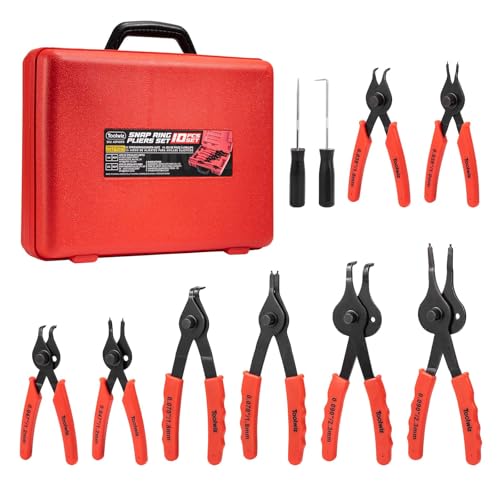 Toolwiz ASP40810Best overall
 Orion Motor Tech GSQ-A001-00Longest reach set
 KJE 12Pcs-Snap Ring PliersBest angle choice
Step 1: Identify the Ring You Have
Snap rings, also called circlips or retaining rings, hold bearings, gears, axles and pins in place. Before you grab any tool, figure out which kind of ring you are dealing with. That decides which way the pliers must move.
An internal ring sits inside a bore or housing. To remove it, you squeeze the ring smaller so it pulls out of its groove. An external ring sits on a shaft or pin. You spread it open so it slips over the shaft and out of the groove.
Most ring ends have two small holes, called lugs or eyes. The pliers tips fit into those holes. If you cannot see the holes clearly, wipe away grease and dirt first.
| Ring type | Where it sits | Pliers action | Ring motion |
|---|---|---|---|
| Internal | Inside a bore or housing | Handles squeeze, tips close | Ring shrinks and lifts out |
| External | On a shaft or pin | Handles squeeze, tips open | Ring expands and slides off |
Step 2: Choose the Right Pliers and Tip
Convertible pliers switch between internal and external modes with a knob, tab or button, so one pair handles both jobs. Fixed pliers do only one. If you are not sure what rings you will meet, convertible pliers are the flexible choice.
Tip size matters more than most people expect. A tip that is too small slips out of the hole. A tip that is too large will not enter it. Common tip diameters run from about 0.038 in to 0.090 in, and the tip should fit snugly without forcing.
Tip angle is the other choice. Straight tips work when you can see the ring head-on. Bent tips at 45° or 90° help when the ring sits deep in a housing or at an angle. Some sets, like the KJE 12-piece set, include straight, 45° and 90° pliers in four tip sizes, which covers most access problems.
If you are still deciding what to buy, our best snap ring pliers page lines up sets and single pliers by tip range, angles and reach. For other jobs around the garage, see our best pliers comparison.
Safety Before You Start
A snap ring is a spring under tension. When it slips off the tips, it can fly off fast and hit your eyes or skin. A few habits prevent most problems.
- Wear safety glasses or goggles every time, and make sure nearby people do too.
- Point the ring away from your face and body while you work. A rag draped over the area can catch a runaway ring.
- Wear gloves if the part has sharp edges, but make sure they do not reduce your grip on the pliers.
- Never work on a part that is still connected to a power source, or on an engine that is hot or could start. Disconnect the battery or spark plug lead first when the job calls for it.
- Do not spread a ring farther than needed. Over-spreading bends it, and a bent ring will not hold.
Step 3: Remove the Snap Ring
With the right pliers and tip chosen, removal takes only a few careful moves. The steps below apply to both ring types, with the mode difference noted.
- Clean the area around the ring so you can see the holes and the groove.
- Set the pliers to the correct mode: closing for an internal ring, opening for an external ring.
- Insert both tips fully into the ring holes. The tips should sit square and deep, not just on the edge.
- Squeeze the handles slowly. Watch the ring change shape and stop when it clears the groove.
- While holding the ring under tension, lift or slide it straight out of the groove.
- Keep the pliers steady, then release the handles gently once the ring is free of the part.
- Set the ring aside in a tray so it does not get lost.
Step 4: Install a New or Reused Ring
Installation is the same motion in reverse. Check the ring first. If it looks bent, stretched or has lost its spring, replace it. A ring that does not grip the groove firmly can let parts come loose.
Many rings have one flat edge and one slightly rounded edge. Put the flat, sharp edge facing the load side if the part instructions say so, and follow the service manual for your equipment when it gives a direction.
- Grip the ring with the tips seated deep in the holes.
- Compress an internal ring or expand an external ring only as much as needed to fit over or into the part.
- Slide the ring to the groove and line it up with the groove all the way around.
- Release the pliers slowly so the ring snaps into the groove.
- Turn the ring slightly with a pick or by hand to confirm it sits fully in the groove and does not wobble.
- Check that the part spins or moves as it should. Replace the ring if anything feels off.
Fixing Common Problems
If the tips keep slipping, the tip is probably too small or worn, or it is not seated deep enough. Try the next size up and check that the holes are clean. Hardened tips made from materials like chrome-moly or CRV steel hold their shape better than soft tips.
If you cannot reach the ring, switch to a bent tip or a longer plier. Some sets include long pliers for deep rings. The Orion Motor Tech set, for example, lists 13.1 in pliers for that kind of reach.
If a ring is stuck, do not force it. Clean out rust or dirt with a pick or small hook, add a little penetrating oil, and try again. Many sets, such as the Toolwiz 10-piece set, include a pick and a hook for cleaning grooves and retrieving dropped rings.
If a ring jumps away when it releases, keep the tips squeezed gently until you can slide it into position, and use a rag around the area to catch it. Rings with no lugs or very small holes may need a different style of tool, so check the ring before you buy.
Frequently asked questions
Can I use regular pliers on a snap ring?
It is risky. Regular pliers do not grip the ring holes well and can slip, bend the ring or scratch the part. Snap ring pliers have pointed tips that fit the holes.
What happens if I use the wrong tip size?
A tip that is too small can slip out of the hole, which can launch the ring. A tip that is too large will not seat. Choose the largest tip that fits the hole without forcing.
Should I replace a snap ring after removing it?
Replace it if it is bent, cracked, worn or loose in the groove. If it looks undamaged and still springs back firmly, many people reuse it, but a new ring is the safer choice on critical parts.
How do I know whether to squeeze or spread the pliers?
Look at where the ring sits. A ring inside a bore is internal and needs the tips to close. A ring on a shaft is external and needs the tips to open.