How to Use Scroll Saw Blades for Beginners
Pick a mid-size reverse tooth blade (around #3 or #5) that matches your saw's blade holder, install it with the teeth pointing down, and tighten it until it gives a clear, high pitch when plucked. Then cut slowly, let the blade do the work, and turn the wood gently along the line. Start with scrap, and swap to a fresh blade as soon as cutting slows or burns.
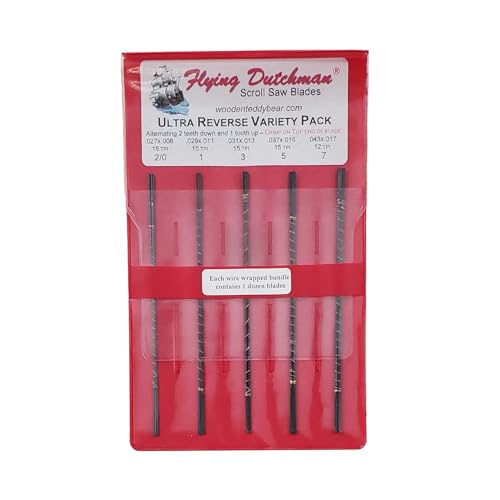 Flying Dutchman Flying Dutchman [unknown model number]Best overall
 Flying Dutchman UR-5Best single-size pack
 Flying Dutchman 191851222Clean bottom edges
Start with the right blade for your saw
Before you buy anything, look at how your saw holds the blade. Most modern saws take pinless (plain end) blades, while some older and entry-level saws need pin end blades. A blade that does not match the holder will not fit properly, so check this first.
Next, think about size. Smaller numbers cut finer detail in thin wood, and larger numbers cut thicker stock faster. If you are not sure where to begin, a mid size like #3 or #5 handles most general projects. Our best scroll saw blades page lays out the packs side by side, including which ones are pinless and which are pin end.
| Blade choice | Good for | What to know |
|---|---|---|
| #2/0 and #1 | Fine fretwork in thin wood | Cuts tight curves, but is delicate and easy to snap |
| #3 and #5 | General beginner projects | A balanced mix of speed and control |
| #7 and larger | Thicker stock | Cuts faster, with a wider kerf |
| Reverse tooth | Wood where you want a clean underside | Teeth at the bottom cut on the upstroke to reduce splintering |
| Spiral | Cutting in any direction without turning the wood | Leaves a wider, rougher kerf |
| Skip tooth | Plastic and acrylic | Clears sawdust well |
Which pack should a beginner buy?
A variety pack is the easiest way to learn what each size feels like. The Flying Dutchman Ultra Reverse variety pack, for example, has 60 pinless blades, with one dozen each of #2/0, #1, #3, #5 and #7. Every blade is 5 in long, and the teeth are reverse style to cut down on splintering underneath.
Once you know which size you reach for most, a single-size pack makes sense. A 72 piece pack of Ultra Reverse #5 blades is one example. If your saw needs pin end blades, the FOXBC 48 piece set is listed for 5 in pin end saws and comes in 10, 15, 18 and 24 TPI (teeth per inch). Higher TPI generally means a slower, smoother cut, and lower TPI cuts faster but rougher.
Install a blade step by step
Blades break often when you are learning, so get comfortable changing them. Unplug the saw every time you change a blade or adjust the holders.
The exact steps vary by saw, so check your manual. The general flow looks like this:
- Unplug the saw and raise the arm or release the tension fully.
- Loosen the lower blade clamp and slide the blade in with the teeth pointing down, toward the table.
- Tighten the lower clamp, then feed the upper end into the upper clamp.
- Apply tension with the tension lever or knob.
- Pluck the blade like a guitar string. It should sound a firm, fairly high note, not a dull flop.
- Turn the saw by hand through one full stroke to confirm nothing hits the table or the hold-down.
Set speed and feed rate
Too little tension makes the blade wander and bow, so your cuts lean and the blade snaps. Too much tension can also break thin blades. If the blade flexes when you push the wood, add a bit more tension.
For speed, start in the middle of your saw's range. Slow the saw down for tight turns, thin blades and plastics, because heat melts acrylic and scorches hardwood. Speed up for straight cuts in softer wood.
Feed rate matters as much as speed. Push the wood into the blade only as fast as it cuts. If you have to force it, the blade is dull, too small for the thickness, or the tension is off.
Make your first cuts
Practice on scrap pine or plywood before cutting a good board. Draw wavy lines, sharp corners and circles, and follow them. Keep your hands on either side of the blade, not in line with it, and keep the wood pressed flat on the table.
For turns, do not twist the wood while pushing. Instead, ease the feed, rotate the board a little, and then continue. Sharp corners work best if you keep the blade moving as you pivot, so it clears its own path instead of burning a spot.
For inside cuts, drill a small entry hole in the waste area, thread the blade through it, then reconnect and tension the blade. Cut to your line, and release the blade again to remove the piece. Choosing a spiral blade can help when you want to change direction without turning the work, though the kerf will be wider.
Fix common problems
Most early frustrations come down to a few causes, and each one has a simple fix.
- Blade keeps snapping: Lower the feed pressure, check tension, and make sure the blade is not twisting in the clamps.
- Cut drifts or leans: Tension is probably too low, or the blade is dull. Replace it and try again.
- Burn marks: Slow the feed less aggressively, or step up to a coarser blade. A dull blade also burns, so swap it out.
- Rough underside: Switch to a reverse tooth blade, which is meant to reduce splintering on the bottom of the cut.
- Blade will not follow tight curves: Move to a smaller size such as #1 or #2/0, and cut at a slower pace.
Safety and blade care
A scroll saw blade is thin, but it still cuts skin. Wear safety glasses, because broken blade pieces and wood chips can fly. A dust mask helps, since fine sawdust builds up quickly, and hearing protection is wise if your saw or dust collector is loud.
Keep loose sleeves, jewelry and long hair out of the way. Never reach under the table with the saw plugged in. Keep your fingers clear of the blade path and use the hold-down for stability.
Treat blades as consumables. Once a blade cuts slower, needs more push, or leaves burn marks, replace it. Buying a pack rather than single blades makes this habit easy. When you are ready to compare options again, our scroll saw blade comparison is a good place to look.
Frequently asked questions
Do scroll saw blades go teeth up or teeth down?
Teeth point down toward the table, so the blade cuts on the downstroke and holds the wood against the table.
Can I use the same blade for wood and plastic?
You can, but skip tooth blades suit plastics and acrylic better because they clear sawdust well. Run slower on plastic so heat does not melt the cut.
Why do my blades keep breaking?
Common causes are too much feed pressure, wrong tension, twisting the wood while cutting, or a blade clamped crookedly. Slow down and check the tension first.
Are pinless blades better than pin end blades?
Neither is better overall. The right one is whichever your saw's blade holder accepts, so check your manual first.
How do I cut a tight inside corner?
Keep the blade moving, back it slightly into the waste area, and rotate the board gently. A smaller blade size helps.