How to Use Pliers Correctly: A Beginner's Guide
Hold pliers with your whole hand wrapped around the handles, keep the jaws square to the work, and squeeze with steady pressure instead of yanking. Pick the type that matches the job: groove joint for pipes and nuts, needle nose for small parts, diagonal cutters for wire and locking pliers for clamping. Wear eye protection, and never use pliers on live electrical wires.
 DISEN 21DGNQBest overall
 WORKPRO W006012AEBest with storage racks
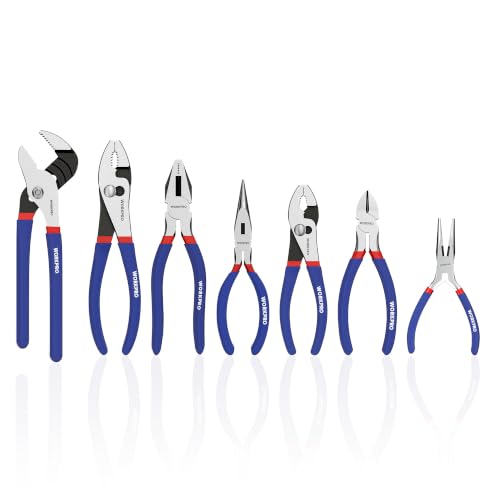 WORKPRO W001306ABest basic set
Start with the right grip
The correct way to hold pliers is simple. Wrap all four fingers around the handles, with the thumb on the inside or along the side. Keep your wrist as straight as you can. A bent wrist tires out quickly and gives you less control.
Hold the handles near the ends, not close to the pivot. The farther from the pivot you grip, the more leverage you get, so you can squeeze with less effort. Choking up on the handles is only for delicate work, such as placing a tiny part with needle nose pliers.
Open the jaws just wide enough to fit around the object, then close them with smooth pressure. Sudden jerks are how knuckles get scraped and fasteners get rounded off.
Match the pliers to the job
Most beginner mistakes come from using the wrong pliers. A pair that is too small slips, and a pair that is the wrong shape damages the part. The table below shows which type fits which task.
If you are not sure what to buy, our best pliers page lists sets that cover these types on one spec sheet, so you can see which ones include the jaws you need.
| Type | Best for | Avoid using it for |
|---|---|---|
| Slip joint | Gripping flat or round items, light bending | Tight nuts and bolts |
| Groove joint | Pipes, large nuts, wide objects | Fine wire or tiny parts |
| Needle nose | Small parts, tight spaces, bending wire loops | Heavy twisting force |
| Diagonal cutters | Cutting wire, zip ties, small pins | Cutting hardened steel |
| Locking pliers | Clamping, holding stuck or rounded fasteners | Delicate surfaces |
| Snap ring pliers | Removing and installing retaining rings | General gripping |
Gripping, turning and bending step by step
Follow this routine for most gripping jobs. It works for slip joint, groove joint and locking pliers alike.
- Choose pliers sized to the object. The jaws should reach around it without being stretched to the limit.
- Set the jaws square to the work. Keep them as parallel as possible so the teeth bite evenly instead of on one edge.
- Position the object deep in the jaws, close to the pivot, where the grip is strongest.
- Squeeze firmly and turn with a steady motion. If the pliers slip, reset them rather than forcing the turn.
- Release the grip fully before you reposition.
Using locking and groove joint pliers
Groove joint pliers have an adjustable pivot. Slide the jaws to the opening that fits, so the handles stay fairly close together when you grip. If the handles are spread wide, you lose strength and control.
Locking pliers work differently. You set the jaw opening with the adjusting screw, close the handles until they snap shut, and the jaws stay clamped without your hand holding them. To release, pull the release lever. Adjust the screw so the lock takes a firm squeeze but not a strain.
Both types have serrated teeth that can mark soft metal and plastic. For finished surfaces, wrap the object in a cloth first. Locking pliers are a good last resort for a rounded fastener, but they will chew up the head, so do not use them on fasteners you want to reuse.
Some sets mix these types together. For example, the DISEN 21-piece set on our comparison page includes locking, groove joint and snap ring pliers, with the largest pliers at 12 inches.
Cutting and stripping wire
Diagonal cutters have angled jaws that let you cut flush to a surface. Place the wire deep in the cutting edge, near the pivot, and squeeze in one firm motion. Do not rock the cutters back and forth, since that can nick the edges.
Cut only materials the cutters are meant for. Hardened wire, screws and nails can chip the edges, even on pliers with hardened cutting edges. If the edge does not bite after a firm squeeze, switch to a heavier cutting tool.
Cut wire pieces can fly. Hold the end you are cutting off, or point it away from your face and wear safety glasses.
Safety and care
A few habits keep both you and your pliers in good shape. Eye protection comes first, because wire ends, rust flakes and snap rings can spring loose.
Electricity needs extra care. Ordinary plier grips are not insulation. Turn off the power at the breaker and confirm the circuit is dead before you cut or strip any wire. Only use pliers that are specifically rated as insulated for work near live circuits, and leave that work to a qualified electrician if you are unsure.
- Do not use pliers as a hammer, and do not slip a pipe over the handles for extra leverage. Both can crack or bend the jaws.
- Keep fingers clear of the pinch point between the handles.
- Wipe pliers clean after use and put a drop of oil on the hinge now and then so they move freely.
- Store them dry. A rack, tray or bag keeps them from banging together and keeps the cutting edges sharp.
- Choose pliers with grips that stay secure when your hands are oily, since a slipping tool is a common cause of injury.
Building a starter collection
You do not need dozens of pliers to start. A slip joint or groove joint pair, needle nose, diagonal cutters and locking pliers handle most household repairs. Add snap ring pliers later if you plan to do car work.
Look for hard steel jaws, comfortable handles and a way to store them. Sets on our best pliers comparison range from 3 to 21 pieces, so you can start small and grow, or buy a larger set and learn each tool over time.
Frequently asked questions
Which hand should I use to hold pliers?
Use your dominant hand for the squeeze and your other hand to steady the work. Keep the off hand out of the line of the jaws in case they slip.
Why do my pliers keep slipping off a nut?
The jaws may be too small, set too wide or not square to the nut. Try groove joint pliers adjusted to fit snugly, or switch to a wrench if the nut is tight.
Can I use pliers instead of a wrench?
Only in a pinch. Pliers grip on two points and can round off a nut or bolt head. A wrench or socket that fits the fastener is the better choice.
How do I know when pliers are worn out?
Watch for jaws that no longer meet evenly, teeth worn smooth, cutting edges that crush instead of cut, or a hinge that is loose or cracked. Replace them rather than risk a slip.