How to Use an Engine Hoist Safely, Step by Step
Plan the lift first, disconnect everything except the mounts, set the boom to the shortest position that reaches, then attach to proper lift points and raise the engine a few inches to check balance before going higher. Keep the load low while rolling, never work under it, and lower it onto a stand or supported cradle. Rushing the setup is the most common way these jobs go wrong.
 Garvee bGc-OaKS-Gnv75Tn3-XOiBest overall
 Maxsa Innovations bxt-zZ9Zfp9tz6J8R1c-P-sVYbkDuLightest hoist
 Maxsa Innovations YellowHeaviest-built frame option
Before you touch the hoist: plan the lift
Most problems with an engine hoist start before the engine moves. Decide where the engine will go once it is out, whether that is an engine stand or a sturdy cradle. Clear a path from the bay to that spot, and make sure the floor is flat, hard and free of cords, hoses and loose tools.
Find out what your engine weighs. Look up the specification for your exact engine, and remember that the figure may not include the transmission, accessories or fluids. If you are pulling the engine and transmission together, add them up. The weight needs to sit comfortably under the rating of the boom position you plan to use.
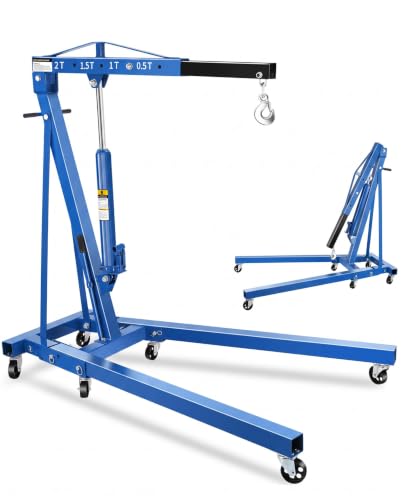
Read the manual for your hoist as well. Models differ in how the release valve works, how the boom pins in place, and how the legs fold out. Our engine hoist comparison lists the boom positions, folded length and caster count for several folding models, which helps if you are still choosing one.
Understand boom positions and capacity
Many folding hoists, including the 2 ton models we compare, have four boom positions rated for 0.5, 1, 1.5 and 2 tons. The rating drops as the boom is extended, so the highest rating applies only with the boom retracted. A hoist sold as 2 ton is not a 2 ton hoist at full reach.
Pick the shortest position that still lets the boom reach the engine's lift points and clear the front of the vehicle. If your engine is heavier than a position allows, move the hoist closer or choose a different position rather than hoping for the best.
| Boom setting | Reach | What it means for you |
|---|---|---|
| Retracted (2 ton position) | Shortest | Highest rating, best for heavy engines close to the hoist |
| Middle positions (1 and 1.5 ton) | Medium | Lower rating, check it against the engine weight |
| Fully extended (0.5 ton position) | Longest | Lowest rating, use only for light loads that need the reach |
Prepare the engine and the vehicle
Work through these steps before the hoist takes any weight. Skipping one can leave the engine hanging on a hose, wire or bracket that was never meant to carry it.
- Disconnect the battery, negative terminal first.
- Relieve fuel pressure and drain or cap lines as the service manual directs.
- Drain coolant and oil into proper containers.
- Have refrigerant recovered by a qualified shop before opening air conditioning lines.
- Label and unplug wiring connectors, then unbolt exhaust, driveshaft or axle connections, and anything else tying the engine to the vehicle.
- Remove or move aside the radiator, hood or other parts that block the path, according to your vehicle's manual.
- Leave the motor mounts, and the transmission connection if lifting them together, for last.
How to connect an engine to a hoist
Use the lift points the manufacturer provides, usually brackets or threaded holes on the cylinder heads or intake area. Where there are none, use lifting plates or bolts rated for the load, with a thread length that fully engages. Do not hang the engine from the intake manifold, a hose, or a weak accessory bracket.
Run chains or straps from the hoist hook to the engine. An engine leveler is handy here, because it lets you tilt the engine by turning a crank so it clears the firewall and crossmember. The Maxsa Innovations 2 Ton Cherry Picker Shop Crane, for example, includes a 1500 lb leveler with adjustable chains and a crank handle, and the Garvee 2 Ton Engine Hoist with Lever includes a leveler too. Check the leveler's own rating, since it can be lower than the hoist's.
Use a chain or sling in good shape, with no kinks, cracks or stretched links. Make sure every shackle or bolt is fully seated, and that the hook has its safety latch closed.
Lift and move the engine, step by step
With the engine connected, follow this order. Go slowly and stop whenever something looks wrong.
- Position the hoist so the boom is as straight over the engine as you can get it, with the legs clear of the vehicle's wheels.
- Pump the handle until the chains are snug. There should be no slack, but the engine should not yet be lifting.
- Support the transmission with a jack or stand if you are leaving it in the vehicle.
- Remove the motor mount bolts and any remaining fasteners.
- Raise the engine one or two inches and stop. Check that the chains are balanced, the hoist is stable and nothing is still attached.
- Lift in small steps, using the leveler or a helper to tilt the engine as it clears the firewall and crossmember. Watch for hoses and wiring that snag.
- Raise it only high enough to clear the front of the vehicle.
- Roll the hoist away from the vehicle with the engine held as low as you can manage, steering carefully with the casters.
Lower the engine and fold the hoist away
Set the engine onto a rated engine stand or a solid cradle. Open the release valve slowly, because a quick turn can drop the load. On many hoists, turning the release valve one way closes it for pumping and the other way lowers the load gradually, but check how your model does it.
Do not remove the chains until the engine is bolted to the stand and sitting stable. Then lower the boom fully, take weight off the hook, and fold the hoist following the manual. Folded lengths on the models we compare range from 51.18 to 64.17 in, so measure your storage space ahead of time.
Inspect the hoist before you put it away. Look for oil leaks around the cylinder, bent legs, loose pins and casters that no longer swivel or lock.
Safety rules that matter most
Never put any part of your body under a suspended engine. A hoist holds a load with hydraulic pressure, and that is not a substitute for a stand. If you must work near it, support the engine mechanically first.
Wear safety glasses and gloves, and closed-toe boots, ideally with steel toes. Keep bystanders and pets out of the area. Lock the casters whenever the hoist is not rolling, and never use it on a slope, gravel or soft ground unless the manual allows it.
Do not exceed the rating for your boom position, and do not shock-load the chains by letting the engine drop onto them. If the engine swings or the hoist tips, lower it right away and recheck the setup.
Frequently asked questions
Can I leave an engine hanging on a hoist overnight?
It is better not to. Hydraulic seals can slowly leak, and a hanging load is a hazard to anyone walking by. Lower it onto a stand or support it mechanically.
Do I need a helper?
A second person makes it much easier to watch for snags, tilt the engine and steer. It is not strictly required, but it is a good idea.
Should the transmission come out with the engine?
That depends on the vehicle. Some are easier to remove together and others separately, so follow the service manual for your model.
What if the engine will not clear the vehicle?
Stop and look for a missed bracket, hose or wire. Adjust the tilt with the leveler or change the boom position before forcing anything.