How to Use a Vacuum Pump on an Auto AC System
Recover any remaining refrigerant, connect your manifold gauge set to the car's low-side and high-side service ports, and run the center hose to the vacuum pump. Open both gauge valves, run the pump until the system reaches a deep vacuum (at least 30 minutes is a common target), then close the valves, shut off the pump and confirm the vacuum holds before you recharge.
 VIVOHOME VH1803Best overall
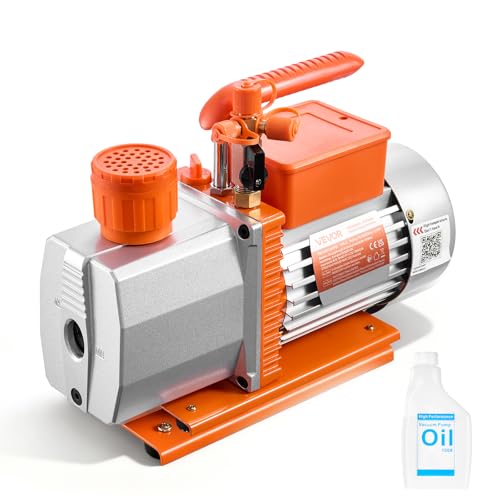 VEVOR 2RS-2Oil included, A2L listed
 SPECSTAR VH1694Lightest in the lineup
Why you pull a vacuum before recharging
Air and moisture inside a car AC system cause real trouble. Moisture can combine with refrigerant and oil to form acids, and it can freeze at the expansion device and block flow. Air does not condense, so it pushes pressures up and cooling down.
A vacuum pump lowers the pressure inside the system so any water boils off at room temperature and gets pulled out with the air. This step is often called evacuating the system. Do it any time the system has been opened, such as after replacing a compressor, condenser, hose or receiver-drier.
What you need before you start
Gather everything first so the system stays closed while you work. Using the pump with the wrong fittings is the most common reason people stop halfway.
- A vacuum pump with fresh oil at the proper level in its sight window
- A manifold gauge set with a blue low-side hose, a red high-side hose and a yellow center hose
- Service-port couplers that match your car's refrigerant (R134a and R1234yf use different fittings)
- Adapters for the pump inlet, such as 1/4-inch SAE to the yellow hose
- Safety glasses and gloves
- A refrigerant recovery machine or a shop that can recover refrigerant, if the system still holds any
Safety and legal basics
Wear safety glasses and gloves. Liquid refrigerant can cause frostbite on skin and serious eye injury. Keep hair, loose clothing and hands away from belts and fans, and keep the engine off while you evacuate.
Never vent refrigerant to the air. In the US it is illegal to release it on purpose, and a vacuum pump is not a recovery tool. If the system is not empty, have the refrigerant recovered first. A vacuum pump can only remove air and moisture from a system with no refrigerant pressure left in it.
Newer cars use R1234yf, which is mildly flammable and classed as A2L. Use a pump with a sparkless motor and an A2L listing, and work in a ventilated space away from sparks and open flames. Our best vacuum pump for auto AC page lists which pumps state A2L compatibility.
How to hook up the pump and pull the vacuum
Follow these steps in order. Keep both gauge valves closed whenever you connect or disconnect hoses.
- Confirm the system holds no pressure. Both gauges should read zero or below.
- Connect the blue hose to the low-side service port and the red hose to the high-side port using the correct couplers.
- Connect the yellow center hose to the pump inlet. Tighten the connection by hand, plus a light snug with a wrench if the fitting calls for it.
- Check the pump oil level in the sight window.
- Open both the blue and red valves on the manifold.
- Switch on the pump. The low-side gauge should drop into vacuum within a minute or two.
- Let it run. Many technicians run the pump for 30 to 45 minutes, and longer if the system was open for a while or the weather is humid.
- Close both manifold valves first, then switch off the pump. This keeps outside air and pump oil from backing into the system.
Reading the gauges and doing a hold test
A standard manifold gauge shows vacuum in inches of mercury (inHg). At sea level, a good result is close to 29 inHg. The reading is lower at higher elevation, so do not expect the same number in the mountains. A dedicated micron gauge gives a more precise reading, but most home jobs rely on the manifold gauge.
After you shut the valves and turn off the pump, watch the low-side needle for at least 15 to 30 minutes. A steady needle means the system is sealed. A needle that creeps back toward zero points to a leak, or sometimes to leftover moisture still boiling off.
| What you see | What it likely means | What to do |
|---|---|---|
| Needle reaches deep vacuum and holds | System is sealed and dry | Go ahead and recharge |
| Needle reaches vacuum but slowly rises | Small leak or remaining moisture | Run the pump longer and repeat the hold test |
| Needle will not reach deep vacuum | Large leak, loose fitting or weak pump | Check couplers and hoses, then pump oil |
| Needle rises right away | Open port or leaking component | Find and fix the leak before going further |
Choosing a pump that suits the job
For a car, a compact pump around 5 CFM is usually enough, as noted in our best vacuum pump comparison. Higher flow clears air faster, but it does not change the final depth. Ultimate vacuum, measured in micron, shows how dry the pump can leave a system, and lower is better.
The table below uses published specifications from our auto AC comparison.
| Pump | Flow | Ultimate vacuum | Weight | Notes |
|---|---|---|---|---|
| VIVOHOME VH1803 | 5 CFM | 1.5 micron | 19.5 lb | A2L compatible, gauge set included |
| VEVOR 2RS-2 | 7 CFM | 2.25 micron | 20.94 lb | A2L compatible, 250 ml oil capacity, no gauges |
| SPECSTAR VH1694 | 7.2 CFM | 1.5 micron | 17.6 lb | Gauge set, anti-backflow and motor protection |
| VIVOHOME VH321 | 5 CFM | 2.25 micron | 18.7 lb | Motor protection, no gauges |
Common mistakes to avoid
Skipping the hold test is the biggest one. A pump can make a leaky system look fine while it runs, and the leak only shows after you stop. Always confirm the vacuum holds.
Other slips are easy to prevent. Old, cloudy pump oil cannot pull a deep vacuum, so change it as the maker advises. Loose hose connections, a missing adapter or a damaged service-port seal also stop the system from sealing. Finally, if you switch off the pump while the valves are open, oil can travel back toward the system, which is why anti-backflow protection is a useful feature.
Frequently asked questions
Can I use a vacuum pump on a car that still has refrigerant in it?
No. Recover the refrigerant first with proper recovery equipment or at a shop. A vacuum pump is not meant to remove charged refrigerant, and venting it is illegal in the US.
Do I need a separate manifold gauge set?
Yes, you need one to connect the pump and read pressure. Some pump kits include one, such as the VIVOHOME VH1803 and the SPECSTAR VH1694 in our data, while others like the VEVOR 2RS-2 do not.
Why does the gauge not reach the same vacuum every time?
Altitude, weather, pump oil condition and the amount of moisture in the system all change the reading. A fresh oil change and tight connections usually help most.
Can I use an R134a pump setup on an R1234yf car?
Only if the pump is rated for A2L refrigerants and your hoses and couplers match the car's service ports. Check the spec sheet, and ask the seller if the maker does not state it.