How to Use a Transmission Jack Safely and Correctly
Center the jack's saddle under the transmission's pan or main case, strap the gearbox down with the tie-down chain, then raise it just enough to take the weight before you unbolt anything. Work on hard, level ground with the casters locked, and lower slowly with the release valve. Vehicle brand matters less than your service manual's weight and mounting-point details.
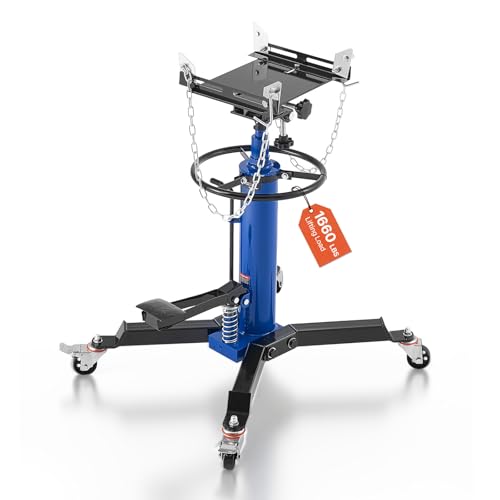 VEVOR GW-0.8Best overall
 VEVOR HTJ-1322Best for steady saddles
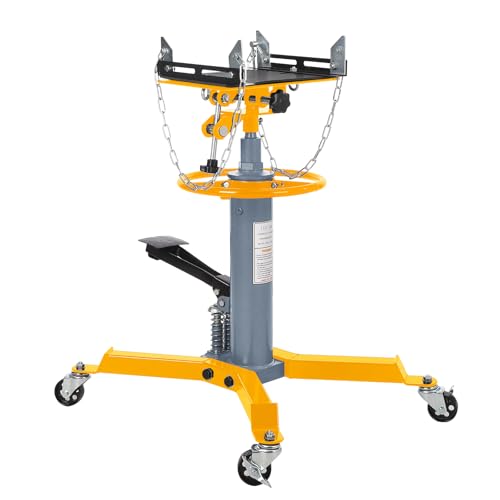 JustSmart LL-jackshuang-YELLOWIos3Le2Best dual plunger
Before you start: match the jack to the job
A transmission jack holds the gearbox while you lower it out of the vehicle or raise it back in. It also lets you tilt the transmission so it lines up with the engine. The first safety step is picking the right style for how the vehicle is supported.
Telescoping jacks are built for vehicles on a lift. Low-profile floor jacks are meant for cars on jack stands. Use the jack only in the way it was designed, and check that its rated capacity is well above your transmission's weight. Your service manual or the manufacturer will list that weight.
If you are still choosing a tool, our best transmission jack page lays out capacity, lift range and saddle tilt side by side.
Which style fits your setup
Here is how the main styles line up, using figures from the published specs on our comparison page.
| Setup | Jack style | Example from our page |
|---|---|---|
| Vehicle on a lift | Two-stage telescoping, foot pedal | VEVOR 1660 lb jack, 34.6 to 69.3 in lift range, saddle tilts up to 30° |
| Vehicle on a lift, air assist | Air/hydraulic telescoping | Sunex 7796, 1000 lb capacity, 35 to 73.5 in lift range |
| Vehicle on jack stands | Low-profile floor jack | MAXSA, 450 lb capacity |
Where to put the jack on the transmission
This is the question most people ask first. The saddle should sit under the strongest, flattest part of the transmission, usually the bottom of the main case or the pan area, with the weight spread across the tray. Avoid resting the load on the pan's thin sheet metal, the cooler lines, the shifter linkage or the speed sensors.
The goal is to place the center of gravity over the middle of the saddle. Many transmissions are heavier toward the bell housing end, so a load that looks centered can still want to tip. Adjust the saddle's position and tilt until the gearbox sits level and steady before you take any weight.
Some saddles have adjustable arms or a mounting plate that changes width. The Sunex 7796, for example, lists four ratcheting saddle arms that adjust to the pan's mounting flange. The VEVOR models list a width-adjustable plate. Use those adjustments so the transmission sits in the tray rather than perched on it.
Step-by-step: removing a transmission
The steps below apply broadly, whether you are working on a Chevy, a Ford or another make. Always follow the factory procedure for your vehicle, since fasteners, crossmember layouts and sequences differ.
- Support the vehicle correctly. Use a lift rated for the vehicle, or jack stands on solid frame points for a low-profile jack. Never rely on a hydraulic jack alone to hold a vehicle.
- Disconnect the battery, then drain fluid and remove the driveshaft, linkage, wiring and cooler lines as your manual directs.
- Roll the jack under the transmission on a hard, level floor and lock the caster brakes.
- Raise the saddle until it touches the transmission, then fit the tie-down chain or strap over the case so the load cannot slide.
- Support the engine if the manual calls for it, then remove the crossmember and bell housing bolts.
- Slide the transmission back off the engine alignment dowels, keeping it level and straight so the input shaft does not bind.
- Lower slowly using the release valve, keeping hands and feet clear, and roll the load out only when it is fully down.
Reinstalling and lining up the gearbox
Installation is where saddle tilt earns its keep. Tilt and rotation let you match the transmission's angle to the engine so the input shaft slides into the clutch or torque converter without force. The VEVOR 1660 lb jack lists a tray that rotates 360° and tilts up to 30°. The Sunex 7796 lists tilt of 37 degrees forward, 26 degrees backward and 12 degrees left and right.
Raise the transmission a little at a time and check alignment at each step. Do not use the bell housing bolts to pull the transmission in. If it does not seat easily, stop and look for a misaligned shaft, a missing dowel or a binding component.
Once the bolts are started and snug, you can remove the strap and lower the jack. Tighten everything to the torque your manual specifies before you take the jack away completely.
Safety checks that matter
A transmission is a heavy load, and the work often happens under a vehicle at head height or higher. A few habits prevent most problems.
- Stay under the rated capacity. Choose a jack with plenty of margin over the transmission's weight.
- Lock the casters. Models on our page with locking casters, such as the VEVOR 1660 lb unit, list two of four casters with brakes.
- Always use the tie-down chain or strap before raising or lowering.
- Lower with the release valve opened slowly. A sudden drop can shift the load or injure you.
- Wear safety glasses and gloves. Fluid, grit and debris fall toward your face when you work underneath.
- Keep your body out of the path of the load. Never put any part of yourself between the transmission and the vehicle or floor.
- Do not push a loaded jack over rough ground. Lower the load before moving it, if the design allows.
Using a transmission jack adapter
An adapter is a plate, cradle or bracket that changes how the saddle holds a particular transmission or transfer case. If a standard tray does not hold your gearbox securely, an adapter can help, but it must be rated for the load and fit the jack's saddle mounts.
Check that the adapter bolts or seats firmly, and still use a chain or strap over the transmission. If you are unsure whether an adapter is compatible, ask the jack maker. Never improvise with blocks of wood or stacked items to fill a gap, because they can shift under load.
Frequently asked questions
Can I use a regular floor jack instead of a transmission jack?
It is not a good idea. A floor jack has a small, flat pad with no tilt, no cradle and no tie-down, so the transmission can slide off. A transmission jack is designed to hold and position the load.
Do Chevy and Ford transmissions use different jacks?
The jack itself works the same way. What changes is the transmission's weight, size and mounting points, so check your service manual and make sure the jack's capacity and saddle fit.
Should the engine be supported while the transmission is out?
Often yes. Many vehicles need the engine held in place once the transmission and crossmember are removed. Your service manual will say how.
Can one person do this job alone?
A jack makes it manageable, but a helper is useful for steadying the load, lining up the shaft and watching clearances. Use the jack's stability features and never rush.