How to Use a Transmission Fluid Pump Step by Step
To use a transmission fluid pump, warm the vehicle slightly, feed the suction tube down the transmission dipstick tube until it stops, then run the pump in manual or air-powered mode until the fluid stops flowing. Measure what came out, refill with the fluid your owner's manual names, and check the level the way the manual describes. Make sure the pump lists transmission fluid or ATF as compatible before you start.
 FOUR UNCLES FU-6502Best overall
 Lustriix QDSDCYBTransmission oil on the list
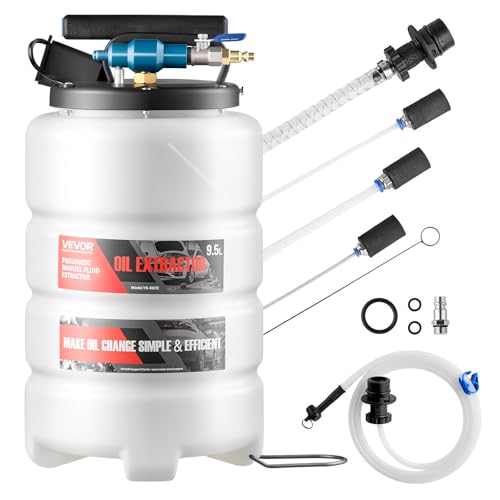 VEVOR YS-087CLong reach, big tank
What a transmission fluid pump does
A transmission fluid pump is a sealed tank with a vacuum source and a thin suction tube. You push the tube down the dipstick tube, the pump pulls fluid up into the tank, and you skip the drain pan and the crawl under the car. Some models can also push fluid back in, which helps on transmissions with no dipstick.
Two things decide whether a pump works for this job: reach and fluid compatibility. The tube has to travel the length of an angled dipstick tube, and the maker should name transmission fluid, ATF or gear oil on the compatible list. Our best transmission fluid pump page puts those specs side by side so you can check both before you buy.
One honest limit: pulling fluid from the dipstick tube removes only part of the total fluid in many automatic transmissions. Some stays in the torque converter and other passages. Treat this as a partial fluid exchange, and plan on a repeat if your goal is a fuller change.
Before you start: gear and checks
Ten minutes of prep prevents most of the problems people run into. Read your owner's manual first. It tells you the correct fluid, whether the transmission has a dipstick at all, and how the maker wants the level checked.
- Fluid that matches the manual, plus a clean funnel or the pump's own dispensing function
- The pump's main tube, the suction tubes and any ATF adapters that came with it
- A clean container to catch and measure the old fluid
- Safety glasses, nitrile gloves and shop rags
- Wheel chocks, and jack stands if you need to raise the vehicle for a fill port
- An air compressor and hose, only if you plan to use pneumatic mode
Step by step: pulling fluid through the dipstick tube
These steps cover the usual dipstick-tube method. Your pump's manual comes first if it differs.
- Park on level ground, set the parking brake and chock the wheels. Let the engine run briefly so the fluid is a little warm and thinner, then let it cool until nothing is too hot to touch. Hot transmission fluid can burn.
- Pull the transmission dipstick and wipe it clean. Note the fluid color and smell, since dark or burnt-smelling fluid is worth knowing about.
- Pick the suction tube that fits the dipstick tube without forcing it. Kits such as the VEVOR 9.5L and the BILITOOLS 8L include three extension tubes in different diameters for this reason.
- Attach the suction tube to the main tube, then to the pump. Check that the lid, fittings and any control plug are snug. On the BILITOOLS unit, the listing says to remove the control plug for extraction and tighten it for dispensing.
- Feed the suction tube down the dipstick tube slowly until it stops. Pull it back up about half an inch so the tip is not pressed against the bottom of the pan.
- Start the pump. In manual mode, work the handle until fluid begins to flow. In pneumatic mode, connect the compressor and follow the pump's air instructions.
- Watch the tank. When the flow slows to a trickle, stop and remove the tube.
- Measure what came out so you know how much to put back.
Refilling and checking the level
Add the new fluid in small amounts, a little less than you removed at first. Check the level with the dipstick, then adjust. Overfilling can cause foaming and shifting trouble, so go slowly.
Many transmissions need the level checked with the engine running and the fluid at a set temperature. Some have no dipstick, and use a fill port on the transmission case. In that case an air-powered pump with ATF adapters helps. The BILITOOLS 8L lists 15 ATF adapters and a built-in pressure gauge, which suits that style of job. Raising the vehicle for a fill port means using jack stands on firm, level ground. Never work under a car held only by a jack.
After the refill, start the engine, shift through each gear with your foot on the brake, return to park and recheck the level. Look for leaks around the pan and lines on your next few drives.
Ford, Toyota and Chevy Silverado: what changes
The pump steps stay the same across brands. What changes is the transmission design, the fluid type and the level-check procedure. I am not listing model-by-model procedures here, so confirm each point in your owner's manual or service information.
Ford, Toyota and Chevy Silverado owners should check three things before pumping:
- Does your transmission have a dipstick tube, or is it a sealed unit with a fill port?
- Which fluid does the manual call for? Do not guess, and do not mix types.
- What temperature and engine state does the maker require for a level check?
| Pump (from our page) | Power | Main tube | Transmission fluid listed |
|---|---|---|---|
| FOUR UNCLES FU-6502 | Pneumatic/manual | Not listed | No (engine oil, brake fluid) |
| Lustriix 6.5L | Pneumatic/manual | Not listed | Yes (transmission oil) |
| VEVOR 9.5L YS-087C | Pneumatic/manual | 59 in | Yes |
| BILITOOLS 8L | Pneumatic/manual | 60 in | Yes (plus differential and transfer case) |
| EWK 6.5L | Pneumatic/manual | Not listed | Yes |
| VEVOR 15L YS-087B | Pneumatic/manual | 39.37 in | Gear oil listed |
Safety notes and common problems
Wear safety glasses, because fluid can spray when a tube pops out or a fitting loosens. Gloves help with skin contact and cleanup. If you use pneumatic mode, check the air fitting before use, keep within the pump's limits, and wear hearing protection around a loud compressor.
Do not use these pumps with gasoline or other volatile fluids. Several listings warn against it, and the EWK listing also notes a vehicle incompatibility, so read the warnings for your pump. Never pump hot fluid you cannot safely handle. Keep rags and fluid away from hot exhaust parts.
If nothing flows, the usual causes are a loose lid, a poor seal at the dipstick tube, a tube pressed against the bottom or a tube too thin for the fluid. Recheck each fitting and lift the tube slightly. Take used fluid to a recycling center or a shop that accepts it.
Frequently asked questions
Can I use a transmission fluid pump on a sealed transmission with no dipstick?
Only if the pump lets you reach the fill port, usually through adapters and a flexible hose. A tube-only extractor cannot get into a sealed unit. Check your manual for the fill and check procedure.
Is manual or air power better for this job?
Manual needs no compressor and works in a driveway. Pneumatic mode needs air but can pull faster. Two models on our page list 1.8 L/min in pneumatic mode.
How do I know how much new fluid to add?
Measure the old fluid you removed, then add slightly less and check the level. Top up in small amounts until the dipstick or fill port check reads correct.
Can I use an engine oil extractor for transmission fluid?
Only if the maker lists transmission fluid, ATF or gear oil as compatible. Some extractors name just engine oil and brake fluid.