How to Use a Spray Gun to Paint a Car
Prepare the surface carefully, set up a gravity-feed spray gun with the right tip and air pressure, and test the spray pattern on scrap before touching the car. Then spray each panel in smooth, overlapping passes, keeping the gun level and the same distance from the panel. Most of the finish quality comes from prep and setup, not from the spraying itself.
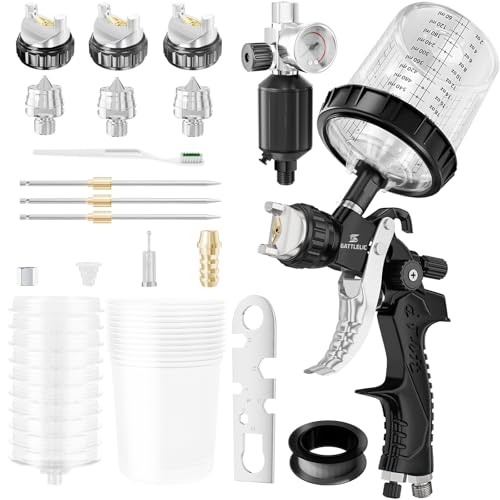 GATTLELIC GATT-HVLPBest overall
 BENTOHKLE A610Best for small compressors
 Fulchron FUL-2008-SCARLETMost nozzle sizes
What you need before you start
Painting a car at home works best when you gather everything first. Stopping mid-panel to find a tool is how runs and dry edges happen.
Your gun and compressor need to match. Check the gun's air use against what your compressor can deliver. In our best spray gun for car painting comparison, the guns range from 4.5 to 15 CFM, so this check matters. For example, the BENTOHKLE A610 LVLP kit lists 3.0 to 3.9 CFM, while the GATTLELIC HVLP gun lists 9.71 CFM.
- A gravity-feed spray gun with a tip that suits the material (see the table below)
- An air compressor, air hose, and a filter and regulator to keep the air dry and steady
- Sandpaper, wax and grease remover, tack cloths and masking supplies
- Paint, reducer, hardener (if your paint needs it), strainers and mixing cups
- A respirator rated for paint vapors, safety glasses, gloves and a paint suit
- Clean, lint-free rags and gun cleaning supplies
Prepare the car and your workspace
A spray gun shows every flaw underneath it. Sand the old finish or primer until it is smooth and evenly dull, fix any dents or rust, and wipe the surface with wax and grease remover. Mask off trim, glass and anything you do not want painted.
Your space matters as much as the panel. Pick a clean, dry, well-ventilated area with good lighting from the side so you can see the wet edge of the paint. Wet the floor lightly to keep dust down and avoid working in wind or direct sun.
Safety first: paint mist and solvent vapors are harmful to breathe and can be flammable. Wear a properly fitted respirator and eye protection, keep sparks, pilot lights and heaters away, and never spray near an open flame. Automotive paints often contain isocyanates, so read the product's safety sheet. Wear hearing protection if your compressor is loud.
Pick the right tip for each stage
Tip size changes how the paint flows. Thin paints need a smaller tip, and thick materials need a larger one. If your gun comes with several tips, change the tip and its matching needle together, or the gun can leak.
These sizes follow the guidance on our comparison page and the kit contents listed for the guns.
| Stage | Typical tip size | Notes |
|---|---|---|
| Basecoat | 1.3 to 1.4 mm | Thin, even coats |
| Clear coat | 1.3 to 1.4 mm | Smaller tips give finer atomization |
| Primer | 1.7 to 2.0 mm | Thicker material needs a bigger opening |
| Thick sealers or underbody coatings | 2.5 mm and up | Check the paint maker's advice |
Set up and test the gun
Read the paint's technical data sheet first. It gives the mixing ratio, the recommended tip and the air pressure. Strain the paint as you pour it into the cup so no lumps reach the nozzle.
Connect the gun to your regulator and set the pressure to the range the gun maker states. As one example, the GATTLELIC HVLP gun lists a working pressure of 2.5 to 3.5 bar, and the BENTOHKLE A610 lists 2.0 to 3.5 bar. Always follow your own gun's manual and the paint data sheet.
Then spray a test pattern on masking paper or scrap metal:
- Turn the fluid control and fan control to a middle setting.
- Pull the trigger for a second and look at the pattern.
- A tall, even oval with fine droplets is what you want.
- If the paint looks coarse or spotty, raise the air pressure a little or thin the paint slightly.
- If the center is heavy and the ends are thin, adjust the fan control and try again.
Spray technique, step by step
Good technique is mostly about being steady and consistent. Practice a few passes on a spare panel before you start on the car.
- Hold the gun square to the panel, not angled. Tilting it makes uneven coverage.
- Keep the same distance from the panel through the whole pass. Check your gun's manual for the right distance.
- Start moving before you pull the trigger, and release the trigger after the pass ends. This avoids heavy spots at the edges.
- Overlap each pass by about half the width of the pattern so there are no stripes.
- Move your whole arm and body along the panel instead of flicking your wrist.
- Work in a set order, such as top to bottom on each panel, and keep a wet edge so the paint blends.
Apply coats and finish the job
Apply thin, even coats rather than one heavy one. Heavy coats cause runs and sags. Follow the data sheet for how long to wait between coats, usually called flash time.
Typically you apply primer first, sand it smooth, then spray the basecoat until the color is even, and finish with clear coat. Clear coat gives the gloss and protects the color, so it needs the most care. A 1.3 mm tip suits it well. The NEIKO 1.3 mm gun in our comparison lists 4.5 CFM, the lowest air use among the guns we compare.
Let the paint cure fully before you handle, wet sand or polish it. Rushing this step can leave fingerprints and soft spots.
Clean the gun and fix common problems
Clean the gun right after spraying, before the paint hardens. Empty the cup, spray a little cleaner through the gun, and brush out the nozzle and air cap. Disposable cup liners, which several kits include, cut down on cleaning between colors. Dispose of waste solvent and rags safely, since used rags can be a fire hazard.
If the finish is not right, these are the usual causes:
| Problem | Likely cause | What to try |
|---|---|---|
| Orange peel | Paint too thick or pressure too low | Thin a little, raise pressure slightly |
| Runs and sags | Too much paint or gun too close | Move faster, apply thinner coats |
| Dry, sandy spray | Gun too far away or too much air | Move closer, lower pressure |
| Stripes | Not enough overlap | Overlap passes by half |
Frequently asked questions
Can I paint a whole car with a small compressor?
Sometimes. Low-air LVLP guns use less air, so they suit smaller compressors. Still, check that your compressor can keep up with the gun's CFM rating, or the pressure will drop mid-pass.
Do I need to thin the paint?
It depends on the paint. Follow the mixing ratio on the technical data sheet, and only adjust it slightly if the test spray looks coarse.
Why does my paint have dust specks in it?
Dust usually comes from the workspace, the surface or unstrained paint. Wipe the panel with a tack cloth, strain the paint and wet the floor to keep dust down.
How many panels should I do at a time?
Work one panel or section at a time so you can keep a wet edge. Plan your order before you start so you do not have to stop in the middle of a panel.