How to Use a Refrigerant Charging Scale on an AC System
Set the scale on a firm, level surface, put the refrigerant cylinder on it, connect your hoses, then zero the display. Open the cylinder valve and let refrigerant flow until the scale shows the amount you want, then close the valve. The target weight comes from the equipment nameplate or the manufacturer's charging instructions, not from the scale.
 YELLOW JACKET ASRCS-220LBest overall
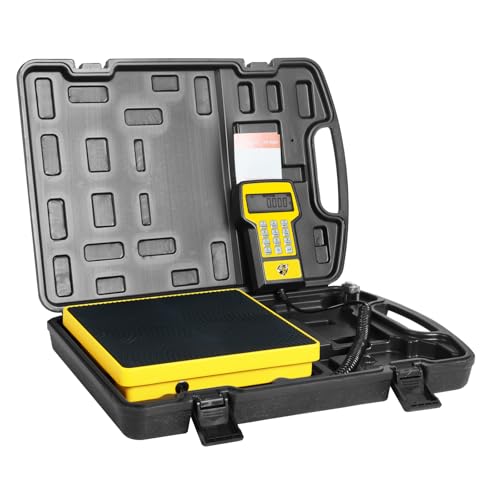 YELLOW JACKET ASRCS-220CProgrammable target weight
 Elitech LMC-100ALight 220 lb option
What a charging scale actually does
A refrigerant scale weighs the cylinder while refrigerant leaves it. Because you know how much weight left the cylinder, you know how much went into the system. This is the most direct way to charge, since it does not depend on outdoor temperature, airflow or gauge readings that can drift.
The scale does not know how much refrigerant your system needs. That number comes from the data plate on the outdoor unit, the installation manual, or the service specification for a vehicle. Your job is to find that number first, then use the scale to hit it.
If you are still choosing equipment, our best refrigerant scale comparison lines up capacity, resolution and accuracy so you can see which specs fit your cylinders.
Before you start
A few minutes of preparation prevents most charging mistakes. Handling refrigerant in the US requires EPA Section 608 certification for most work on stationary systems, and venting refrigerant into the air is not allowed. If you are not certified, this job belongs to a licensed technician.
- Find the factory charge on the nameplate or in the manual, and note the refrigerant type.
- Check whether the line set is longer than the manual's standard length. Many manufacturers list an adjustment for extra length.
- Confirm the system has been evacuated and holds a vacuum, if it was opened or emptied.
- Check that the cylinder plus its contents is below the scale's rated capacity. Listed capacities among the scales we compare are 110 lb, 155 lb, 220 lb and 252 lb.
- Put in fresh batteries or confirm the charge, so the display does not shut off mid-job.
- Wear safety glasses and gloves.
Step-by-step: charging by weight
The exact method depends on the refrigerant and the manufacturer's instructions, so treat these steps as the general flow and follow the equipment manual where it differs.
- Place the scale on a hard, level surface, away from vibration and wind. A soft or tilted surface can cause unstable readings.
- Stand the cylinder on the platform in the position the instructions call for. Some cylinders must be upright for vapor and inverted or fitted with a dip tube for liquid.
- Connect the manifold gauge set and charging hose to the cylinder and to the system service port. Keep the cylinder valve closed for now.
- Turn the scale on and let the display settle. Choose the units you want, such as pounds and ounces or kilograms and grams.
- Briefly purge air from the hose as the manufacturer directs, then close it back up.
- Press the zero or tare button with everything connected, so the hoses are already counted in the starting weight.
- Open the cylinder valve and the manifold valve slowly. Watch the display count down as refrigerant leaves the cylinder.
- Close the valves when the display reaches your target, then check the final weight and record it.
- Disconnect the hoses carefully and cap the service port.
Using the scale features that help
Zeroing is the feature you will use most. After you zero, the display shows how much has been removed, so you can count straight to the target. Some scales, such as the VIVOHOME VH104, list an auto-zero button for this purpose.
Some scales let you enter a target. The Yellow Jacket ASRCS-220C has 12 buttons for setting a charging or recovery value, and it beeps when the value is reached. A beep is a prompt to close the valve, not a valve control, so stay at the cylinder.
Overload warnings matter more on recovery jobs with heavy tanks. The Yellow Jacket ASRCS-220L shows FULL on the remote when the load goes past its 220 lb rating, which protects the platform and sensor.
Resolution and accuracy set how closely you can hit the number. The Yellow Jacket models above list a 5 g resolution with 0.05% accuracy plus 10 g, while the Fieldpiece SR47 lists a 10 g resolution with 0.03% accuracy. Finer steps help when a system takes only a small charge.
A backlight and a remote display make reading easier in attics and crawl spaces. Among the scales that list battery life, the numbers run from 20 hr to 200 hr.
AC system versus car: what changes
The scale works the same way in both cases. What changes is where the charge amount comes from, how the refrigerant goes in and how much margin you have for error.
The scale needs the cylinder and contents to stay within its capacity either way. For a small automotive job, a smaller scale with fine resolution can work, while large recovery cylinders call for a higher rating.
| Item | Home AC system | Car AC system |
|---|---|---|
| Where to find the charge | Outdoor unit nameplate and installation manual | Under-hood label or service manual |
| Typical charge size | Larger, with line set adjustments | Smaller, so fine resolution matters |
| Refrigerant type | Check the nameplate, as types vary by age | Check the label, as vehicles differ |
| Evacuation first | Yes, after the system is opened | Yes, after the system is opened |
| Scale choice | Capacity for the cylinder you carry | Fine resolution for small charges |
Safety notes
Refrigerant can freeze skin on contact and can injure eyes, so wear safety glasses and gloves. Work in a ventilated space and never heat a cylinder with a flame.
Never overfill a cylinder or exceed its rated fill. Do not leave cylinders in a hot vehicle or in direct sun.
Turn off power at the disconnect before working near the electrical parts of an outdoor unit. Some refrigerants are mildly flammable, so check the label and follow the manufacturer's instructions.
Use a stable ladder or platform for rooftop and attic work, and keep hoses out of walkways.
Common mistakes to avoid
Zeroing before the hoses are connected is a frequent error. It leaves the hose weight out of the reading, so you can miss your target.
Letting the scale shift or lean while charging also throws off readings. Make sure the cylinder is stable, and keep hoses from pulling on it.
Charging without knowing the line set adjustment is another. If your line set is longer than the standard length, the nameplate number alone will undercharge the system.
Relying only on the scale also has limits. After charging by weight, the manufacturer may still call for checks such as superheat or subcooling. Use both, and see our refrigerant scale comparison when you want to match features to the way you work.
Frequently asked questions
Do I need to zero the scale every time?
Yes, zero it each time after the hoses and cylinder are in place. That makes the display show only the amount that leaves the cylinder.
Can I use one scale for charging and recovery?
Usually yes, as long as the cylinder plus its contents stays within the rated capacity. Recovery cylinders can be heavy, so check capacity first.
Why does the reading jump around?
Common causes are an uneven surface, wind, a pulling hose or a low battery. Stabilize the setup and check the battery before trusting the number.
Is weighing enough to confirm a good charge?
It gets the amount right, but follow the manufacturer's instructions for any additional performance checks after charging.