How to Use a Power Inverter in a Car Without Draining the Battery
The safest way to use a power inverter without draining your battery is to run the engine whenever you power anything beyond a phone charger, and to keep the load well under the inverter's rating. With the engine off, limit use to short, light loads and unplug the inverter when you are done, since even an idle inverter draws a little current. Watching battery voltage and keeping a jump starter handy covers the rest.
 BESTEK MRI3011BU-4.8ABest overall
 BESTEK MRZ3011HU-PD-BKRDMost efficient
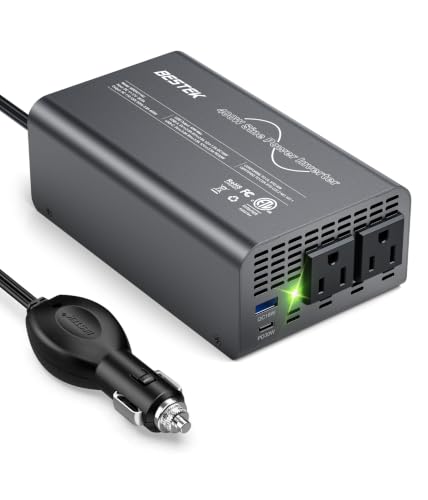 BESTEK MRZ4011AUMost power with USB-C PD
Why an inverter can drain your car battery
An inverter turns the 12V DC from your car into 120V AC. It has to pull more power from the battery than your device uses, because some energy is lost as heat during the conversion. The less efficient the inverter, the more it takes from the battery for the same job.
A starter battery is built to deliver a big burst of current for a few seconds, not to be drained slowly. Running it down far enough can leave you unable to start the engine. With the engine running, the alternator supplies the power instead, so the battery is not carrying the load.
Use the engine to your advantage
The simplest habit is to run the engine for anything more than a quick charge. The alternator covers the load, and the battery stays topped up. Idling for long stretches wastes fuel, so a short drive while you charge is often the better option.
If you must run the inverter with the engine off, keep it to small loads for short periods. Phone and camera battery charging fits this category. A laptop for a brief session is usually fine. A fan, a heater or anything with a motor or heating element is not.
Never idle the engine in a closed garage or any enclosed space. Exhaust contains carbon monoxide, which is dangerous and can be deadly. Park outdoors or in a well-ventilated area when the engine is running.
Match the load to the inverter and the socket
Most car lighter sockets are fused for roughly 150W, so a 300W or 400W inverter only delivers its full rating when connected to the battery with clamps. If you plug a bigger inverter into the lighter socket and ask for too much, the socket fuse will blow. Keep your total load comfortably under the socket limit. Our best power inverter for car cigarette lighter page lists which units are meant for the socket and which need a direct battery connection.
As a rough guide, divide the AC watts by 12 and add a margin for conversion losses to estimate the current pulled from the battery. The figures below assume about 85% efficiency, so treat them as estimates rather than measurements.
| Device load (AC) | Approx. DC power drawn | Approx. current at 12V | Fits a 150W socket? |
|---|---|---|---|
| 20W (phone charger) | About 24W | About 2A | Yes |
| 60W (laptop) | About 70W | About 6A | Yes |
| 100W (small fan or camera charger bank) | About 118W | About 10A | Yes |
| 150W (small appliance) | About 176W | About 15A | Borderline |
| 300W or more | About 350W or more | About 29A or more | No, use battery clamps |
Pick an efficient inverter
Efficiency matters most when the engine is off. Our spec data shows a spread: the BESTEK 300W Pure Sine Wave Car Inverter lists 96% efficiency, the BESTEK 300W Car Power Inverter lists 83.33%, and the BESTEK 400W Pure Sine Wave Inverter lists 80%. At the same load, the 96% unit wastes less energy as heat, so it draws less from the battery.
Fan behavior is another clue. The BESTEK 300W Car Power Inverter, for example, runs its fan faster when the unit gets warmer or output exceeds 70W. A fan that works harder is a sign the inverter is shedding heat, which means energy is going to waste.
Pure sine wave output is worth choosing for sensitive electronics such as CPAP machines. Modified waveforms are fine for most chargers. If you use a medical device, check its power needs and run the engine rather than relying on the battery alone.
Watch the battery while you use it
Voltage is the easiest warning sign. A healthy 12V battery at rest sits a little above 12V. If the reading drops toward 12V or lower while the engine is off, stop and start the car. Some inverters have built-in low-voltage shutoff, which protects the battery by cutting power before it gets too low.
The DrimMek 300W Car Power Inverter has an LED display that shows real-time car battery voltage, which makes this check easy without extra tools. If your inverter has no display, a plug-in voltage meter for the socket does the same job.
An older battery drains faster and recovers worse. A best car battery tester gives you a clear picture of battery health before you rely on it for extra loads. It is worth checking before long trips or camping.
A simple routine for safe use
Follow these steps each time and the battery stays in good shape:
- Check that the inverter's rating covers your device, and that the lighter socket can handle the load.
- Start the engine before plugging in anything bigger than a phone charger.
- Plug the inverter into the socket first, then plug in your device, and switch it on.
- Keep the inverter in a spot with airflow. Do not cover it with bags or blankets.
- Unplug the inverter when you finish. Some units keep drawing a small current even with nothing connected.
- If you must run it with the engine off, check voltage every so often and stop early.
- Never use extension cords or splitters that push total draw past the socket's fuse rating.
Have a backup plan
Even careful drivers get caught out sometimes. A portable jump starter can get you going again if the battery runs too low. See our best portable car battery jump starter comparison for options.
If you regularly need more power than a car battery should supply, such as for tools or appliances, consider a different setup. Trucks with larger electrical systems may suit bigger inverters, which our best power inverter for truck page covers. For camping or outages, an inverter generator avoids the car battery altogether, and you can compare options on our best power inverter generator page. Generators must always run outdoors, away from windows and doors.
Frequently asked questions
Can I leave an inverter plugged in overnight?
It is best not to. Even with nothing connected, an inverter draws some current, and over many hours that can weaken the battery. Unplug it when you are done.
Does the lighter socket stay powered when the car is off?
It depends on the vehicle. In some cars the socket turns off with the ignition, and in others it stays live. Check your owner's manual, and test it with a small device before relying on it.
Will a bigger inverter drain the battery faster?
Not by itself. What matters is the load you connect and the inverter's efficiency. A larger inverter with a small load draws only a little more than a smaller one, though its own idle draw may be higher.
Is it safe to run a CPAP from a car inverter?
Many people do, usually with a pure sine wave inverter. Check your device's power needs first, keep the engine running if you can, and avoid depending on the car battery alone overnight.