How to Use a Measuring Wheel to Measure Distance
To use a measuring wheel, unfold the handle, reset the counter to zero, set the wheel at your starting point and walk at a steady pace in a straight line while pushing it ahead of you. Stop at the end point and read the counter. Keep the wheel rolling on the ground the whole way, and measure long runs twice to confirm the number.
 zozen 002Best overall
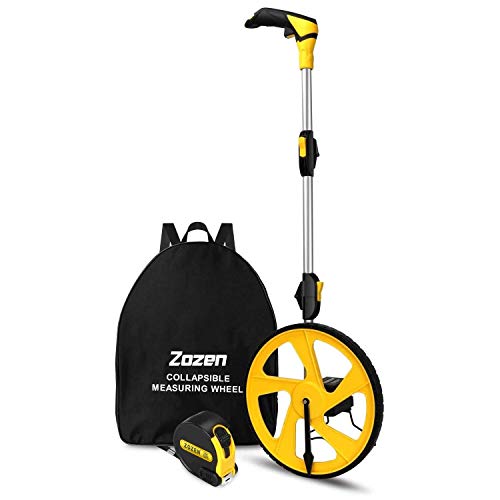 zozen Best mechanical wheel
 zozen hong-2Easiest to spot on site
Get the wheel ready
Most measuring wheels fold for carrying, so the first step is to unfold the frame and lock the joints. On the Zozen models in our data, the handle folds twice to 16 inches and extends to 40 inches. Check that every joint is snug, because a wobbly handle makes the wheel wander off line.
Next, look at the wheel itself. Dirt, mud or a small stone stuck in the tread can change how the wheel turns. Wipe it clean, and give it a short test roll to make sure it spins freely and the counter moves.
Finally, press the reset button so the display reads zero. Several wheels on our comparison page, including the Zozen and DEKOPRO models, list a one-key reset, which clears the count in a single press. A wheel that starts above zero will give you a wrong answer, so never skip this step.
Measure a straight line, step by step
The basic method is the same for mechanical and digital wheels. The wheel counts how many times it turns, then converts turns into distance based on its size. A 12.5 in wheel covers about 39.3 inches per turn (diameter times pi), which is why bigger wheels need fewer turns and tend to smooth out small bumps.
- Walk the route first and clear obvious obstacles such as hoses, branches and loose stones.
- Set the wheel so its marker or the edge of the tread lines up exactly with your starting point.
- Press reset and confirm the display shows zero.
- Hold the handle upright with the wheel just ahead of your feet, and push it forward at a normal walking pace.
- Keep your eyes on the end point, not the wheel, so you stay in a straight line.
- Stop when the marker reaches the end point. Do not let the wheel roll a little extra.
- Read the counter right away and write the number down, or save it if your model has memory.
Measure curves, corners and areas
A measuring wheel is useful for more than straight lines. For a curve, such as a garden bed edge or a curved driveway, roll the wheel along the curve itself and keep it tracking smoothly. Slow down on tight bends so the wheel does not skid sideways, since a skidding wheel undercounts.
For a corner or an irregular shape, measure each straight side as its own leg. Reset between legs, write each number down, and add them up at the end. This is also how you handle a run longer than your wheel's limit. A mechanical Zozen on our list reads up to 9999 ft, so very large parcels may need a break and a reset.
To find an area of a rectangular space, measure the length, reset, then measure the width and multiply the two. For example, a lawn that reads 60 ft by 40 ft is 2,400 square feet. Some digital wheels, such as the DigiRoller Plus III, can calculate areas, volumes and perimeters for you, but doing the multiplication by hand works with any wheel.
Reading mechanical and digital wheels
Mechanical wheels use a geared counter, much like an odometer. The Zozen mechanical models on our list read in feet and inches only, so the number matches what a tape measure would show. They need no batteries, which makes them dependable for simple outdoor jobs.
Digital wheels show the count on a screen and add extras. The table below uses the specifications published for the Zozen 12.5in Digital wheel and the Zozen mechanical wheels.
| Feature | Mechanical (Zozen Double Collapsible) | Digital (Zozen 12.5in Digital) |
|---|---|---|
| Units | Feet and inches only | Imperial and metric |
| Memory | None listed | Stores 5 readings |
| Backlight | None listed | Yes |
| Reset | One-key reset | One-key reset |
| Listed accuracy | 0.5% | 0.5% |
| Folded length | 16 in | 16 in |
Tips for accurate readings
Accuracy is a percentage of the distance, not a fixed amount. A wheel rated at 0.5% accuracy could be off by about 0.5 ft over a 100 ft run, and by about 5 ft over 1,000 ft. That is why a careful method matters more on long measurements.
Rough ground is the biggest source of error. A wheel that bounces or skips on gravel, tall grass or cracked pavement can lose count. Larger wheels roll over these surfaces more smoothly, and our best measuring wheel page explains how wheel diameter relates to terrain.
- Walk at a steady pace and avoid jerking the handle.
- Keep the wheel upright, not tilted to one side.
- Roll forward only. Some wheels subtract when rolled backward, so a quick backward nudge can change your count.
- Measure important distances twice and compare the two readings.
- Use the pause or hold function, if your wheel has one, when you need to stop mid-run.
Safety on the job
Watch where you are going. Eyes on the end point means eyes off the ground, so scan your route first for holes, curbs, slippery patches and tripping hazards.
Stay out of traffic when you measure roads, parking lots or driveways. Wear a high-visibility vest if vehicles are nearby, and have someone watch for cars if you are measuring along a street.
Call before you dig or stake. If you are using marking flags to lay out a line, check for buried utilities before pushing anything into the ground. Do not use a metal handle or pole near overhead power lines.
Choosing the right wheel for your job
If you mostly measure rooms and sidewalks, a compact wheel is enough. For lawns, fields and property lines, a 12.5 in wheel is the better match because it handles uneven ground more smoothly. If you want metric units, saved readings or a backlit screen, look at digital models.
Our best measuring wheel page lines up accuracy, maximum distance, wheel diameter and display type side by side. It is a quick way to see which model fits your terrain and the longest distance you expect to roll. Once you pick one, the steps above work the same way for any wheel.
Frequently asked questions
Do I push or pull a measuring wheel?
Push it ahead of you. That keeps the wheel in your line of sight and makes it easier to hold a straight path. Pulling it behind you works, but it is harder to steer.
Can I use a measuring wheel on grass or gravel?
Yes, but expect more bounce. A larger wheel, such as the 12.5 in size, rolls more smoothly over rough surfaces, and slowing down helps keep the count steady.
What should I do if I forget to reset the wheel?
Note the starting number and subtract it from your final reading. If you are not sure what the starting number was, reset and measure again.
Can I measure a vertical height with a measuring wheel?
Not reliably. These tools are built for ground distances, so use a tape measure or a laser distance tool for walls and ceilings.
How do I check that my wheel is accurate?
Lay out a known distance with a tape measure, such as 50 ft, and roll the wheel along it. If the reading is close to the tape, your technique and wheel are working well.