How to Use a Home Tool Kit for the First Time
Open the kit and sort what is inside before your first job. Then match the bit or screwdriver to the screw head, press firmly, and turn slowly with your other hand clear of the tip. Practice on scrap wood first, and put every piece back in its slot when you finish.
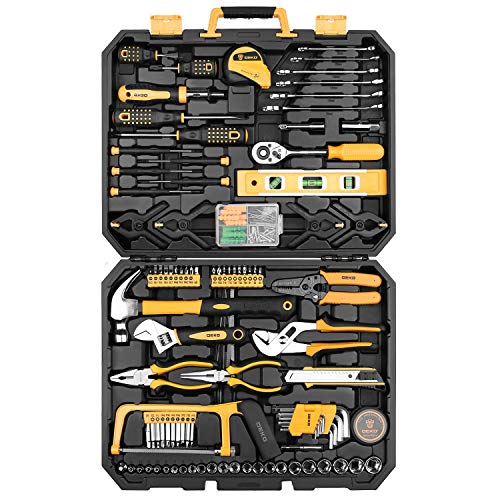 DEKOPRO ET00654Best overall
 DEWALT DWMT75049Three drive sizes
 DEKOPRO DKMHTK094BMC-OrangeClosest to a basic kit
What is in a home tool kit and how it works
Most home tool kits are a hard case with shaped trays. Each tool has its own slot, so you can see at a glance what is missing. The tools fall into a few groups: driving (screwdrivers and bits), gripping (pliers), striking (a hammer), measuring (a tape measure) and, in some kits, sockets and a ratchet for nuts and bolts.
Contents vary a lot. Some kits are close to a basic household set. Others are mechanics sets built around sockets, so the piece count can include dozens of pieces you may never touch on a shelf or furniture job. Our best home tool kit page shows which kits include a hammer and tape measure and which do not. Read your kit's contents list first so you know what you actually own.
As an example, the DEKOPRO 94 Piece Basic Home Tool Kit lists a 4 oz steel claw hammer, 5.5-inch combination pliers, a utility knife, a 6.56-foot tape measure, five hex keys, ten screwdriver bits, 70 fasteners and four 1/4-inch sockets in a hard case. That is a typical mix for small repairs and furniture assembly.
Set up before your first job
Take everything out once and lay it on a towel or a workbench. Identify each tool and check that nothing is bent or loose. This takes five minutes and saves hunting later.
Choose a clear, well-lit work area with a stable surface. Clamp or hold your workpiece so it cannot slide. Keep the case open nearby, but not where you will knock it off the table.
- Wear safety glasses whenever you hammer, cut or pry. Metal chips and bent nails can fly.
- Wear gloves if you handle rough lumber or sharp edges, but take them off near moving parts.
- Turn off power at the breaker before you work near an outlet, switch or wiring. A hand tool kit is not insulated protection.
- Check for hidden pipes and wires before you drive anything into a wall.
- Use a sturdy step stool or ladder for anything above shoulder height, and keep your body centered over it.
How to use a home tool kit with screws
Screws are the most common first job. The key idea is that the bit must fit the screw head snugly. A loose fit slips and chews up the head, which is called cam-out.
- Look at the screw head and choose the matching bit. If the bit wobbles, try the next size.
- Seat the bit fully in the head. Push toward the screw as you turn, so the tip stays engaged.
- Turn clockwise to tighten and counterclockwise to loosen. Use steady, slow turns.
- For hard wood, drill or press a small pilot hole first so the wood does not split.
- Stop when the screw is snug and flush. Over-tightening can strip the hole or crack the part.
- Keep your free hand behind the screwdriver's path, never in front of the tip.
Match the bit to the screw head
Bit sets use short codes. The DEKOPRO 94 piece listing, for example, names its bits SL4, SL5, SL6, PH1, PH2, T15, T20, H4 and H5. SL means slotted, PH means Phillips, T means Torx (star) and H means hex. The number is the size. If your kit uses different labels, the same letters usually apply.
| Screw head | Bit code | Typical use | Tip |
|---|---|---|---|
| Slotted (single line) | SL | Older fixtures, cover plates | Choose a blade that fills the full slot width |
| Phillips (cross) | PH | Furniture, general household screws | Push in firmly to prevent slipping |
| Torx (star) | T | Some appliances and fixtures | Seat the bit fully before turning |
| Hex (six-sided) | H | Flat-pack furniture, bike parts | A hex key works the same way as a bit |
Using the hammer, pliers and tape measure
Hammer: Hold the handle near the end, not close to the head. Start with a few light taps to set the nail, then swing from the elbow. Keep your eyes on the nail head, not on your hand. A light hammer such as the 4 oz one in the DEKOPRO kit suits small nails and tacks. Use the claw to pull a nail by rocking the handle sideways, and slide a thin scrap of wood under the head for extra leverage.
Pliers: Use them to grip, bend or hold small parts steady. Do not use pliers on a nut when a wrench or socket fits, because they round the corners. Never use ordinary pliers on live wires.
Tape measure: Hook the end on the edge, pull it straight and read at the line. Measure twice before you mark or cut. The small hook at the end slides slightly on purpose to account for its own thickness, so do not bend it.
Sockets and ratchet: If your kit has them, pick the socket that fits the nut snugly, push it on fully and use the ratchet switch to set the direction. A higher tooth count, such as the 72-tooth ratchets in several kits we compare, needs a smaller swing between clicks. That helps in tight spaces.
Practice, then put everything away
Before a real repair, practice on a scrap piece of wood. Drive a few screws, hammer a nail and measure a board. You will quickly learn how much force each tool needs.
When you finish, wipe off dust and moisture, especially if the kit lives in a garage. Return each tool to its slot, close the latches and store the case somewhere dry. A kit that is easy to carry and put back gets used more often.
If a job needs drilling or driving many screws, a cordless drill can save effort. Our best power tool combo kit for the money page compares options. If you use one, add hearing protection and eye protection, and read its manual first.
Frequently asked questions
Can I use a socket set instead of a screwdriver?
Only if the fastener is a hex or nut type that the socket fits. Sockets do not fit slotted or Phillips screws. Use a bit and a screwdriver handle for those.
What should I do if a screw head gets stripped?
Stop turning, because more force makes it worse. Try a slightly larger bit with firm pressure, or ask for help removing it. Next time, press harder and turn slower.
Do I need to buy extra tools after the kit?
Possibly. Most kits cover basic tightening, gripping, hammering and measuring. Add items such as a level or stud finder when a job calls for them.
How often should I check my kit?
Look it over every few months. Check for rust, missing pieces and loose handles, and replace worn bits so they do not slip.