How to Use a Hex Key Set Correctly
Pick the key that fits the socket snugly with no wobble, push it in all the way, and turn with the key square to the fastener. If a key feels loose, it is the wrong size, so try the next one up or down before applying force. Steady, even pressure protects both the key and the screw.
 ELEAD 70084Best overall
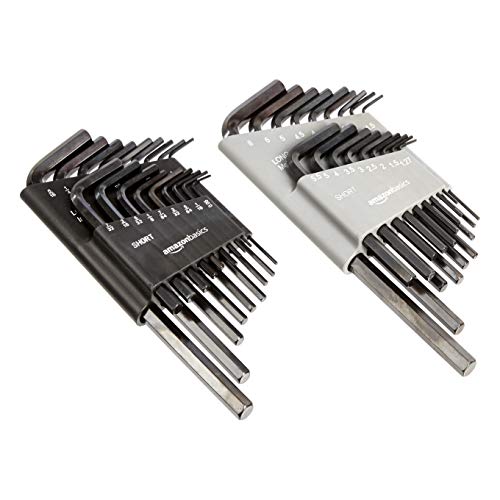 Amazon Basics DS-AMZ030Long-arm keys in two cases
 HORUSDY 94262Color-coded ball-end set
Step by step: the basic method
A hex key is a simple tool, but small mistakes are the main reason fasteners get rounded off. Most problems come from the wrong size or a key that is not fully seated.
Follow these steps each time and the job usually goes smoothly.
- Clean out the socket. Dust, paint or grit can stop the key from seating fully.
- Choose the size. Start with the key you think fits, then test it. It should slide in with almost no play.
- Check the size system. SAE (inch) and metric keys can look nearly identical, but a mismatch leaves a small gap that damages the socket.
- Insert the key all the way to the bottom of the socket.
- Hold the key at 90 degrees to the fastener, in line with its axis.
- Turn slowly with steady pressure. Counterclockwise loosens and clockwise tightens.
- Stop tightening when the fastener feels snug. Do not keep pushing until something gives.
Choosing the right size and system
The most common mistake is using a key that is close but not exact. A metric key in an inch socket, or the reverse, may seem to fit but will have slight play. Under load, that play rounds the corners of the socket and the key tip.
Try the test fit before you turn anything. Insert the key and gently rock it. If you feel movement, switch sizes. If two keys seem to fit, the tighter one is almost always correct.
A set that covers both systems makes this easier. For example, the ELEAD 70084 lists 0.7 to 10 mm and 0.028 to 0.375 in, so you can usually find an exact match instead of settling for a near one. Our best hex key set page compares size ranges across several sets so you can check coverage against the fasteners you own.
Torx (star) fasteners are a separate case. A hex key will not fit properly in a star socket, so use a Torx key marked with a T number instead.
Using the long and short ends
Most L-shaped keys have two arms of different lengths, and each end has a job.
Use the long arm in the socket when you need reach or speed. You get more clearance around the fastener and can spin it quickly once it is loose. The downside is less leverage than the short arm gives.
Use the short arm in the socket when you need more turning force. You grip the long arm as a handle, which acts like a lever. This is the end to use for breaking a tight fastener loose or for the final snug turn.
Some sets include a torque handle or T-handle style keys. These give a more comfortable grip for longer jobs and spread pressure across your palm instead of your fingers.
Ball-end, folding and other key styles
Ball-end keys have a rounded tip that lets you turn a screw at an angle. The HORUSDY set, for example, lists access to socket cap screws up to a 25 degree entry angle. That helps in tight spots where a straight approach is blocked.
Use the ball end for speed and access, but not for the final tightening or the first break-loose. The rounded tip contacts less of the socket, so it handles less force. Switch to the straight hex end for those steps.
Folding sets keep the keys on a handle, so they are easy to carry and hard to lose. Hold the key you want fully open and make sure it is locked straight before you turn. Keep the other keys folded so they do not dig into your hand. Folding sets can have a narrower range. The Amazon Basics folding set lists 1.5 to 8 mm and 0.078125 to 0.25 in, so check that your fastener sits inside that range.
| Key style | Best for | Watch out for |
|---|---|---|
| L-shaped, straight end | Breaking loose and final tightening | Limited angle of entry |
| L-shaped, ball end | Quick turning and angled access | Lower force capacity at the tip |
| T-handle or torque handle | Comfortable, longer jobs | Bulkier in tight spaces |
| Folding set | Carrying and quick fixes | Narrower size range, keys must lock straight |
Handling stuck or rounded fasteners
If a fastener will not budge, resist the urge to add a pipe to the key for extra leverage. That can bend or snap the key and hurt your hand. Instead, try these gentler steps first.
Make sure the key is the right size and fully seated. Then apply steady pressure rather than a sudden jerk. A drop of penetrating oil, given time to soak in, can help with rusty fasteners. Tapping the end of the key lightly with a hammer can help seat it before you turn.
Steel quality matters here. Many sets use chrome vanadium steel, and a hard, heat-treated key is less likely to twist when a fastener is stiff. A soft key can deform and then round off the socket. Our hex key set comparison notes the material for each set.
If the socket is already rounded, stop forcing it. Special extractor bits exist for damaged hex sockets.
Safety and care
A slipping key can scrape knuckles or send your hand into a sharp edge. Keep your body clear of the path your hand would take if the key let go, and pull toward you rather than pushing away when you can.
Wear safety glasses when working on anything under tension, such as springs or rusty parts, since a key can slip or a fastener can fly off. Gloves help with grip, but skip them near rotating machinery.
Never use a hex key on a part connected to a power source. Unplug tools and appliances first. Be careful with bicycle and vehicle parts that bear weight, and check torque specs for critical fasteners.
After use, wipe the keys clean and put them back in their slots. Worn, rounded or bent keys should be replaced, because a damaged tip will damage the next fastener.
Frequently asked questions
Is a hex key the same as an Allen wrench?
Yes. Allen wrench is a common name for the same tool. Both turn fasteners with a six-sided socket.
Can I use a metric key in an inch socket if it seems to fit?
It is best not to. Even a tiny gap lets the key slip and round the socket. Use the exact size in the matching system.
Which way do I turn a hex key?
Turn clockwise to tighten and counterclockwise to loosen, as with most standard screws.
Should I use a power drill with hex key bits?
Hex bits can be fine for light work, but a drill can overtighten or strip a fastener quickly. Hand tools give better feel for small screws.