How to Use a Forstner Bit on Wood
Mount the bit firmly in the chuck, clamp the wood, and run the drill at a slow, steady speed. Let the center point find its mark, then feed the bit down with light, even pressure and back out often to clear chips. A drill press gives the cleanest result, but a regular corded or cordless drill works for smaller bits if you hold it square.
 Fisch FSA-367208Best overall
 Freud PB-100Lifetime guarantee included
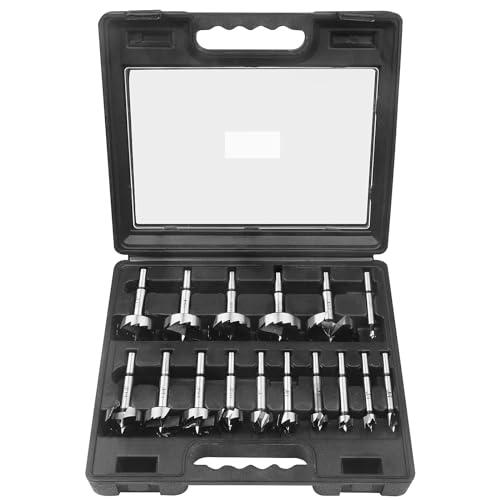 BAIDETS BD210035Every size named
What a Forstner bit does best
A Forstner bit drills a clean, flat-bottomed hole with smooth sides. A small center point locates the hole, and a rim around the edge shears the wood fibers. That is why people use these bits for hinge cups, dowel holes, shelf pins, and any hole that must stop at a set depth without poking through.
Twist bits and spade bits cannot do this as neatly. A twist bit leaves a cone-shaped bottom, and a spade bit tends to wander and tear the wood. If you want a flat floor or a hole that overlaps another one, the Forstner bit is the right tool.
Check your setup before you drill
Most of a good result comes from preparation. Start with a bit that matches the hole you need, and look at the cutting edges. Dull edges burn the wood and make you push harder, which hurts control.
Then work through this short list:
- Mark the hole center with a pencil cross or a small awl dimple so the center point has a spot to settle into.
- Clamp the workpiece to a bench or the drill press table. Never hold small pieces by hand while drilling.
- Put a scrap board underneath if you plan to drill all the way through, so the bit does not tear out the back face.
- Wear safety glasses, and add hearing protection if you are drilling a lot of large holes.
- Tie back loose hair and sleeves, and remove gloves that could catch on the spinning bit.
How to attach a Forstner bit to a drill
Open the chuck wider than the shank, slide the shank in, and tighten the chuck evenly. With a keyless chuck, tighten it by hand and then give it a firm final turn. With a keyed chuck, tighten it at all three key holes so the jaws grip evenly. Unplug a corded drill or remove the battery from a cordless one before you change bits.
Shank shape matters, especially on large bits. Some sets use a reduced shank with flats. For example, the Fisch Black Shark set lists a reduced cylindrical shank with three flat clamping surfaces, which gives the chuck more to bite on. The Cortool set lists a 0.375 in hex shank that is meant to resist slipping. Plain round shanks can still work, but check them for slipping after the first few seconds of drilling.
Make sure the bit sits straight in the chuck before you tighten it. A bit that is slightly crooked will wobble and leave a ragged hole. If you are shopping for a set with a secure shank, our best forstner bit set page compares shank types side by side.
Drilling the hole step by step
The same basic method works with a drill press or a hand drill. The drill press just makes it easier to keep the bit square.
- Set the speed low. Forstner bits cut with a lot of surface area, so they generate heat quickly. Larger bits need slower speeds than small ones.
- Set a depth stop if you have one, or wrap a piece of tape around the bit as a visual marker.
- Place the center point in your mark and start the drill. Let the point and rim bite in before you add pressure.
- Feed the bit with light, even pressure. Let the cutting edges do the work instead of forcing the bit down.
- Lift the bit out every so often to clear chips. Packed chips cause heat, burning, and a rough wall.
- Stop at the depth mark. For a through hole, slow down as the point breaks through and drill against the scrap board to limit tear-out.
- Let the bit stop spinning before you set the drill down.
| Drill type | Best for | Watch out for |
|---|---|---|
| Drill press | Large bits, exact depth, repeat holes | Clamp the work so it cannot spin |
| Corded drill | Medium bits and steady torque | Hold it square and brace against the kickback |
| Cordless drill | Small to medium holes, tight spaces | Bits can stall on large sizes, so go slow |
Using a Forstner bit in a hand drill
Yes, you can use a Forstner bit in a regular drill. Many listings say their bits work in power drills and hand drills as well as drill presses. The challenge is control, not compatibility.
Hold the drill with both hands if the handle design allows it, and stand so you can see the bit from two sides. Check that the drill is square to the surface before you start. A small square or a piece of folded paper laid next to the bit can help you check the angle.
Start slowly and let the center point and rim engage fully. Large bits can grab and twist the drill in your hands, so brace your arms and keep a firm grip. If the bit binds, release the trigger rather than fighting it. For bits at the larger end of a set, such as the 2.125 in size, a drill press is the safer choice.
Speed, heat, and clean results
The usual advice is simple: bigger bit, slower speed. Hardwoods like oak and maple also call for slower speeds and more frequent chip clearing than softwoods. If you smell smoke or see dark rings in the hole, slow down and ease off the pressure.
Edge design affects how clean the hole looks. Our best-set page notes that a wave or serrated rim helps clear chips and leaves a smoother wall, and that a center point stops the bit from wandering. Steel type matters too. High-speed steel tends to resist heat better than carbon steel, which helps in dense woods. You can see which listed sets name their steel and rim design in our forstner bit set comparison.
After drilling, brush the chips out of the hole and wipe off any resin from the bit. A clean bit cuts cooler the next time.
Frequently asked questions
How do I avoid tear-out when drilling through?
Clamp a scrap board under the workpiece and drill into it. Alternatively, drill from one side until just the center point shows through, then flip the board and finish from the other side.
Why is my Forstner bit burning the wood?
Burning usually comes from too much speed, too much pressure, or packed chips. Slow the drill, lighten your feed, and lift the bit often. A dull bit will also burn, so check the edges.
Can I drill overlapping holes with a Forstner bit?
Yes. This is one of the bit's strengths, because the rim guides the cut. Drill the first hole, then drill the second so it overlaps the first. Go slowly where the rim crosses the open edge, since the bit can drift.
Can I drill an angled hole with a Forstner bit?
It is possible, but it is easier on a drill press with a tilting table. Start at 90 degrees until the rim and center point have cut in, or use a guide block cut at the angle, to keep the bit from skating.