How to Use a Foam Cannon for Car Washing
Connect the foam cannon to your pressure washer wand or gun, fill the bottle with warm water and a little car shampoo, set the knob and spray pattern, then coat the car from the bottom up. Let the foam sit briefly without drying, then rinse. Most foam cannons use a 1/4 in quick connect and need a pressure washer, so a plain garden hose usually will not work.
 Tool Daily JT001-1Lightest in the lineup
 Tool Daily JT067Gun included, M22 fittings
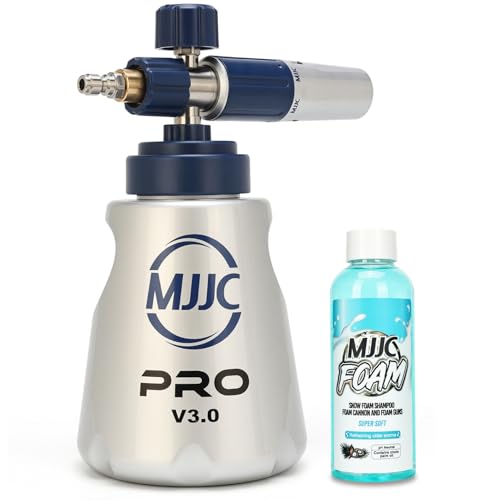 MJJC QRFLPROV3Biggest soap bottle
Check what you are connecting to first
Before you mix any soap, confirm that your cannon actually fits your equipment. Most foam cannons use a 1/4 in quick connect fitting. That fitting clicks onto a pressure washer wand or gun that has a matching quick connect socket.
Several cannon listings say plainly that they will not fit a garden hose or a faucet. If you are still choosing a model, our best foam cannon comparison lists the connector type for each product, so you can match it to your washer before you order.
The table below shows the common setups and what each one needs.
| Your setup | What the cannon needs | Notes |
|---|---|---|
| Pressure washer with a 1/4 in quick connect wand | A cannon with a 1/4 in quick connect | The most common match among the models we compare |
| Pressure washer with an M22 14mm or 15mm hose fitting | A gun with M22 fittings, or an adapter | The Tool Daily JT067 includes a gun with M22 fittings for both sizes |
| Garden hose or faucet only | A different type of foam gun | A pressure washer cannon will not fit directly |
Step-by-step: using a foam cannon on a pressure washer
This is the basic routine, and it works for nearly every pressure washer cannon. Read your washer manual too, since fittings and limits vary.
- Park the car in the shade if you can, and make sure the paint is cool to the touch. Hot panels dry soap too fast.
- Fill the bottle partway with warm water. Warm water helps the soap mix and foam better.
- Add car shampoo using the amount on the soap label. Many people start with a small amount and add more only if the foam looks thin. Swirl gently rather than shaking hard, which creates bubbles in the bottle instead of in the spray.
- Screw the bottle onto the cannon head and make sure it is snug.
- Attach the cannon to the wand or gun. Pull back the collar on the quick connect, push the cannon on, and release until it clicks. Tug lightly to confirm it is locked.
- Turn the water on and squeeze the trigger away from the car to purge air from the line.
- Set the foam knob and spray pattern (more on those below), then start spraying at the lower panels and work upward.
Applying the foam so it works well
Start with the lower panels and move up. Lower panels are usually the dirtiest, so they get the longest contact time with the soap. Overlap each pass a little so you do not leave bare patches.
Let the foam sit for a few minutes, but do not let it dry on the paint. If you see it starting to dry or streak, rinse sooner. On a warm or breezy day, work one side of the car at a time.
Foam loosens dirt and adds lubrication, but it does not replace a careful wash. For a car with heavy grime, rinse first with plain water to knock off loose grit. Then foam, then rinse again, then follow with a hand wash if you normally do one.
Using a foam gun with a garden hose
If you only have a garden hose, a pressure washer cannon is the wrong tool. The listings we compare say these cannons need a pressure washer, and several say they will not fit a hose or faucet. Forcing a connection will not work and can damage the fitting.
Garden hose users need a different type of foam gun, one that threads onto a standard hose end and draws soap from its own bottle. These produce lighter, wetter foam than a pressure washer cannon does, because a hose has far less pressure behind it. That is fine for a soapy pre-soak. It just will not look like the thick foam you see in pressure washer videos.
The steps are similar. Fill the bottle with warm water and soap, attach the gun to the hose, set the dilution dial if it has one, and spray from the bottom up. Check the product page for the exact fitting before you buy.
Dialing in foam thickness
Three controls shape the foam: the foam knob, the spray pattern and the orifice. Not every cannon has all three, so check the specs.
The foam knob sets how much soap mixes with the water. On the Tool Daily models, the listing says to turn the top knob right (-) for the thickest mixture. The spray pattern setting changes the fan shape, from a narrow stream to a wide fan. Wide fans cover panels fast, while narrow ones suit wheel wells and lower trim.
The orifice is the small jet inside the cannon. A smaller opening suits a lower-powered washer, and a larger one suits a stronger washer. Swappable orifices let you match the cannon to your machine. The MJJC Pro V3.0 lists three sizes:
- 1.1mm for 1305 to 1595 PSI
- 1.25mm (pre-installed) for 1595 to 2175 PSI
- 1.35mm for 2175 to 4061 PSI
Troubleshooting thin or weak foam
Thin foam is the most common complaint, and it usually has a simple cause. Work through these checks in order.
First, check the soap. Foam thickness depends heavily on the shampoo, and some soaps simply foam better than others. Second, check the foam knob and make sure it is turned toward the thicker setting. Third, check that the orifice suits your washer. A mismatch between orifice and pressure gives weak, watery foam.
Also check your washer against the cannon's listed range. For example, the Tool Daily JT001-1 lists 1000 to 3000 PSI. Many makers do not publish a range at all, so if yours does not, the orifice guidance above is the best place to start.
Safety notes
A pressure washer is powerful equipment, and a few simple habits keep the job safe.
- Wear eye protection. Soap and debris can spray back, and the stream itself can injure skin and eyes.
- Never point the wand at people, pets or your own feet, even with the cannon attached.
- Keep electrical plugs and connections dry and off wet ground. Use a GFCI outlet for an electric washer.
- Do not exceed the pressure, flow or temperature limits on the cannon. The Tool Daily JT067 listing, for example, gives a maximum water temperature of 140°F.
- Wear shoes with grip. Soapy driveways get slippery fast.
- Use a stable step stool for roof panels on a tall truck or SUV, and never lean from a ladder while holding a pressure washer.
Cleaning up and storing your cannon
After washing, pour out any leftover soap and run clean water through the cannon for a few seconds. Trapped soap can clog the orifice and corrode some fittings. Some cannons list stainless steel fittings or internals, which resist this better, but rinsing helps on any model.
Detach the cannon from the washer, let it drain, and store it upright in a dry spot. If foam output drops over time, check the orifice for buildup before assuming the cannon is worn out.
Frequently asked questions
Can I use any car soap in a foam cannon?
Most car wash soaps work, but they do not all foam equally. If your foam is thin, try a soap made for foam cannons before changing anything else.
How much soap should I add?
Follow the label on your shampoo. Start on the low side, check the foam, and add a little more only if it looks thin.
Does a bigger bottle matter?
It means fewer refills on a large vehicle. Among the models we compare that list a capacity, bottles run from 32 fl oz to 44 fl oz. A wide mouth also makes filling easier.
Do I need to rinse the car before foaming?
A quick rinse helps because it removes loose grit first. Then the foam can work on the bonded dirt.