How to Use a Digital Scale for Reloading
Place the scale on a level, steady surface away from drafts, let it settle, zero it with the pan in place, then check it with the calibration weight that came with it. Weigh each powder charge in the pan, compare it to the value in a published load manual, and recheck zero often. If the reading drifts or fails the calibration check, stop and fix that before you weigh another charge.
 GOYOJO TP-500NRanks first, not for powder
 Aoderda Aoderda-01Light backlit pull scale
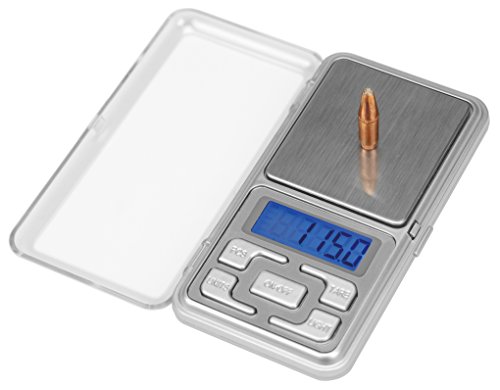 Frankford Arsenal 205205Lightest, 0.1 grain accuracy
Start with the right kind of scale
A reloading scale reads in grains or small gram steps and shows tiny changes in weight. A trigger pull gauge or a kitchen scale does not do that job. Our best digital scale for reloading page explains the difference and lists which units and increments to look for.
In our product data, the Frankford Arsenal DS-750 and the Hornady G3-1500 both list 0.1 grain accuracy and a 0.000229 oz resolution. Both read in grains, grams, ounces and carats. Trigger gauges in the same data list 0.1 oz or 1 oz steps, which are far too coarse to show a powder charge.
If you are still comparing options, our page on the best digital scale 0 01 gram accuracy shows how finer readouts line up across models.
Set up the bench before you power on
Most weighing errors come from the setting, not the scale. A few minutes of preparation makes every reading more trustworthy.
Many handloaders say a scale needs time to settle after it is switched on. Check your manual for how long yours recommends.
- Put the scale on a solid, level bench. A wobbly table or a soft mat shifts the readings.
- Keep it away from fans, open windows, vents and your own breath. Use the draft cover if one is included. The Hornady G3-1500 lists one in its box.
- Avoid strong light sources and nearby electronics that could interfere with the display.
- Keep the scale away from the edge of the bench so you do not knock it while working.
- Check the batteries. The Frankford and Hornady scales in our data use two AAA batteries, and weak batteries can cause odd readings.
Zero, calibrate and check the scale
Calibration tells the scale what a known weight looks like. Use the calibration weight that came with your model, and follow the steps in its manual, since the button sequence differs by brand. The Hornady G3-1500 lists a 10 gram calibration weight, and the Frankford DS-750 lists a calibration weight in its box too.
A typical routine looks like this:
- Power on the scale and let it finish its start-up display.
- Place the empty powder pan on the platform.
- Press the tare or zero key so the display reads zero with the pan in place.
- Enter calibration mode as described in your manual and place the calibration weight when prompted.
- Remove the weight and confirm the display returns to zero.
- Place the weight on again as a check. If the reading is off, repeat the calibration.
- Do a quick check with the weight at the start of each session and every so often as you work.
Weigh a powder charge step by step
Once the scale is ready, the routine is simple. Work slowly and keep your attention on one step at a time.
First, look up the charge in a current, published load manual for your exact bullet, powder and cartridge. Never guess a charge or copy one from memory.
Next, tare the empty pan. Add powder with a scoop or a measure, then trickle small amounts in until the display matches your target. Wait for the reading to settle before you decide to add or remove powder.
Then pour the charge into the case and set the pan back on the scale. The display should return to zero. If it shows a small positive or negative number, powder may be stuck in the pan, or the scale may be drifting. Re-zero and continue.
Finally, spot-check a few charges as you go. You do not have to weigh every one on a progressive setup, but regular checks catch drift early.
Tips for 9mm and other small charges
Pistol cartridges like 9mm use small powder charges, so a 0.1 grain step is a meaningful part of the total. That makes a steady scale and careful zeroing more important than with large rifle charges.
Convert units with care. If your manual lists a charge in grains and your scale is set to grams, the numbers will look wildly different. One grain is about 0.0648 gram. It is easiest to set the scale to grains and leave it there.
Static can cling to light powder and the pan. Wipe the pan with a clean, dry cloth, and avoid weighing in very dry rooms with synthetic carpet nearby if you notice the numbers jumping.
Capacity matters less for powder than for bulk weighing. The Frankford DS-750 lists a 750 grain capacity, and the Hornady G3-1500 lists a 1500 grain capacity with a constant readout up to 500 grains. Both are far more than a typical pistol charge needs.
Compare the two common bench scales
The table below uses figures from our product data. Both models include extras that save you a trip to the store.
If your scale came with a printed manual or PDF, follow its calibration steps first. Brand-specific key presses and auto shut-off times differ.
| Spec | Frankford Arsenal DS-750 | Hornady G3-1500 |
|---|---|---|
| Accuracy | 0.1 grain (0.01 gram) | 0.1 grain |
| Capacity | 750 grain (50 gram) | 1500 grain |
| Units | Grains, grams, ounces, carats | Grains, grams, ounces, carats |
| Power | 2 AAA batteries (included) | Two AAA batteries (not included) |
| Extras listed | Powder pan, carry case, calibration weight | 10 gram calibration weight, pan, draft cover |
| Auto shut-off | After 60 seconds | Not stated |
Safety and common mistakes
Smokeless powder is flammable. Keep it in its original container, handle one powder at a time, and keep sparks, flames and heat away from the bench. Wear safety glasses while you load. Follow published load data, and stop if anything looks or feels off.
Auto shut-off is worth knowing about. The Frankford DS-750 powers down after 60 seconds, so a slow trickling session may need a restart and a fresh zero check.
- Do not weigh with the draft cover open or a fan running.
- Do not lean on the bench while the display settles.
- Do not skip the zero check after the scale shuts off and restarts.
- Do not use a scale that fails the calibration check.
- Do not weigh loose powder directly on the platform. Always use the pan.
Frequently asked questions
How often should I recheck the zero?
Check it whenever you refill the pan, restart the scale or move anything near the bench. Rechecking at regular points in a session catches drift before it affects a batch.
Can I use a kitchen scale instead?
No. Kitchen scales do not read small enough steps for powder charges. Use a scale that reads in grains or 0.1 gram steps or finer.
Why does my reading keep changing?
Drafts, vibration, static, a weak battery or a dirty pan are the usual causes. Fix the setting first, then re-zero and recalibrate if the reading still wanders.
Do I need to weigh every charge?
It depends on your method. Many loaders weigh each charge on a manual setup and spot-check on a powder measure. Whatever you choose, check the scale against the calibration weight often.