How to Use a Corded Jigsaw: Step-by-Step Guide
To use a corded jigsaw, unplug it, install a blade that suits your material, clamp the workpiece, set the speed and orbital dial, then rest the front of the shoe on the work and start the saw before the blade touches it. Guide the saw along your line without forcing it and let the blade do the cutting. The steps are the same for DeWalt, Ryobi, Craftsman and other corded models.
 Bosch JS470EBest top-handle Bosch
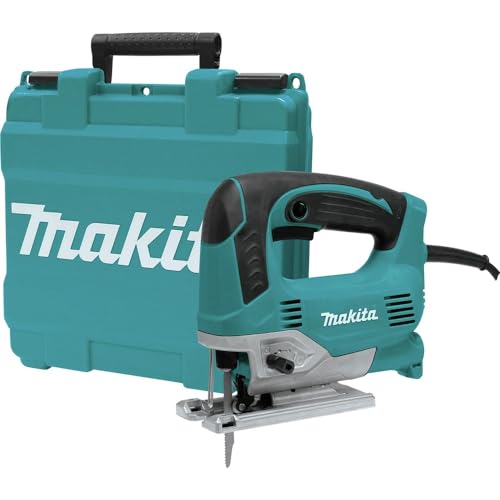 Makita JV0600K-RBest overall
 Bosch JS470EBBest barrel-grip control
What you need before the first cut
A jigsaw is a handheld saw with a thin blade that moves up and down. It is the usual tool for curves, cutouts and rough straight cuts in wood, plastic and thin metal. A corded model keeps steady power through long cuts, so you never have to think about a battery fading halfway through a line.
Gather these items first so you do not have to stop mid-cut:
- Safety glasses and hearing protection
- A dust mask, since jigsaws throw sawdust toward you
- Two or more clamps
- A pencil and a straightedge or template
- The right blade for your material
- A drill and bit if you plan to cut an opening in the middle of a board
Safety first
Unplug the saw every time you change a blade, adjust the shoe or clear a jam. A cord left plugged in with the trigger lock engaged can start the saw the moment you touch it.
Wear eye and hearing protection for the whole job. Blades can snap, and chips fly up and back toward your face. Keep your free hand well away from the blade path, and never hold small pieces by hand while cutting them.
Run the cord behind you and away from the cutting line. Before you plug in, check that the cord is not frayed or cut, and use an extension cord rated for the saw if you need one. Used blades get hot, so let them cool or use the ejection lever if your saw has one. Several saws on our best corded jigsaw page, such as the Bosch JS470E, include a blade ejection lever for this reason.
Step 1: Choose and install the blade
Match the blade to the material. Coarse teeth cut wood quickly but leave a rougher edge. Fine teeth give smoother results in plywood, plastic and metal. Many saws take T-shank blades, and some do not accept U-shank blades at all. The Bosch JS260 listing, for example, says it takes T-shank only. Check your manual before buying blades.
With the saw unplugged, open the blade clamp. On tool-free models you flip a lever or turn a collar, slide the blade in with the teeth facing forward, and let the clamp close. Tug gently to confirm it is locked. The blade's back edge should sit in the roller guide just behind it.
Step 2: Set speed, orbit and the shoe
Most corded jigsaws have a speed dial and an orbital dial. Speeds on the saws we compare reach roughly 3000 to 3100 strokes per minute, and the dial sets the maximum while the trigger controls the speed as you squeeze. Use faster settings for wood and slower ones for metal and plastic.
Orbital action swings the blade forward on the upstroke. That makes cuts faster but rougher. Use these starting points, then adjust to what you see:
| Material or cut | Orbit setting | Speed |
|---|---|---|
| Rough cuts in softwood | High | High |
| Hardwood or plywood | Low to medium | Medium to high |
| Tight curves and clean edges | Zero or low | Medium |
| Thin metal | Zero | Low |
| Plastic | Zero or low | Low to medium |
Step 3: Mark and secure the workpiece
Draw your cut line clearly. For curves, trace around a template or a round object. Dark, visible lines are easier to follow than faint ones.
Most blades cut on the upstroke, so splintering tends to show on the top face of the board. Place the good face down when the finish matters. Clamp the piece to a stable surface so the part you are cutting off overhangs the edge, and make sure the blade has clear space beneath it. Cutting into a bench or your own leg is a common beginner mistake.
If you need a cutout in the middle of a panel, drill a hole just larger than the blade inside the waste area. Start the cut from that hole. Plunge cuts made by tipping the saw into the surface are harder to control, so beginners should skip them.
Step 4: Make the cut
Rest the front of the shoe flat on the material with the blade just clear of the edge. Plug in the saw, squeeze the trigger and let it reach speed before the blade touches the wood. Starting while the blade is already in contact makes the saw jump.
Keep the shoe pressed down so it stays flat, and push forward at a steady pace. If the motor bogs down, you are pushing too hard. If the blade chatters, slow your feed or lower the orbit. Follow the pencil line with your eyes, not the blade itself.
Some saws have a built-in dust blower or an LED light. The Skil JS314901 and the DEKOPRO models in our data list a light, and a blower helps clear the line so you can see it. If your saw has a vacuum port, using one keeps the area cleaner.
Step 5: Handle curves, corners and finishing
For gentle curves, simply steer the saw as you push. For tight curves, make relief cuts: short straight cuts from the waste side up to the line, so the blade is never trapped. Do not twist the saw sideways, as that can bend or snap the blade.
For sharp inside corners, cut to the corner on one side, back out, then cut in from the other. Release the trigger and let the blade stop completely before you lift the saw off the work. Sand the edge lightly to remove fuzz.
If you cut angled edges, loosen the shoe and set the bevel angle. Many saws on our list reach 45 degrees. Make a test cut on scrap and check the angle before you cut your good piece.
Does the brand change anything?
The method above applies to DeWalt, Ryobi, Craftsman and other corded jigsaws. What changes is where the controls sit and how the blade clamp opens, so read the manual for your model. Grip style matters too. Top-handle saws, like most of those on our best corded jigsaw page, are easier for straight cuts and for newcomers. A barrel-grip saw such as the Bosch JS470EB puts your hand closer to the work for tight curves.
If you are still deciding which saw to buy, the weight and grip details in our comparison can help you narrow the choice before you start your first project.
Frequently asked questions
Which way should the teeth face?
The teeth should point forward, toward the front of the saw, and the blade should sit snugly in the roller guide behind it.
Why does my blade wander off the line?
Usually the blade is dull, the orbit is set too high, or you are pushing too hard. Switch to a sharp blade, lower the orbit and let the saw move at its own pace.
Can I cut metal with a jigsaw?
Yes, with a metal-cutting blade, a low speed, zero orbit and the sheet clamped firmly. Wear gloves when handling cut edges, which are sharp.
Should I use the trigger lock?
Only if you are comfortable with it. Most beginners do better holding the trigger so the saw stops the moment they let go.
Can I use a jigsaw to cut a straight line?
You can, using a clamped straightedge as a guide. For long, perfectly straight cuts, a circular saw or table saw will usually give a cleaner result.