How to Use a Box Cutter Properly
To use a box cutter properly, extend the blade only as far as the job needs, cut away from your body with steady pressure, and retract or lock the blade every time you stop. Keep your free hand well clear of the cutting line and swap the blade as soon as it drags. Most injuries come from dull blades, too much force and rushing, so slow, controlled cuts are the safest habit.
 WORKPRO W013053Best overall
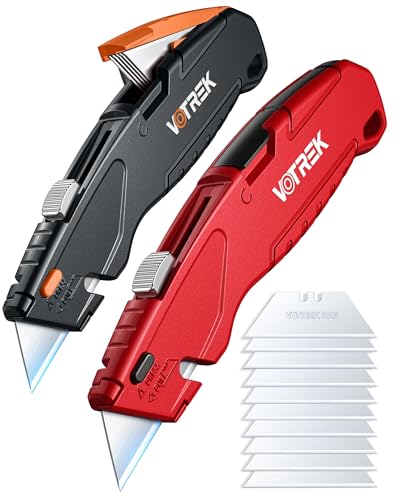 VOTREK UK003Best for one-handed use
 WORKPRO W011047Most blades included
How a box cutter works
A box cutter is a handle that holds a thin, sharp blade and lets you control how much of it sticks out. The blade is usually a replaceable steel segment with a pointed or trapezoid shape. The handle gives you grip and leverage so your whole forearm, not just your fingers, guides the cut.
There are two common designs. A retractable cutter has a slider that pushes the blade out of a closed body and locks it at set positions, then pulls it back in. A folding knife swings the blade out of the handle and locks it open, then folds it shut. Our box cutter comparison lays both designs side by side if you want to see how they differ on weight, length and blade changes.
The blade does the work by concentrating force on a very fine edge. That is why a sharp blade needs little effort, and a dull one needs a lot more. More effort means less control, and less control is how slips happen.
Get set up before the first cut
A minute of preparation prevents most accidents. Clear a stable surface and put the item on it, rather than holding it in your lap or against your leg. Good lighting helps you see exactly where the blade will travel.
Safety note: wear safety glasses if you are cutting strapping, plastic bands or anything under tension, because pieces can snap back. Cut-resistant gloves on the hand that holds the material are a sensible extra, especially for beginners.
- Check the blade. Look for chips, rust or bending, and replace it if you see any.
- Confirm the lock works. Push on the extended blade gently from the side and top to make sure it does not wobble or slide back.
- Pick a cutting surface. A scrap of cardboard or a cutting mat protects your table and the blade tip.
- Clear your path. Know where your free hand, legs and any bystanders are before you start.
Step by step: making a safe cut
The first cut with a new tool usually feels awkward, so go slowly. Grip the handle the way you would hold a hammer, with your index finger resting along the side or on the thumb rest if there is one. Do not put your finger on the spine of the blade for pressure unless the design clearly allows it.
- Extend the blade just enough to pass through the material. A fraction of an inch past the thickness is plenty.
- Lock it in place and test that it is secure.
- Mark your line with a pencil, or use a straightedge as a guide. A metal ruler works better than plastic, which the blade can nick.
- Place your free hand flat on the material, well behind the cutting line and out of the blade's path.
- Angle the blade slightly and draw it toward you or sideways in a smooth pull, with your arm and body moving together. Always plan the path so a slip would miss you.
- Let the blade do the cutting. If it tears or sticks, stop and make a second pass instead of forcing it.
- Retract or fold the blade as soon as the cut is finished, before you set the tool down.
Match blade depth to the material
Shallow depth gives more control. Pushing the blade out fully makes it flex and increases the chance of a slip, so use the minimum for each task. Many retractable cutters offer a few preset positions. The WORKPRO W013053 on our page lists three adjustable blade positions, and the VOTREK UK003 lists 3 mm, 8 mm and 15 mm depths, which makes it easy to go shallow on cartons and deeper for thicker material.
For cardboard, a shallow cut through the top layer then a second pass is often cleaner than one deep plunge. This also protects whatever is inside the box. For thicker material such as carpet or foam, make several light passes rather than one heavy cut.
Hard or abrasive materials dull the edge faster, so expect to swap blades more often with those.
Changing and storing blades
A dull blade is more dangerous than a sharp one because you push harder. Change it when cuts start to tear, drag or need extra force. Many current models use a release button, so you can swap blades without a screwdriver. The WORKPRO W013053, the VOTREK UK003 and the EQUIPTZ UK1 all list tool-free blade changes.
Safety note: retract the blade fully and put the tool on a flat surface before opening the body or pressing the release button. Pick up used blades by the flat sides, never the edge, and drop them into a sturdy container such as a small metal tin or a purpose-made blade bank. Do not toss them loose in a trash bag.
Spare blades should be stored where they cannot cut you or damage the tool. Some cutters keep them inside the handle. The VOTREK UK003 lists built-in blade storage, and the EQUIPTZ UK1 stores 10 SK5 blades inside the body.
Choosing a cutter that is easier to use safely
The right tool makes good technique easier. A secure lock, a body that fits your hand and simple blade changes all reduce risk. Here is how the two designs compare for everyday use.
Weights and lengths vary quite a bit across the models we list. Among those that publish a figure, weight runs from 3.17 oz to 9.44 oz and closed length from 4.5 in to 6.97 in, so check the spec table on the best box cutter page against how you plan to carry and use it.
| Feature | Retractable | Folding |
|---|---|---|
| How the blade is stored | Slides back into the body | Folds into the handle |
| Best for | Opening many cartons in a row | Pocket or toolbox carry |
| One-handed use | Often available | Some models list it |
| What to check | Slider lock and blade positions | Blade lock and clip |
Common beginner mistakes
Most problems come from habits, not from the tool. Cutting toward your own hand or leg is the biggest one, followed by leaving the blade out between cuts. Using one blade for far too long is a close third.
Another mistake is using the cutter as a pry bar or screwdriver. Blades are brittle and can snap, sending a sharp fragment toward your face. Keep the tool for cutting only, and keep it away from children.
Frequently asked questions
Should I cut toward me or away from me?
Cut away from your body whenever you can. If you must pull the blade toward you, make sure your hands and legs are not in its path and that the material is held firmly so it cannot slip.
Can I use a box cutter with one hand?
Some models open and close with one hand, which helps when you are holding a box. Still, the blade should only be extended when you are ready to cut, and the free hand should stay clear of the cutting line.
How often should I change the blade?
There is no fixed schedule. Replace it when it tears the material, drags, or needs extra pressure, and right away if it chips or bends.
Is it safe to carry a box cutter in a pocket?
It can be if the blade is fully retracted or folded and locked closed. A belt clip or sheath keeps the tool in a steady position, and some folding models list a clip.