How to Service and Maintain a Snow Blower
Most snow blower care comes down to three steps: a tune-up before the first storm, quick checks before and after each use, and proper storage in spring. Gas models need oil, fresh fuel, a spark plug and a belt check. Cordless and corded models need less, mostly the auger, the chute and battery care. Always shut the machine off and remove the power source before you touch anything near the auger.
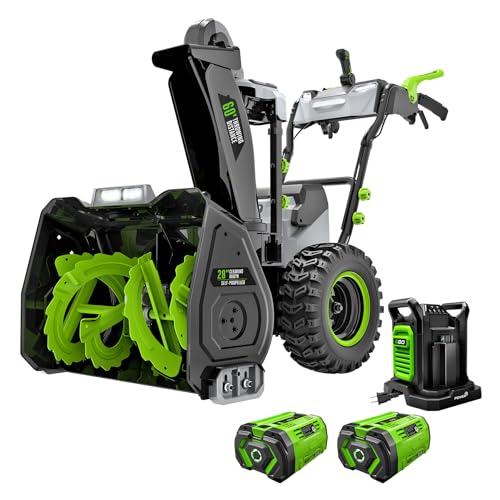 EGO Power+ SNT2807Best overall
 PowerSmart 101010648Wide gas two-stage
 PowerSmart 101010644Smaller gas two-stage
Safety first, every time
Most snow blower injuries happen when someone clears a clog with a hand. Never put your hand or a tool into the chute or auger housing while the machine is running or while it can still start. Spinning parts can keep moving for a moment after you let go of the controls.
Before any service, turn the machine off and take out the key if it has one. On a gas model, pull the spark plug wire. On a cordless model, remove the battery. On a corded model, unplug it. Wear safety glasses and gloves, and use hearing protection when you run a gas engine.
Run gas engines outdoors or with the garage door wide open. Exhaust contains carbon monoxide, which you cannot smell and which is dangerous in a closed space. Let the engine cool before you add fuel or work near the muffler.
Know what you own before you start
The right service plan depends on the power source. A gas two-stage machine has an engine, belts and a drive system that all need attention. A cordless unit swaps most of that for a battery and electronics. A corded unit has the fewest wear parts.
Our best snow blower page lists the power source for each model. For example, the PowerSmart gas models list 212cc and 252cc engines, while the EGO Power+ SNT2807 is a cordless two-stage with a 1344 Wh battery energy listing. The Westinghouse WSnow20 is a corded 1800 W unit. Each of these needs a different routine.
Your owner's manual is the final word on service intervals, oil type and part numbers. The steps below are general good practice, so check the manual for exact amounts and schedules.
Pre-season tune-up for gas models
Do this a few weeks before the first forecast storm, so you have time to order a part if something is worn out.
Work through this list in order:
- Check the oil level on a flat surface and top it up with the oil type your manual names. Change the oil if it is dark or if the season's last change is long past.
- Replace the spark plug if it looks worn or fouled, or at the interval in your manual.
- Check the air filter and replace it if it is dirty.
- Inspect the drive and auger belts for cracks, fraying or glazing.
- Look at the shear pins or bolts that protect the auger and confirm you have spares.
- Tighten loose bolts, nuts and chute hardware.
- Check tire pressure on wheeled models.
- Drain old fuel and refill with fresh fuel, or add a stabilizer if your manual allows it.
- Test the pull start or electric start. Models with electric start, such as the PowerSmart gas units, run the starter from a 120-volt outlet, so check the cord and outlet too.
Checks before and after each use
Short checks take a few minutes and prevent most breakdowns. Before you start, look at the oil level, the fuel level and the tire condition. Make sure the chute turns freely and the auger spins by hand once the machine is off and safe.
After you finish, let the machine run a minute or two to throw off packed snow, then shut it down. Scrape snow and ice off the auger, chute and skid shoes. Packed wet snow can freeze overnight and make the auger stick or tear a belt on the next start.
Check the skid shoes, which are the metal or polymer plates under the housing. They set the gap between the scraper bar and the ground, and they wear down. The BILT HARD and PowerSmart listings mention adjustable skid shoes, which help protect surfaces. Raise them a little on gravel so the machine does not pick up stones.
Service by power type
The table shows how the routine changes by type. It is general guidance, so use your manual for details.
Cordless and corded models skip the fuel and oil work. A cordless machine such as the EGO SNT2807 has a battery to look after. Keep it charged as the maker advises, and do not leave it in freezing temperatures for long periods if your manual says to store it indoors. Heated grips, electronic chute controls and similar features also depend on the battery.
| Task | Gas two-stage | Cordless | Corded |
|---|---|---|---|
| Oil and fuel | Yes | No | No |
| Spark plug and air filter | Yes | No | No |
| Belts and drive | Yes | Check drive on self-propelled models | Not on most small units |
| Auger, scraper and skid shoes | Yes | Yes | Yes |
| Battery care | No | Yes | No |
| Cord inspection | Starter cord if electric start | No | Yes, check for cuts |
Common repairs you can handle
A machine that will not throw snow often has a sheared pin or a loose belt. If the auger stops turning while the engine runs, a shear pin has probably broken. This is by design. The pin breaks to protect the gearbox when the auger hits ice or a hidden object. Replace it with the exact part listed in your manual, not a regular bolt.
A gas engine that will not start usually points to old fuel, a dirty spark plug or a clogged carburetor. Fresh fuel and a new plug solve many cases. If the engine still runs badly, a repair shop is the safer choice for carburetor or gearbox work.
A weak throw can come from a worn scraper bar, a slipping belt or a partly blocked chute. A cordless unit that loses power fast may have a tired or cold battery. Let it warm to room temperature and try again before you assume the unit is faulty.
Check your warranty before any larger repair. The listings on our page show a 5 year warranty on the EGO model, a 3 year warranty on the Husqvarna ST124 (with a separate 5 year warranty on the engine only), and a 2 year warranty on the Westinghouse WSnow20. Opening sealed parts or using the wrong parts can affect coverage.
End-of-season storage
Spring storage protects the machine for next winter. Clean off dirt and salt, dry the housing and touch up bare metal with paint or a light coat of protective spray. Lubricate the chute crank and moving linkages as your manual suggests.
For a gas model, either run the engine until the tank is empty or add a fuel stabilizer to a full tank, following your manual. Old fuel is the top cause of spring and fall starting trouble. Store the machine in a dry spot with the tank cap closed.
For a cordless model, store the battery indoors in a cool, dry place at the charge level the maker advises. For a corded model, coil the cord loosely and check it for nicks. If you are still choosing a machine, see how the weight and storage needs differ on our snow blower comparison, since a 250 lb two-stage needs more room than an 11.9 lb shovel-style tool.
Frequently asked questions
How often should I change the oil in a gas snow blower?
Many makers call for a change at the start of each season or after a set number of running hours. Your manual lists the exact interval and oil grade.
Can I leave gas in the tank over summer?
It is better not to. Old fuel can gum up the carburetor. Either run the tank dry or use a stabilizer as your manual allows.
Why does my auger stop but the engine keeps running?
A broken shear pin is the usual cause. Turn off the engine, pull the spark plug wire, and replace the pin with the exact part from your manual.
Do electric snow blowers need any maintenance?
Yes, but less. Clean the auger and chute, check the scraper and skid shoes, inspect the cord on corded units, and care for the battery on cordless ones.
When should I call a repair shop?
Call a pro for carburetor problems, gearbox noise, a bent auger shaft or any repair you are not comfortable doing safely.