How to Replace a Kitchen Faucet in Your Sink
To replace a kitchen faucet, shut off the water, disconnect the supply lines, remove the mounting hardware under the sink, lift out the old faucet, then install the new one in reverse order and test for leaks. Most jobs take a few hours at most, and the main thing to check first is that the new faucet matches your sink's holes and the space above it. The steps are nearly the same for single-handle, single-hole and 3-hole setups, with a few differences covered below.
 Moen 7594SRSBest overall
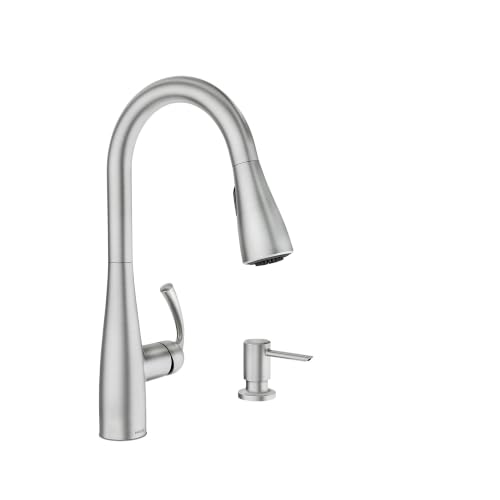 Moen 87014SRSBest for big sinks
 GIMILI GM1019NBest for RVs and small sinks
Check the fit before you buy or begin
Look at your sink deck from above and count the holes. A single-hole sink has one opening. A 3-hole sink has a spout hole in the middle with a hole on each side, usually for handles or a sprayer. Some sinks have four holes, with the extra one used for a soap dispenser or side spray.
If you are moving from a 3-hole faucet to a single-handle model, you will want a deck plate (also called an escutcheon) to cover the extra holes. Some faucets include one and some do not. For example, the Moen Arbor 7594SRS is listed for 1 or 3 holes with a deck plate included, while the GIMILI GM1019N is a 1-hole model with no deck plate included.
Also measure the clearance above the sink. A pull-down faucet needs room for the spout and for the sprayer to lift out. Overall heights in our data range from 14.4 in for the VFAUOSIT 06MBV to 18.5 in for the GIMILI GM1019N, so a low cabinet or window sill can rule out taller models. Our best kitchen faucets page lists these specs side by side.
Gather tools and prepare the space
Clear everything out from under the sink and lay down a towel or shallow tray. The work is cramped, so a headlamp or flashlight helps a lot. Put on safety glasses, because grit and old mineral deposits tend to fall toward your face when you work overhead.
Check the instructions that come with your new faucet, since mounting hardware and supply connections differ between models.
- Adjustable wrench and a basin wrench for hard-to-reach nuts
- Screwdrivers (flathead and Phillips)
- Bucket or towels for drips
- Plumber's tape, if your connections call for it
- Flashlight or headlamp
- Safety glasses and gloves
- Penetrating oil for stuck nuts
- Mild cleaner and a rag for the sink deck
Remove the old faucet
Start with the water. Turn the hot and cold shutoff valves under the sink clockwise until they stop. Then open the old faucet and let it run until the flow stops, which relieves pressure in the lines. If you have no shutoff valves, turn off the main water supply to the house instead.
If a garbage disposal or dishwasher connects near the faucet, make sure nothing is running. If any power cord is near your work area, keep it dry and unplug the appliance for the job.
Follow these steps to take the faucet out:
- Disconnect the hot and cold supply lines from the shutoff valves, with a bucket ready for leftover water.
- If the faucet has a pull-down or pull-out sprayer, unscrew the hose from its connector and any weight attached to it.
- Remove any side sprayer or soap dispenser and its lines, if you have one.
- Loosen the mounting nuts or brackets that hold the faucet to the sink. A basin wrench reaches these best.
- Lift the faucet straight up and out. Wiggle it gently if old sealant is holding it.
Install the new faucet
Clean the sink deck well. Scrape off old putty or caulk and wipe the surface dry so the new gasket or deck plate sits flat.
For a single-hole or single-handle faucet, feed the hoses down through the hole and seat the base so the spout points straight. If you are covering extra holes, set the deck plate first and center it over the openings. Then go under the sink and tighten the mounting hardware by hand, followed by a gentle turn with a wrench. Over-tightening can crack a porcelain sink or warp plastic parts.
For a 3-hole sink with a 3-hole faucet, the handles and spout usually sit on a one-piece base or on separate pieces. Line them up with the holes, make sure the deck plate (if used) is aligned, and secure each piece from below.
If you are moving from three holes to a single-hole faucet, put the faucet in the center hole and use the deck plate to hide the others. Check that the plate is wide enough to cover every hole before you start.
Connect the water and the sprayer
Attach the hot and cold supply lines to the matching shutoff valves. Mark which is which as you go, since many faucets color-code them. Hand-tighten, then give each a small turn with a wrench. Do not force them.
With a pull-down faucet, connect the sprayer hose to the quick-connect fitting under the sink and attach the counterweight to the hose at the spot the instructions show. The weight keeps the sprayer docking smoothly. Hose length matters for how far you can pull. Our data lists 68 in for the Moen Arbor 7594SRS and 67 in for the Moen Essie 87014SRS.
Before you turn on the water, remove the aerator at the tip of the spout. This lets any debris flush out instead of clogging it. Open the faucet, turn the shutoffs back on slowly, and let the water run for a minute or two. Then screw the aerator back on.
Test for leaks and fix common problems
Run a dry paper towel along every connection under the sink while the water is on. Check again after 10 to 15 minutes and again the next day. A slow drip usually means a connection needs a small extra turn.
If the faucet wobbles, the mounting nut is probably loose or the deck plate is not seated. If water flow is weak, check that the shutoff valves are fully open and that the aerator is clean. If the sprayer will not dock, adjust the weight position on the hose.
| Faucet | Mounting holes | Deck plate included | Overall height (in) |
|---|---|---|---|
| Moen Arbor 7594SRS | 1 or 3 hole | Yes | 15.5 |
| Moen Essie 87014SRS | 1, 2, 3 or 4 hole (per listing) | Yes | 15.75 |
| GIMILI GM1019N | 1 hole | No | 18.5 |
| VFAUOSIT 06MBV | 1 hole | No | 14.4 |
| OWOFAN 9009SN-A | 1 or 3 hole | Yes | 16 |
Choosing a replacement that makes the job easier
The easiest swap is a faucet that matches your existing holes and includes what you need to cover any gaps. A model with a deck plate included, such as the OWOFAN 9009SN-A, avoids a separate purchase if you are changing hole layouts.
Also think about daily use. Longer hoses reach more of the sink, and extra spray modes help with rinsing versus filling pots. For drinking water, look for lead-free construction and NSF certification, which our data lists for several of these models. You can compare all of these details on our kitchen faucet comparison before you pick one.
Frequently asked questions
Do I need a plumber to replace a kitchen faucet?
Not usually. If your shutoff valves work and the old faucet comes out without damage, many homeowners handle it themselves. Call a plumber if the valves are seized, the pipes are corroded or you see leaks you cannot stop.
What if my shutoff valves will not close?
Turn off the main water supply to the house and replace the faulty valves before you install the new faucet. Old valves that do not seal fully can cause leaks later.
Can I put a single-handle faucet on a sink with three holes?
Yes, if the faucet works with a deck plate that covers the extra holes. Check the product details to see whether a plate is included and whether it fits the spacing of your sink.
Why is my new faucet's water pressure low?
Check that the shutoff valves are fully open, the supply lines are not kinked and the aerator is clean. Debris from the install often collects there, and flushing it out usually fixes the flow.