How to Remove Drawer Slides: Release, Detach and Replace
To remove drawer slides, empty the drawer, pull it fully open, and find the release on each side. That is usually a small lever or a plastic tab, and you push one up and the other down, then lift the drawer free. Once the drawer is out, unscrew the slide parts from the drawer and the cabinet.
 HBL' DLSBest overall
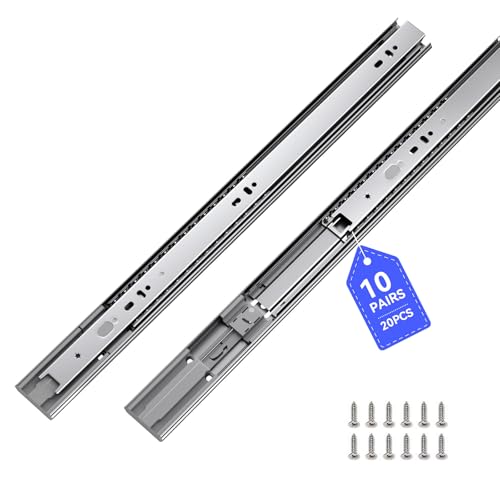 LONTAN SL4502S3-22-10PairsBig soft close pack
 VAGUDE 4512Short soft close pair
Identify your slide type first
Slides come off in different ways, so look before you pull. Open the drawer all the way and check the sides and the underside. A quick look tells you which of the methods below applies and saves you from forcing a part that is meant to unclip.
Most modern slides are metal with ball bearings and three sections. The outer section stays on the cabinet, the middle one slides, and the inner one stays with the drawer. Older dressers often use wood runners or a single center track instead.
| Slide type | Where it sits | How the drawer usually comes off |
|---|---|---|
| Side mount, lever release | On both sides of the drawer | Push one lever up and the other down, then pull the drawer out |
| Side mount, plastic buckle | On both sides of the drawer | Press the tab at the back of the inner track and pull the drawer free |
| Undermount | Under the drawer box | Squeeze or lift the locking device at the front corners, then lift the drawer |
| Wood runner or center track | Under the drawer or along the sides | Lift the front slightly and pull straight out past the stop |
Gather tools and prepare the drawer
You need very little. A screwdriver that fits your screws, a small flat tool for stubborn tabs, and a towel to set the drawer on will cover most jobs. A cordless drill with a screwdriver bit speeds things up if there are many screws.
Empty the drawer completely. Even a lightly loaded drawer can tip or drop when it comes loose, and the weight is harder to control than it looks.
- Screwdriver or drill with a driver bit
- A flat tool such as a putty knife for stuck tabs
- A towel or blanket to protect the drawer and the floor
- A pencil and tape to mark where parts go
- A phone camera to record how everything sits before you start
Step by step: release and remove a side mount drawer
This is the common case, and the steps are the same for lever and buckle designs. Work slowly, and keep the drawer level as it comes out. Many slides have a stop that holds the drawer in, and that stop is what you are releasing.
- Pull the drawer out until it stops.
- Look at the inner section of each slide near the front or the back for a lever or a plastic buckle.
- Push the lever on one side up and the lever on the other side down. For a buckle design, press the tab on each side.
- While holding both releases, pull the drawer straight out toward you.
- Set the drawer on a towel and look at what stayed in the cabinet.
Take the slides off the drawer and cabinet
With the drawer out, the inner section of each slide is still attached to the drawer, and the outer section is still in the cabinet. Before you unscrew anything, take a photo and mark which side each part came from. Left and right parts are often not interchangeable.
Start with the cabinet side. Retract the middle section into the outer one if it is sticking out, then remove the screws through the holes in the rail. Hold the slide as the last screw comes out so it does not fall inside the cabinet. Repeat on the other side.
Next, turn the drawer over and remove the screws that hold the inner sections to the drawer sides or bottom. If a screw spins without backing out, press the screwdriver in harder, or try a slightly larger bit. If the wood around a hole is stripped, a wood filler or a matchstick dipped in glue can restore the grip before you reinstall anything.
Undermount and old wood slides
Undermount slides hide below the drawer and attach with small locking devices at the front corners. Look under the front edge of the drawer for a lever or clip on each side. Release both, lift the back of the drawer slightly, and the drawer comes off the rails. A listing for an undermount kit on our best drawer slides page, for example, mentions locking devices and rear brackets, which is a good clue about where the release points are.
Old dressers with wood runners have no levers. Pull the drawer out until it stops, then lift the front slightly so the back clears the stop block and slide it out. If a rail is held by nails or glue, tap gently to loosen it rather than prying hard, since old wood splits easily.
Replacing slides and adding them to an old dresser
Yes, you can replace slides on old cabinets, and you can add slides to an old dresser that never had them. The main limit is space. Side mount slides need about 0.5 in of clearance on each side of the drawer, so measure the gap between the drawer and the cabinet wall before you buy anything. If the gap is tight, you may need to trim the drawer or choose a slide style that fits the space.
Measure the drawer depth too. The slide should match the drawer length or run a little shorter, and it cannot be longer than the cabinet. Then think about what the drawer will hold. On our comparison page, 100 lb ratings are fine for clothes and linens, while pots, tools and files call for the high end. You can compare lengths, load ratings, soft close and mount types for several products on our best drawer slides page.
On an old dresser, you may also need to add a small wood spacer or strip so the slide has a flat, solid surface to screw into. Keep the front of the slide set back slightly so the drawer face still closes flush.
Safety notes
Drawers are heavier than they look, and a falling drawer can hurt your feet or hands. Empty the drawer, stand to one side, and keep your fingers away from the slide edges, which can be sharp. Wear safety glasses when you pry at stuck parts or drive screws overhead, since metal and old finish can fly.
If you use a drill, keep the cord and your hands clear of the bit, and wear a dust mask when sanding or cutting old painted wood, because old finishes may contain lead. Never stand on a chair to reach a high cabinet. Use a stable step stool instead.
Frequently asked questions
What if the release lever will not move?
Check that the drawer is fully open, since many levers only work at full extension. Clean away dust, and press the lever while you wiggle the drawer slightly. Do not force it with a hammer.
Do I need to replace both slides if one is bad?
Replace them as a pair. Mixed old and new slides can sit at different heights and make the drawer bind or hang crooked.
Can I reuse the old screws?
You can if the heads are not stripped and the length fits the new slide. If the holes in old wood are worn, use the screws that come with the new slides and fill the old holes first.
How do I put the drawer back in?
Pull the middle sections of the cabinet slides out to the front, line up the drawer sections with them, and push the drawer in until the releases click. Then test it a few times before you load it.