How to Remove an Oil Filter Without a Wrench
Yes, you can often remove a spin-on oil filter without a dedicated wrench. A dry grip with a rubber glove or rag, a rubber pad, a belt or strap loop, or ordinary slip-joint pliers will loosen most filters. A cartridge-style filter cap is different, because it needs an exact-fit socket and household tools will damage it.
 Felisbieti TZ-1Best for cartridge filters
 WORKPRO W114083ABest adjustable pliers
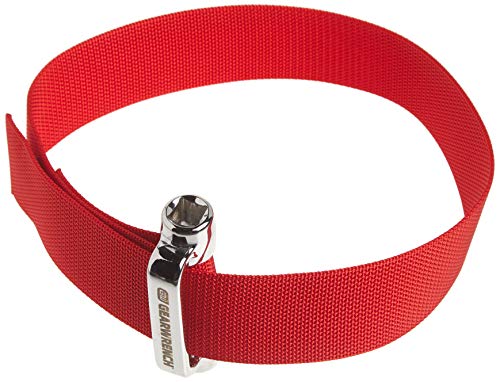 GEARWRENCH 3529DBest for trucks and tractors
Start with the filter type
Before you grab a substitute tool, look at what is on your engine. A spin-on filter is a metal canister that screws onto the engine. A cartridge filter is a paper element inside a housing, and you remove a plastic or metal cap to reach it.
Nearly every workaround in this guide is for spin-on canisters. Cartridge caps have flutes, tabs or a hex shape, and they crack or round off when you force them with pliers or straps. If you have a cartridge housing, check your owner's manual for the cap size. Our best oil filter wrench page lists a 27mm low-profile socket and a Toyota-specific cap wrench for that style.
Safety first
Oil filters sit low on the engine, so you will be working under the car. Use jack stands on level ground, never a jack alone. Let the engine cool until the exhaust and oil are warm at most, not hot. Hot oil burns, and it runs down your arm when you reach up to the filter.
Wear safety glasses, because oil and grit can drip or spray toward your face. Nitrile gloves help with grip and keep used oil off your skin. Have a drain pan under the filter, and keep rags nearby for spills.
Six ways to loosen a filter without a wrench
Try these in order, starting with the gentlest. Each one relies on the same idea: more friction or more leverage on the canister.
- Gloved hand and rag: Wipe the filter clean and dry. A dry rubber glove or a dry rag gives more grip than bare, oily fingers. Turn counterclockwise with steady pressure.
- Rubber pad: A rubber jar opener, a piece of shelf liner or a bicycle inner tube wrapped around the canister adds grip without marking the shell.
- Sandpaper: Wrap a sheet of coarse sandpaper, grit side against the filter, and twist. This works well on smooth, painted canisters.
- Belt or strap loop: Loop an old belt or a strong strap around the canister, pull it snug and turn with the free end. Keep the loop low, near the base, where the shell is strongest.
- Slip-joint or locking pliers: Grip the canister near the base and turn. This bites hard, but the jaws will dent the shell and may crush it, so only use this when you are replacing the filter anyway.
- Screwdriver through the canister: This is a last resort. Drive a long screwdriver through the shell and use it as a lever. It is messy, oil will pour out, and a slip can hurt your hand. Skip it unless nothing else works.
Which method fits which situation
The right choice depends on how stuck the filter is and how much room you have around it. Start at the top of this table and work down.
| Method | Best for | Main risk |
|---|---|---|
| Gloved hand and rag | Filters tightened by hand | Slips if oily |
| Rubber pad | Light resistance, easy access | Not enough torque on stuck filters |
| Sandpaper | Smooth canisters | Grit left near the engine |
| Belt or strap loop | Medium resistance, open space | Slips if wet with oil |
| Pliers | Stuck filters you are discarding | Crushed shell, oil leaks |
| Screwdriver | Last resort only | Oil spray, hand injury |
Tips that make stuck filters easier
Grip matters more than force. Wipe the canister with a rag, then dry it, because even a thin film of oil defeats most improvised grips. A little brake cleaner on a rag can cut through grime, but keep it away from the engine's hot parts and wear gloves.
Turn slowly and steadily. A sudden jerk makes the grip slip and your knuckles hit the frame or exhaust. If the filter will not budge, stop and check whether you are turning the right way. Counterclockwise as you look at the end of the filter loosens it.
Once the seal breaks, the filter usually spins off by hand. Tilt it so oil drains toward the pan, then lower it carefully. The old gasket sometimes stays stuck to the engine. Check that it came off with the filter, because a doubled gasket causes leaks.
Putting the new filter on
Wipe the mounting surface clean. Rub a thin film of fresh oil on the new filter's rubber gasket, then thread it on by hand. Tighten by hand only, following the instructions printed on the filter or its box. Overtightening is the most common reason filters become hard to remove next time.
Add oil, run the engine for a minute, and check for drips at the filter. If you see any, shut the engine off and re-check the seal.
When a real wrench is the better choice
Household substitutes work for an occasional filter, but they struggle on a filter that has baked on or sits in a cramped spot. If you change your own oil regularly, a purpose-made tool is easier on your hands and on the filter. Our oil filter wrench comparison puts the options on one spec sheet.
Here is how the common styles differ, based on the published specs:
- Adjustable pliers, such as the WORKPRO 12 in model, fit filters from 2-3/8 to 4-1/2 in and have a bent head for tight spaces.
- A strap wrench like the GEARWRENCH 3529D handles filters up to 9 in and uses a 3/8 or 1/2 in drive ratchet for leverage, which suits trucks and tractors.
- A rubber strap set, such as the ValueMax pair, covers up to 4 in and 6 in filters and is meant not to scratch the surface. Its listing says not to exceed the rated torque and to keep the straps free of oil.
- A cap socket, such as the 27mm Felisbieti low-profile socket, fits cartridge caps of that size on a 1/2 in drive.
Frequently asked questions
Can I use a rubber band to loosen an oil filter?
A thick rubber band rarely gives enough grip or strength. A wide rubber pad or a strap loop works better because it spreads the force across more of the canister.
Is it safe to use the screwdriver method?
It carries real risk. Oil will spill, the filter is ruined, and a slipping screwdriver can injure you. Try gloves, a rubber pad, a strap or pliers first.
Why is my oil filter so hard to turn?
Usually it was overtightened, or the gasket has hardened over many miles. Tightening the new one by hand only helps prevent a repeat.
Should I replace the filter if I dented it removing the old one?
The old filter is going in the trash anyway, so dents on it do not matter. Just avoid damaging the engine's mounting surface or threaded stud.