How to Remove a Stuck Spark Plug Socket
Most stuck spark plug sockets are held by the rubber insert or magnet gripping the plug, not by anything locked in place. Rock the socket gently, add a little straight-line pull, and use a magnet or long-nose pliers to lift it out. If the plug is still in the threads, unscrew it with the socket attached, then separate the two on the bench.
 DURATECH DT401280Best overall
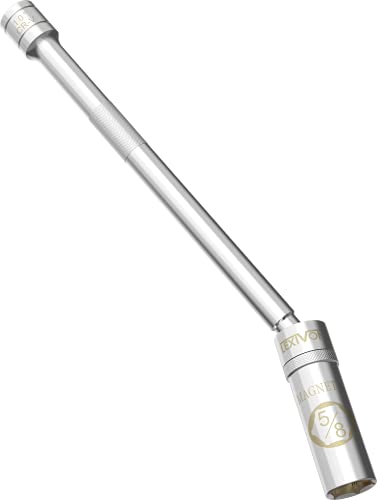 LEXIVON LX-122Lifetime warranty listed
 QWORK CA8329Two sizes in one pack
First, work out what is stuck
"Stuck" can mean a few different things, and the fix depends on which one you have. Before you pull harder, look down the well with a flashlight and decide which situation matches.
Engine off and fully cool first. Wear safety glasses, because a slipping tool or a puff of compressed air can throw grit toward your face.
| Situation | What is usually happening | Best first move |
|---|---|---|
| Socket stuck on a plug that is already out of the threads | Rubber insert or magnet is gripping the ceramic | Twist and rock gently, then tap the plug out from the open end |
| Socket stuck on a plug that is still threaded in | Over-tightened plug or a bound swivel joint | Unscrew the plug with the socket attached |
| Socket is down the well and the ratchet came off | Extension or swivel separated from the socket | Retrieve with a magnet or long-nose pliers |
| Socket will not come up past a narrow section | Socket is cocked at an angle, or debris is wedged beside it | Straighten it, blow out debris, and lift straight up |
Safety checks before you start
Spark plug wells sit close to ignition parts, and a few quick precautions prevent most problems.
Keep the work area free of open flame, and do not use a torch or heat gun near the engine. Fuel vapor and oily residue can ignite. Pulling the battery's negative terminal is a sensible step if you will be working near the ignition coils or wiring, and your owner's manual may recommend it.
Also keep anything small out of the cylinder. If the plug is already out, the open threaded hole leads straight into the combustion chamber, so do not let tools, debris or loose parts fall in.
Step-by-step: freeing a socket that is stuck on the plug
Start gentle. Force is how ceramic insulators crack and how sockets get bent.
- Remove the ratchet and extension if they are in the way, so you can see and reach the top of the socket.
- Check that the socket sits straight in the well. A socket that has tilted can wedge against the tube wall.
- Grip the socket body, or the extension if it is still attached, and twist it back and forth while pulling straight up with light pressure.
- If the plug is out of the threads and the socket will not release, keep the assembly upright and tap the plug's terminal end through the open top of the socket with a wooden dowel or the rubber end of a tool. This pushes the plug out of the rubber insert.
- If it still holds, wiggle the socket in small circles to break the grip of the rubber, then try again.
- Once the socket is free, look inside it for a loose insert or magnet piece, and check the plug's ceramic for cracks before you reuse anything.
What to do if the plug is still threaded in
If the socket is stuck on a plug that has not come out, the simplest route is often to finish the job. Put the ratchet back on, keep it in line with the plug, and unscrew the plug with the socket still attached. Then lift the whole assembly straight up and out of the well.
Do not use a pry bar on the socket, and do not hammer on it while it sits in the head. If the plug refuses to turn, stop and check that you are using the right socket size. The 5/8 in and 16mm sizes are close, and a mismatch can round the hex or damage the plug seat.
If the plug is seized, a penetrating oil designed for engines can help once it is safe to apply, but keep it out of the cylinder. When in doubt, a shop can remove a seized plug with the right equipment.
Retrieving a socket that dropped or separated down the well
When a socket stays behind after the extension or ratchet comes off, the goal is to lift it out without letting anything fall further.
A telescoping magnet pickup is the easiest tool, since sockets are steel. A flexible grabber or long-nose pliers also work. If the socket sits at an angle, nudge it upright first so it can clear the tube.
Blow out any loose dirt around it with a short burst of compressed air before you lift, so debris does not fall into the cylinder when the plug is out. Use eye protection for this step.
If you cannot reach it, a mechanic's inspection light and a little patience beat forcing a bent tool into a tight well. Avoid pushing the socket deeper in the hope of freeing it from below, since that can drop it into a place you cannot easily reach.
Why sockets get stuck, and how to prevent it
A few design details affect how likely a socket is to hold on. Rubber inserts and magnets are useful for holding a plug steady, but they are also the parts that grip the ceramic. Swivel joints help on angled plugs, though they can bind if the ratchet is pulled off-axis.
Our best spark plug socket page compares these features side by side. For example, the DURATECH 14mm socket is 12 in long with a rubber insert, a magnetic core and a swivel joint, while the GEARWRENCH 5/8 in socket is 6 in long with a rubber insert and a magnetic insert. The ecocstm set lists a 10mm deep magnetic ring and warns you to verify the plug size before use so the ring is not damaged by force.
If you are choosing a new socket for a deep or angled well, our spark plug socket comparison lays out length, swivel, magnetic retention and wall design in one place, so you can match the tool to your engine.
- Confirm your plug size in the owner's manual before you buy or use a socket.
- Seat the socket fully before turning, and keep the ratchet aligned with the plug.
- Pull straight up rather than levering sideways.
- Clean debris from the well before removal.
- Check the rubber insert and magnet for wear, and replace a worn socket.
Frequently asked questions
Can I use pliers on the socket itself?
Long-nose pliers are fine for lifting a socket that sits loose in the well. Avoid crushing or prying the body, since a damaged socket can crack the plug or slip when you next use it.
Will a magnet always pick the socket up?
Mostly, because spark plug sockets are steel. A telescoping magnet can fail if the socket is wedged or sitting at an angle, so straighten it first, then lift.
Should I stop if the socket will not budge?
Yes. If gentle rocking and straight pulling do nothing, stop before you bend the tool or crack the plug. A shop has the right pullers and inspection tools for a seized setup.
Does a rubber insert make a socket more likely to stick?
It can grip the ceramic more firmly, which is the point of it. That grip is helpful for holding the plug, but it is also why a tap on the plug's terminal end sometimes releases the socket.