How to Properly Use a Knee Kicker on Carpet
Hook the carpet onto the tack strip along one wall, set the kicker head a few inches from that wall, and tap the padded end with the fleshy part of your knee just above the kneecap. Work in short, controlled kicks along the edge to seat the carpet on the strip. A knee kicker positions carpet over short distances, so use it for corners, edges and wrinkles, and use a power stretcher for a whole room.
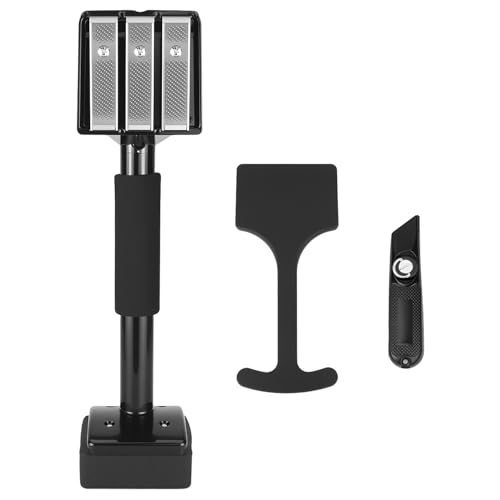 QWORK DG16521Best overall
 NATGAI NTJ-0915-01Simplest fixed-length kicker
 ROBERTS 10-410Adjustable basic option
What a knee kicker does and does not do
A knee kicker has a toothed head on one end and a padded bumper on the other. The teeth grip the carpet backing. When your knee hits the pad, the head pushes the carpet forward a short distance so it catches on the tack strip.
That short push is the limit of the tool. Some listings for kickers, such as the QWORK DG16521 and the FLKQC compact model, say plainly that the tool is for positioning, corners and wrinkle removal, not full-room stretching. If your room is large, our best knee kicker page explains why a power stretcher is the usual choice and a kicker is the finishing tool.
Get ready before you kick
Most problems come from skipping setup. Take a few minutes to check the room and the tool first.
- Confirm the tack strips are nailed down along every wall, with the pins angled toward the wall and a gap of about a quarter inch between strip and baseboard.
- Check your carpet against the tool's pile rating. Several light-duty kickers list low to medium pile, and the FLKQC lists low pile only. Thick or high-pile carpet needs a heavier tool.
- Wear knee pads or at least thick pants, plus work gloves. Tack strips have sharp pins that go through skin easily.
- Wear closed shoes with a good grip, and keep the floor clear of tools and offcuts.
- If your kicker has a depth dial, set the teeth so they grip the backing without piercing the floor or the padding underneath.
Step-by-step: using the kicker
The steps below cover a typical room. Work in one direction so you do not push wrinkles from one side to the other.
- Lay the carpet roughly in place, with extra overlapping every wall. Anchor one edge by pressing it firmly onto the tack strip along a starting wall.
- Move to the opposite or adjacent wall. Place the kicker head on the carpet about 2 to 3 inches from the wall, angled slightly in the direction you want the carpet to move.
- Check that the teeth are biting into the carpet backing. Keep your shin and foot behind the tool, never in front of the head.
- Strike the padded bumper with the fleshy part of your knee, just above the kneecap. Use a firm, controlled tap, not a wild swing.
- Hold the carpet in place with the tool or your hand. Press it onto the tack strip pins to lock it.
- Move a foot or so along the wall and repeat. Short, even steps give a smoother result than a few hard strikes.
- Trim the excess with a proper carpet trimmer, then tuck the edge into the gap between strip and wall with a tucking tool.
Choosing the right kicker for the job
Fixed-length kickers are simple and have nothing to set wrong. Adjustable models let you change the reach, which helps in tight spots. Here is how a few models on our comparison page line up, using their published specifications.
Weight is listed for only some models, so check the product page before you assume. For more detail on padding, pile ratings and kit contents, see the full knee kicker comparison.
| Model | Length | Adjustable | Listed weight | Pile rating |
|---|---|---|---|---|
| NATGAI NTJ-0915-01 | 16.625 in | No | Not listed | Low to medium |
| FLKQC G20251125931 | 16.625 in | No | Not listed | Low only |
| Roberts 10-412-2 | 17 to 21 in | Yes | 4.3 lb | Not listed |
| Roberts 10-422BK | 17.5 to 21.5 in | Yes | 4.92 lb | Not listed |
Common mistakes to avoid
Kicking too far from the wall is the most common error. The carpet then bunches up in the middle instead of reaching the strip. Staying within a few inches of the wall gives you control.
Another mistake is trying to stretch an entire room with the kicker alone. You end up with slack in the center that shows up as ripples later. Use the kicker to seat edges and corners, and bring in a power stretcher for the main pull.
Finally, do not ignore padding. Your knee takes every strike, so a padded bumper matters on long jobs. Some listings name a foam-filled bumper pad, and the Roberts 10-422BK lists a bumper pad described as 50% thicker. Others say nothing about padding, so wear knee protection regardless.
Safety notes
Tack strips are the main hazard. Their pins are sharp and angled, and they can catch your hand or leg when you reach over them. Keep gloves on and watch where you put your hands.
A kicker strike should land on soft tissue above the kneecap. Hitting the kneecap itself, or striking with your shin out in front of the head, can injure you. If a strike feels harsh, stop and adjust your position or the bumper.
Keep blades and knives away from the work area while kicking. Cut the carpet to size only when it is laid flat, and store trimmers with the guard on. Take breaks during long sessions, since repeated knee strikes add up.
Frequently asked questions
Can I use a knee kicker on thick carpet?
Check the listing first. Many light-duty kickers are rated for low to medium pile only. Thick or high-pile carpet generally needs a heavier tool or a power stretcher.
Where do I place the kicker on the carpet?
About 2 to 3 inches from the wall or tack strip, angled slightly toward the direction you want the carpet to move.
Does the kicker hurt my knee?
It can if you strike badly or skip the padding. Hit with the fleshy part above the kneecap, use a padded bumper, and wear knee protection.
Do I still need a power stretcher?
For a full room, yes, in most cases. A kicker handles small areas, corners and wrinkles. A power stretcher does the main pull across a room.