How to Plug in a Garage Door Opener Safely
Plug the opener's three-prong cord straight into a grounded outlet, ideally one mounted on the garage ceiling near the unit. Skip extension cords and power strips for the opener itself, because the motor draws a surge of current at start-up and most opener makers say to plug directly into the wall. A strip is better saved for tools and chargers elsewhere in the garage.
 GE 54638Best overall
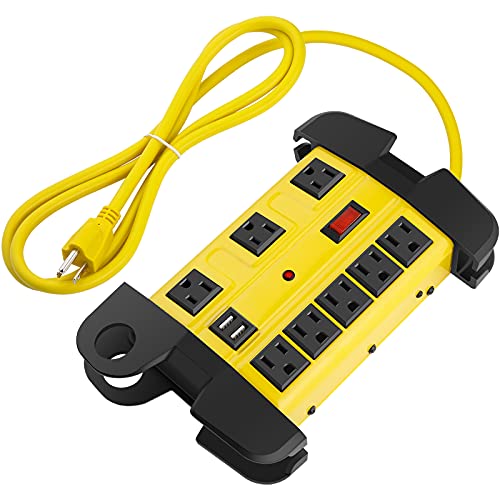 CCCEI CC-02-8U-03Metal strip with 2700 J
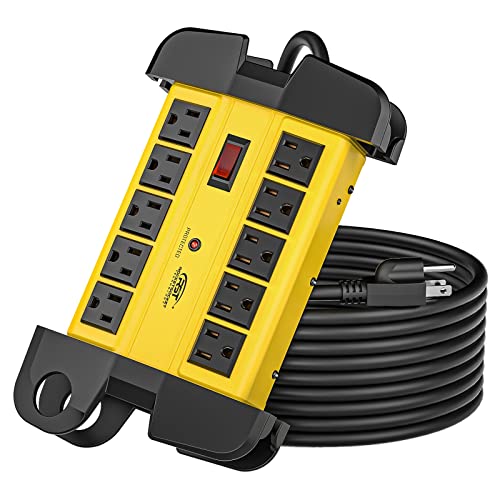 CRST LTS-10TSTied for longest cord
The short version of safe opener power
A garage door opener is a motor on a three-prong plug. It needs a grounded outlet, a steady supply and a cord that is not stretched, pinched or tangled in the rails. Most openers ship with a cord of about a few feet, which is meant to reach an outlet mounted on the ceiling right next to the unit.
Before you plug anything in, read the manual that came with your opener. It is the final word on cord length, voltage and any wiring the model needs. The tips below cover the general approach, not a replacement for those instructions.
Check the outlet before you plug in
Look at the outlet first. It should be a grounded three-slot receptacle, firmly mounted, with no cracks, scorch marks or loose faces. If the plug wiggles or feels hot after the opener runs, stop using that outlet and have an electrician look at it.
Garage outlets are usually protected by a GFCI, the type with test and reset buttons. That is a good thing for a damp space. A GFCI can trip when the opener starts, though, which leaves the door dead until you reset it. If yours trips often, ask an electrician about the circuit rather than bypassing the protection.
- Confirm the outlet is grounded (three slots) and mounted tightly.
- Check that the cover plate is intact and the outlet is dry.
- Look for other heavy loads on the same circuit, such as a freezer or a welder.
- Make sure the cord can reach without pulling tight or hanging across the door path.
Safe steps to plug in the opener
Work from a stable stepladder, since the outlet is usually overhead. Never stand on the opener, the rail or a shelf. Keep the ladder clear of the moving door, and ask a helper to hold it if the floor is slick.
- Disconnect the door from the trolley by pulling the red release cord, so the door will not move while you work.
- Switch off power at the wall switch or breaker if you are touching the outlet or wiring.
- Set up your ladder, then confirm the cord is not twisted or caught on the rail or chain.
- Push the plug fully into the outlet. Hold the plug, not the cord, when you insert or remove it.
- Restore power and check that the opener lights come on and the control panel responds.
- Reconnect the door to the trolley only when the door is fully closed or fully open, following the manual.
Can you use a power strip for a garage door opener?
Most opener manufacturers advise against it, and it is not a good habit even when it seems to work. A strip adds another connection point that can loosen, and its rating is shared across every outlet. Our best power strip for garage page notes that the ranked strips are all rated for 1875 W, and adding outlets does not raise that limit.
If you must connect through something, a surge protector is the better choice than a basic strip, but it should still be a fixed, short link and not a daisy chain. Never plug one strip into another. The motor can also trip a strip's resettable breaker at start-up, which would leave you stuck with a closed door.
A better plan is to have an electrician add a ceiling outlet if the opener's cord does not reach one. That keeps the opener on its own short, direct connection.
What to use instead, by situation
Match the setup to what you are trying to do. The table below sums up the common choices.
One more point on the bulbs: the lights in the opener share the same power, but they are separate from the motor. If you are swapping them, our best light bulb for garage door opener page covers options. Check your manual for the maximum bulb wattage, since the vibration and heat in the housing are hard on some bulb types.
| Situation | Best option | Why |
|---|---|---|
| Outlet is next to the opener | Plug directly into the wall outlet | Shortest path, fewest failure points |
| Outlet is out of reach | Have an electrician add a ceiling outlet | Keeps the cord short and untangled |
| Need power for tools or chargers | Use a garage-rated power strip on a different outlet | Keeps the opener off a shared load |
| Want surge protection for the opener | Ask the maker or an electrician about a suitable option | Avoids overloading or tripping a strip |
| Cord is frayed or damaged | Replace the cord or unit before use | Damaged insulation is a shock and fire risk |
Safety notes that matter in a garage
Electricity and a heavy moving door are a risky mix, so slow down. Turn off power at the breaker before touching any wiring, and never work on a wet floor. If a cord looks cracked or the plug is discolored, do not use it.
Springs and cables on the door are under high tension and can cause serious injury. Leave spring and cable work to a trained garage door technician. Wear safety glasses when you work overhead, since dust and small parts fall into your eyes, and use gloves if you handle metal rails.
Keep the cord away from the door's path, hot surfaces and stored items. Do not run it under a rug, through a door or across a walkway where it can be stepped on.
When to call an electrician
Call a licensed electrician if the outlet is missing, if you would need to run a new line, or if the breaker trips when the opener starts. The same goes for outlets that feel warm, buzz or smell of burning plastic. These signs point to a wiring or load problem that a new cord or strip will not fix.
Frequently asked questions
Can I use an extension cord for a short time?
It is best not to. A long or thin cord can overheat under the motor's start-up load, and it is easy to trip over. Move the outlet or add one rather than stretching a cord.
Why does my opener stop when the garage freezer is running?
They may share a circuit, and the combined load can trip the breaker or GFCI. An electrician can check the circuit and suggest a fix.
Should the opener stay plugged in all the time?
Yes, in normal use. Unplug it only when you work on it, for a long absence or when your manual says to.
Is a surge protector worth using with an opener?
It can help guard the control board against spikes, but only if the maker allows it. Check your manual first and avoid sharing it with other heavy loads.