How to Plane a Door Edge Without Ruining It
Remove the door, mark the exact amount to trim, and take light passes with a sharp hand plane or an electric hand planer, working from the corners toward the middle. Stop at your line and seal the bare edge afterward. A benchtop thickness planer is the wrong tool for this job, because a full-size door is far too big to feed through one.
 WEN PL1337Best overall
 CRAFTSMAN CMEW320Longest warranty listed
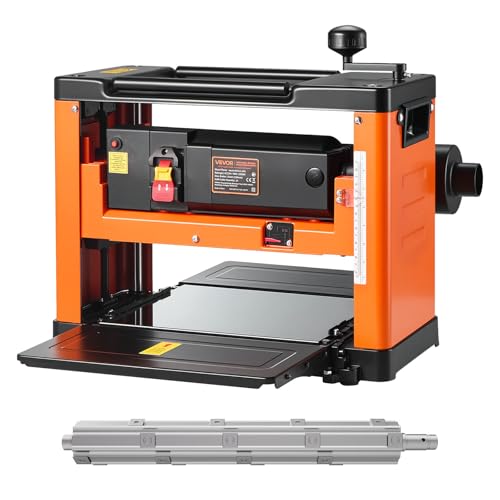 VEVOR M1B-LS-3301Fastest cutterhead speed
Pick the right tool for a door edge
Most door trimming is done with one of three tools: a hand plane, an electric hand planer, or a circular saw with a guide for larger cuts. A hand plane gives the most control for shaving 1/16 in or less. An electric hand planer removes wood faster, which helps when a door needs a longer trim, but it also makes mistakes faster.
It is tempting to think a bench machine could do the work. It cannot, for a simple reason of size. The benchtop models on our best wood planer page list a maximum thickness of about 6 in and a maximum width of 12.25 in to 13 in. A door stood on edge presents its whole width, often 30 in or more, as the stock height, which is well beyond that limit. Those machines are meant for boards, not finished doors.
Find out why the door sticks first
Before you remove any wood, check where the door actually rubs. Planing the wrong edge is the most common way to ruin a door, because wood cannot be put back once it is gone.
Look for shiny spots, scuffed paint or a line of rubbed finish along the edge. Slip a sheet of paper around the gap to find tight spots. Also check the hinges. A loose hinge screw can drop the door by a fraction of an inch and mimic a swollen edge.
- Tighten every hinge screw and see if the rubbing goes away.
- If a screw hole is stripped, glue in a wooden toothpick or dowel and re-drive the screw.
- Check whether the rub is on the latch side, the top, or the bottom.
- Note whether the problem comes and goes with the seasons, which points to moisture swelling.
Gather your gear and set up safely
A door is heavy and awkward, so set up before you lift it. You need two solid sawhorses or a workbench, clamps, a pencil, a tape measure, a straightedge and a sharp plane. Cover the supports with a blanket or cardboard so the door face does not get scratched.
Wear safety glasses for any planing, and add hearing protection and a dust mask if you use a powered tool. If the door is from an older home and has many layers of paint, do not sand or plane it until you know the paint is lead free. Lead dust is a real hazard, and a test kit from a hardware store is a sensible first step.
Get help lifting the door off its hinges. Pushing the hinge pins out from the bottom with a nail and hammer works on most doors. Rest the door on its side with a helper holding it so it does not fall.
Mark the cut and plane step by step
Work slowly. The goal is to remove only what is needed, plus a hair for the finish you will add later.
Follow these steps:
- Measure the gap you need, then mark the trim line on both faces of the door with a pencil and straightedge.
- Clamp the door upright, edge up, between two sawhorses or in a bench vise. A piece of scrap wood under the clamp jaws protects the faces.
- Set a hand plane for a very fine cut so it makes thin, curled shavings. For an electric planer, set the depth to a small fraction of the total.
- Plane from each corner toward the middle. This prevents the wood at the ends from splintering off.
- Keep the plane flat and move at a steady speed. Do not let the front dip at the start or the back drop at the end.
- Check your progress against the pencil line after every few passes.
- Stop at the line, then test-fit the door before removing any more.
Avoid the common mistakes
The mistakes below account for most ruined door edges. Each one is easy to prevent with a little patience.
Planing against the grain tears out chunks of wood. Look at the edge grain and plane in the direction that lets the blade lift fibers rather than dig into them. If a spot starts to tear, flip your direction or reduce the depth.
Taking off too much on one side leaves a tilted edge. A door that is planed at a slight bevel toward the latch side lets the latch edge clear the jamb when it closes, but the bevel should be tiny. Do not make it larger than a few degrees.
Never plane the bottom more than you must. On a hollow-core door, the frame is thin, and cutting too deep can expose the hollow interior. Solid wood and solid-core doors are more forgiving.
Compare the tools at a glance
The table below summarizes how the common options compare for trimming a door. It reflects general tool behavior, not product ratings.
If you later plan woodworking projects that need flat, even boards, a benchtop machine becomes useful. The cutterhead and snipe details on our wood planer comparison can help you choose one. For this one door, though, a hand tool is enough.
| Tool | Best for | Control | Main risk |
|---|---|---|---|
| Hand plane | Small trims and final fitting | High | Slow on larger cuts |
| Electric hand planer | Moderate trims on solid doors | Medium | Removes wood very quickly |
| Circular saw with guide | Large cuts, such as a long trim | Medium | Rough edge needs cleanup |
| Benchtop thickness planer | Boards, not doors | Not applicable | Door exceeds its size limits |
Finish and rehang the door
Once the edge fits, ease the sharp corner lightly with fine sandpaper. Brush off the dust, then seal the bare wood with primer, paint or varnish. Bare wood absorbs moisture, and an unsealed edge is the usual reason a door swells and sticks again.
Rehang the door and check the gap. A gap about the thickness of a nickel is a common target along the sides and top. Close the door several times to confirm the latch lines up.
Frequently asked questions
Can I plane a door without taking it off the hinges?
You can, but it is not recommended. The door moves, the hinge side is hard to reach, and the plane can catch the hardware. Removing the door gives better control and a cleaner result.
How much should I take off at once?
Take very thin shavings and test the fit often. It is easy to remove more, and impossible to add it back.
Do I need to plane both edges?
Usually not. Trim only the edge that rubs. Taking wood off both sides can leave uneven gaps around the frame.
What if the door has a veneer or thin skin?
Be careful. A thin face layer can chip or peel when a plane catches it. Use a sharp tool, score the line with a utility knife first, and plane lightly.