How to Mix Paint for a Spray Gun on Cars
Yes, most automotive paint gets thinned, but not by guesswork. Mix it by volume using the ratio on the paint's technical data sheet, usually paint plus reducer for basecoat, and clear or primer plus hardener and sometimes reducer. Measure in a graduated cup, stir well, strain it, and test the spray pattern before you touch the car.
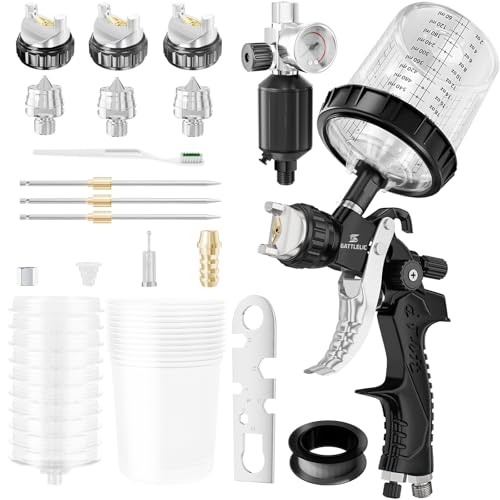 GATTLELIC GATT-HVLPBest overall
 BENTOHKLE A610Best for small compressors
 Fulchron FUL-2008-SCARLETMost nozzle sizes
Start with the technical data sheet
Every automotive paint system has a technical data sheet (TDS), and it is the only mixing guide you should fully trust. It lists the mix ratio, which reducer and hardener to use, the working time after mixing, the recommended tip size and the air pressure range. Different brands and product lines vary a lot, so a ratio that works for one can ruin another.
Typical examples are a basecoat mixed roughly one part paint to one part reducer, or a 2K clear mixed with hardener and sometimes a little reducer. Treat those as examples only. Your can will tell you the real numbers, and the reducer speed (fast, medium or slow) should match your shop temperature.
Never mix brands or product types unless the manufacturer says they are compatible. Mixing a lacquer reducer into a urethane system, for instance, can cause lifting, cloudiness or paint that never cures properly.
Gather the right mixing gear
Good mixing starts with the right supplies. Most of the trouble people have with runs, orange peel and fisheyes traces back to sloppy measuring or dirty tools.
Some spray gun kits make this easier. For example, the BENTOHKLE A610 kit uses disposable cup liners with measurement lines, so you can mix right in the liner. The KCNKCN H2008 kit includes a 650cc mixing cup, paint strainer papers and a paint stirrer. If you are still choosing a gun, our best spray gun for car painting comparison shows which kits include these extras.
- Graduated mixing cups with printed ratio scales, one for each product type
- Flat paint sticks for stirring
- Paint strainers sized to your gun's cup
- The correct reducer and hardener for your paint system
- Clean disposable gloves and a lint-free rag
- A scale or cup that matches the units on the data sheet
Mix the paint step by step
Work in a clean, well-lit area away from dust and open flames. Mix only what you can spray before the working time runs out, since hardened paint cannot be saved.
- Stir the paint thoroughly before measuring. Pigments and metallic flakes settle in the can.
- Pour the paint into the mixing cup up to the first number on the ratio scale you are using.
- Add the reducer or hardener to the next number on the scale. Pour slowly and read the level at eye height.
- Stir for a minute or two, scraping the sides and bottom of the cup.
- Pour the mix through a strainer into the spray gun cup or disposable liner.
- Note the time. Count the working time from the moment hardener goes in.
- Mix a little extra if you are painting a whole panel, so you do not run out in the middle of a pass.
Match the mix to each coating stage
Primer, basecoat and clear coat each have their own mixing needs, and they also call for different gun setups. Our spray gun comparison notes that 1.3 to 1.4 mm tips suit basecoat and clear, while 1.7 to 2.0 mm tips suit primer and larger tips suit thick sealers. The table below shows how that fits together.
The mix components in the table are general patterns. The data sheet always wins.
| Stage | Usual mix components | Suggested tip size |
|---|---|---|
| Primer | Primer, hardener, often reducer | 1.7 to 2.0 mm |
| Basecoat | Paint plus reducer, no hardener in most systems | 1.3 to 1.4 mm |
| Clear coat | Clear, hardener, sometimes reducer | 1.3 to 1.4 mm |
| Thick sealers or heavy coatings | Per product instructions | Larger tips |
Test the spray before you paint the car
Even a perfect ratio can spray badly if the gun is set up wrong. Spray a test card or scrap panel first and look at the pattern. A good fan is even from top to bottom, with fine droplets and no spitting.
Set your inlet pressure within the range on the data sheet and your gun's manual. Several HVLP guns on our comparison page list a working pressure of 2.5 to 3.5 bar, and the BENTOHKLE A610 LVLP lists 2.0 to 3.5 bar. Use an air regulator with a filter so the air stays dry and steady.
If the paint looks rough or dry, check your pressure, tip size and reducer speed before you add more thinner. If it runs or sags, you may be holding the gun too close or laying on too much paint per pass. If you swap tips, remember that the matching needle needs to be changed too, as the kit instructions for several guns point out.
Safety notes
Automotive paint, reducers and hardeners are hazardous. Many hardeners contain isocyanates, which can harm your lungs and skin and cause lasting sensitization. Read the safety data sheet for every product you use.
Wear a properly fitted respirator rated for the paint vapors, along with chemical-resistant gloves, safety glasses or goggles and a paint suit. A dust mask is not enough. Ventilate the space well and keep sparks, pilot lights, heaters and cigarettes far away, because reducers are flammable.
Store leftover solvents in sealed, labeled containers, and dispose of used paint, cups and rags as your local rules require. Soaked rags should not be left in a pile.
Common mixing mistakes
A few errors cause most problems. Guessing amounts instead of measuring is the top one. Others include using the wrong reducer for the weather, skipping the strainer, stirring too little, and mixing more than you can spray in time.
Cleanliness matters just as much. Clean the gun right after spraying so dried paint does not clog the tip. Disposable liners cut down on cleanup between colors, which is one reason they appear in so many of the kits we compare.
Frequently asked questions
Do you dilute paint when using a spray gun?
Usually yes, but only with the reducer the manufacturer specifies and in the stated ratio. Adding random thinner can weaken the finish or stop it curing.
Can I mix paint by eye?
It is not a good idea. Small ratio errors change how the paint flows, covers and cures. Use a graduated cup or a scale.
How long can mixed paint sit?
That depends on the product. Paint with hardener has a limited working time listed on the data sheet. Once it starts to harden, it cannot be reused.
Should I strain the paint every time?
Yes. Straining removes lumps and debris that can clog the tip or leave specks in the finish.
Should I get the color mixed at a paint shop?
If you need to match an existing color, a paint supplier can mix it for your car's color code. You then add reducer and hardener at home.