How to Light a Living Room With No Overhead Lighting
You can light a living room well without any ceiling fixture by layering plug-in sources at different heights: floor lamps, table lamps, plug-in sconces and indirect LED strips. Aim for three or four light sources spread around the room so no corner is left dark. If you later want one bright, even source, a hardwired ceiling fixture is the only option that needs an electrician or a wired junction box.
 LUTEC XDD-7Best overall
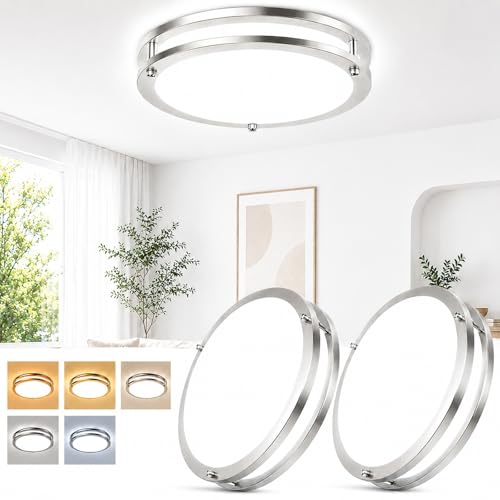 weddeg 63633008-03CRI 90 two-pack
 Brightever XD300-09Most efficient on the page
Why layers beat one big light
A single ceiling light throws the same flat glow over everything. A living room with no overhead light can actually look better, because lamps at different heights make softer light and let you set different moods.
The goal is to cover three jobs. Ambient light fills the room, task light helps you read or work, and accent light highlights art, shelves or a plant. Most rooms need all three, and you can build them with plug-in products that need no wiring.
Your no-wiring options at a glance
Almost everything below plugs into a standard wall outlet or runs on batteries, which makes it a good fit for apartments and rentals. Use the table to decide where each one earns its spot.
| Option | Needs wiring? | Best for | Watch for |
|---|---|---|---|
| Floor lamp | No | Main ambient light in corners | Tip-over risk on busy walkways |
| Table lamp | No | Reading and side-table glow | Too low to light the whole room alone |
| Plug-in wall sconce | No, plugs into an outlet | Light at head height without using floor space | Visible cord unless you add a cord cover |
| Arc or torchiere lamp | No | Bouncing light off the ceiling for a soft, even wash | Needs a light-colored ceiling to work well |
| LED strip lights | No, plug-in or USB | Indirect glow behind a TV or under shelves | Adhesive may mark paint |
| Plug-in pendant | No, hung from a hook with a cord | A centered look where a fixture would be | Cord runs down the wall |
A simple step-by-step plan
Start with the big sources and add smaller ones until the room feels even. Work in the evening so you can judge the result as it will really be used.
- Place a floor lamp in each of two opposite corners to create a base of ambient light.
- Add a table lamp on a side table or console near the seating so every seat has a nearby source.
- Bounce light off a wall or the ceiling with an arc lamp or a plug-in sconce, which fills in shadows between lamps.
- Put accent light on one feature, such as a shelf, an artwork or a plant, using an LED strip or a small picture light.
- Step back and look for dark patches. Move a lamp or add one more until the corners no longer look heavy.
Spread lamps in a loose triangle
Think of the room as a triangle or a loose ring of light. If all your lamps sit on one wall, the opposite side will feel dim and the room will seem smaller.
Mix heights too. A tall floor lamp, a mid-height table lamp and a low LED glow behind furniture give the eye several places to rest, and they cut glare compared with one bright bulb.
Pick the right bulbs
With lamps, the bulb does most of the work. Check the lumens on the package for brightness, and choose a color temperature that fits the room. Around 2700K or 3000K feels warm and relaxing, while 5000K to 6500K looks cool and crisp, which suits a reading corner better than a lounge.
Choose dimmable bulbs, or lamps with a dimmer built into the cord or base. A living room is used for movies, guests and reading, so being able to turn the light down matters as much as being able to turn it up. If you care about how fabrics and wood look, a higher CRI gives truer colors, and 90 is better than 80 or 85.
Keep the color temperature matched across lamps. Mixing a very warm lamp with a very cool one makes the room look patchy.
Safety and rental tips
Check the wattage rating on every lamp and never put a bulb above that limit. LED bulbs run cooler, so they are a safer fit for lamps near curtains or shades.
Do not run cords under rugs or across walkways. Use cord covers along walls, and keep cords away from water and from where pets or kids can chew them. Do not overload one outlet or a power strip with several lamps.
Tall lamps can tip, so choose a heavy base or place them where they will not be bumped. If you hang a plug-in pendant or sconce, use the right wall anchors for your wall type and use a stable step stool, not a chair. In a rental, read your lease before drilling and test adhesive on a hidden spot first.
When a ceiling fixture makes sense
Lamps are enough for many rooms, but a large or open-plan space can still feel dim. In that case, adding a ceiling light gives broad, even light in one step. This does need power at the ceiling, so it is a job for a licensed electrician if there is no existing junction box. Turn off the circuit at the breaker before touching any wiring, and do not work on a ladder alone.
If you do add one, check lumens against room size. In our best lighting for living room comparison, the LUTEC XDD-7 is rated for rooms up to 250 sq ft at 4200 lumens, with 10% to 100% dimming and five color presets. For a larger room, that page lists higher-output ring fixtures too.
Be aware that some fixtures only work with a basic on/off switch. The hykolity panel, for example, is not dimmable and needs hardwiring to a junction box, so it suits a utility space better than a living room. You can read the full spec comparison on our living room lighting page before you decide.
Frequently asked questions
Can I light a living room with only lamps?
Yes. With three or four lamps at different heights and spread around the room, most living rooms feel evenly lit. Add a bounce light, such as an arc lamp or sconce, to soften shadows.
What if my apartment has no ceiling box at all?
Plug-in sconces, floor lamps and LED strips need no ceiling power. Ask your landlord before any wiring work, since a new ceiling box must be installed safely and often needs a licensed electrician.
How do I hide the cords?
Run cords along baseboards or door frames and use paintable cord covers. Place lamps near outlets so the cord stays short, and never tuck cords under a rug.
Are smart bulbs worth using in lamps?
They can help because you can dim or change color temperature from a phone or remote. Make sure the bulb fits the lamp's socket and wattage rating, and check that your lamp is not marked for non-dimmable bulbs only.