How to Install Self-Closing Gate Hinges
Mount the hinges on the gate and post with the gate propped level, check that the gap between post and frame fits the hinge, then set the spring tension a little at a time until the gate swings shut and latches on its own. Use fasteners that suit your post material, and pre-drill the holes. Most of the work is measuring and leveling, not the final tightening.
 Ajingff MJMJL02Best overall
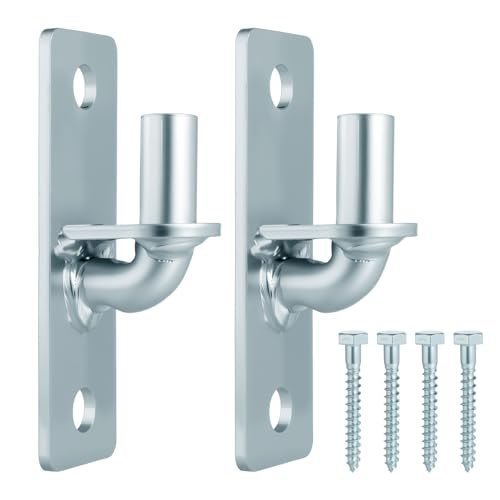 WENHUALI WENHUALI-0248Chain link pin hinge
 Insaga INPS-B-3-P2Highest listed load rating
What to check before you buy or start
Self-closing hinges use a spring to pull the gate shut. That makes them different from plain strap hinges, which only carry weight. Before you install anything, confirm the hinge suits your gate material and the space between your post and gate frame.
Our best gate hinges page lists the fence types each model says it fits. For example, the SANKINS self-closing hinge lists wooden, vinyl and PVC fences, and it adjusts to a post-to-frame gap of 0.23 in to 1.25 in. That same listing says you need at least a 0.23 in gap before it can be installed. Measure your gap first, because a gate hung tight against its post leaves no room for the hinge body.
- Two self-closing hinges (some sets include a pair, so check the pack contents)
- Fasteners for your material: self-tapping screws for vinyl, wood screws for wood
- Drill and drill bits, plus a screwdriver or driver bit
- Tape measure, pencil and a small level
- Wood blocks or shims to prop the gate
- Safety glasses and work gloves
- A helper to hold the gate
Match the fasteners to your gate and post
The pack does not always include the right screws for your fence. The SANKINS listing, for instance, includes 1 in self-tapping metal screws for vinyl fences. It says wood fences need wood screws, which are not included. Always read the pack contents before you start so you are not stopped halfway through.
Here is a general guide to fasteners by surface.
| Surface | Typical fastener | Tip |
|---|---|---|
| Wood post or frame | Exterior-rated wood screws | Pre-drill to avoid splitting the wood |
| Vinyl or PVC post | Self-tapping screws that suit the hinge | Go slowly so the screw does not crack the material |
| Metal frame | Self-tapping screws or bolts | Mark the hole spots with a punch so the bit does not wander |
| Aluminum rail | Bolts or self-tapping screws | Check the wall thickness before choosing screw length |
Step-by-step installation
Work with the gate closed and propped in its final position. Having the gate held at the right height makes every later step easier. Ask a helper to steady it while you mark and drill.
Follow the order below.
- Prop the gate on blocks so it sits level, with an even gap at the latch side and at the bottom.
- Hold the top hinge against the post and gate frame. Check that the hinge spans the gap and that its leaves sit flat.
- Mark the screw holes with a pencil. Do the same for the bottom hinge, then use a level to confirm both hinges line up vertically.
- Remove the hinge. Pre-drill each hole, using a bit slightly smaller than the screw shank in wood.
- Attach the gate-side leaf of each hinge first, using the screws that suit the gate frame. Leave the screws a little loose until all are started.
- Attach the post-side leaf of each hinge. Tighten all screws once the gate hangs level.
- If your hinge has a gap adjustment bolt, set it so the gate sits square in its opening, then tighten it.
- Remove the props and swing the gate by hand to see how it moves before you set the spring.
Set the spring tension
Self-closing hinges ship with the spring at low or no tension, so the gate may not close until you adjust it. Tension is usually set with a small tool or rod placed in one of the holes around the top of the hinge. The SANKINS listing describes this method: you place the stop, a small rod, in a hole to hold the setting.
Add tension one hole at a time on both hinges, so the pull stays even. After each change, open the gate partway and release it. You want it to close firmly and latch without slamming. If it bangs shut, back off one hole. If it stops short of the latch, add one.
Light gates need less tension than heavy ones. Keep in mind that spring hinges add pull but do not add much strength, so check the listed fit before you use them on a heavy gate. For gates that are wide, thick or made of heavy wood, a strong strap hinge on the other side of the post may be the better choice. Our best gate hinges heavy duty page covers those options.
Fix common problems after installing
Most trouble comes from small alignment errors. A few quick checks usually solve it.
If the gate sags and drags, check that the screws are tight and that the post has not shifted. A loose post will defeat any hinge. If you are working on a wood gate, our best wood gate hinges page can help you pick longer straps to spread the load.
If the gate swings open too far or stops before it latches, adjust the spring one hole at a time and check the latch alignment. If the hinge binds, the gap may be too narrow or the two hinges may not line up. Loosen the screws, re-level the hinges and tighten again.
Safety notes
Wear safety glasses when you drill, because metal and vinyl chips can fly. Gloves help with sharp hinge edges.
Springs can pinch fingers. Keep your hands clear of the hinge barrel while you adjust tension, and never reach into the hinge while the gate is swinging.
If you use a ladder for a tall gate, set it on firm, level ground. For electric drills, avoid wet ground, and check for buried cables or pipes before drilling or driving any post fasteners. If the gate guards a pool, follow your local code for self-closing and self-latching hardware, because it may have specific requirements. Check with your local building office before you start.
Frequently asked questions
How many hinges do I need on one gate?
Most small gates use two, one near the top and one near the bottom. A tall or wide gate may need a third hinge for support. A self-closing hinge can be one of them, as long as the others carry the weight.
Can I put self-closing hinges on a gate that has no gap to the post?
Not usually. The hinge body needs room to sit between the post and the frame. Check the hinge's listed gap range, and add a spacer or move the gate if there is too little space.
Do both hinges need the same spring setting?
Yes, in most cases. Matching the settings keeps the gate from twisting as it closes. If your gate still closes unevenly, adjust one hinge by one hole and test again.
Should I add a latch too?
Yes. A self-closing hinge brings the gate back to the post, and a latch holds it shut. Line up the latch so the gate closes into it without needing extra force.