How to Charge an Air Compressor and How Long It Takes
With a tank compressor, you charge it by closing the drain valve, setting the regulator, and plugging it in until the motor shuts off at the cutoff pressure. That usually takes from under a minute to several minutes, depending on tank size, pump output, and starting pressure. With a battery combo unit, you charge the internal battery through its charger, and the time depends on the charger and the battery.
 birvsw DM1264Strongest truck jump power
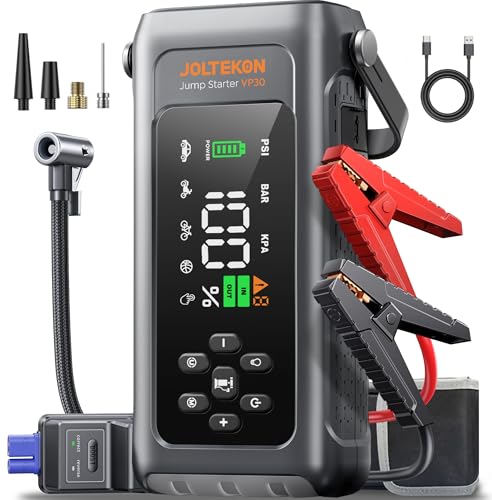 Joltekon VP30Balanced combo for cars
 NACKEO N30High pressure, light body
What "charging" means for an air compressor
People use the word for two different things. On a shop or garage compressor, charging means filling the tank with compressed air. On a portable jump starter with a built-in pump, it means recharging the battery that powers the unit.
The steps and timing differ a lot, so find your type in the table first.
Both types are covered below. If you are still choosing a model, our best air compressor for home garage page compares specs for tank-style units.
| Type | What you charge | What ends the charge |
|---|---|---|
| Tank compressor (corded or gas) | The air tank | Pressure switch shuts the motor off at cutoff pressure |
| Battery combo (jump starter with pump) | The internal battery | Charger indicator or display shows full |
| Cordless tool-battery inflator | The tool battery | Charger light changes color |
How to charge a tank compressor, step by step
Most tank compressors fill themselves once you power them on. The setup before that is what keeps the process safe and fast.
Work through these steps in order:
- Place the compressor on a flat, stable surface with room around it for airflow.
- Check the oil level if your model is oil-lubricated, and top it up if it is low.
- Close the tank drain valve at the bottom. A tank with the valve open will never fill.
- Set the regulator knob to its lowest setting so no air flows out while the tank fills.
- Plug the compressor into a grounded outlet of the correct rating. Use a short, heavy extension cord only if the manual allows one.
- Switch the unit on. The motor runs and the tank gauge climbs.
- Wait for the motor to shut off. That is the cutoff pressure, and the tank is now fully charged.
- Raise the regulator to the pressure your tool or tire needs, then connect your hose.
How long does it take to fill the tank?
There is no single number, because the time depends on a few things. A bigger tank holds more air, so it takes longer to fill from empty. A pump with higher air output fills the same tank faster. A tank that is only partly empty after a short task refills much sooner than one drained to zero.
As a rough guide, a small tank can top up in a minute or two, while a large tank filled from empty can take several minutes. Your manual may list a fill time or air delivery figure at a set pressure. That figure is a better guide than any general rule.
Hose length and fittings also play a small part. Leaky or poorly matched connectors waste air while you fill. Our best air compressor fittings page can help you pick connectors that seal well.
Charging a battery combo compressor
A jump starter with a pump runs from its own battery, so you charge the battery, not an air tank. Use the charger that came with the unit, and plug it into the port the manual names. Most units show the charge level on a display or with indicator lights.
Charging time depends on battery size and charger output. For example, the birvsw DM1264 lists a 57W fast charger and says it recharges fully in about 4 hours. That model is a truck jump starter with no air compressor, so it only shows how a listed charge time looks. Check the manual for your own unit.
Pump specs tell you what the battery can do, not how long it takes to recharge. The Joltekon VP30 lists a 150 PSI pump and the NACKEO N30 lists 160 PSI. Both ratings are pump limits, not fill speeds. If you want to compare these units, see our best battery charger and air compressor combo page.
Keep the battery topped up before you need it. A unit that sits in a hot or cold car can lose charge, so check the operating temperature range in the specs.
If your compressor is charging slower than it used to
A tank that takes longer to reach cutoff than it once did usually points to a fixable problem. Check these first:
- Air leaks at fittings, the drain valve, or the hose. Listen for hissing or brush on soapy water to spot bubbles.
- A dirty intake filter, which starves the pump of air.
- Water built up in the tank, which takes up space. Drain it after use.
- A worn check valve or pump seals, which let air escape or fail to compress it.
- A long or thin extension cord that cuts power to the motor.
Safety notes before you charge
A compressed air tank stores a lot of energy. Never exceed the maximum pressure printed on the tank, and never modify or bypass the pressure switch or safety valve. Drain the tank after use to remove moisture and prevent rust.
Wear eye protection whenever you connect hoses or use air tools, since a loose fitting can whip or spray debris. Wear hearing protection near a running compressor, because many units are loud.
Use a grounded outlet and a cord rated for the load, and keep the unit dry. Gas-powered compressors must run outdoors or in a well-ventilated space because of carbon monoxide. For battery units, charge only with the supplied charger and stop if the battery swells, smells, or gets very hot.
Picking a compressor that fits your use
How fast a compressor recharges matters most if you run tools in bursts. Spray guns and sanders draw steady air, so they need a pump that keeps up. Nail guns and tire inflation use short bursts, so a smaller tank can be enough.
If your work is mostly at a bench or in a workshop, see our best air compressor for home shop page for options sized for that kind of use. For tires and roadside needs, a combo unit may cover the job.
Frequently asked questions
Why won't my compressor tank fill?
Check that the drain valve is closed, the unit has power, and the regulator is not feeding air out through an open hose. If the motor runs but pressure stays low, look for leaks or a failed check valve.
Can I use the compressor while it is filling?
Yes, but the tank will take longer to reach cutoff because you are drawing air as it fills. For heavy tools, let the tank fill first.
How often should I drain the tank?
After each use is the safest habit. Open the drain valve slowly and let the water and air out, then close it again.
Is it bad to leave a battery combo unit plugged in?
Follow the manual. Many units stop charging when full, but the maker's guidance on long storage and charge level is the one to follow.