How to Change a Chainsaw Chain Step by Step
Unplug the saw or remove the battery or spark plug cap, take off the side cover, slip the old chain off the bar, and loop the new chain over the sprocket and around the bar with the cutting edges facing forward on top. Refit the cover, set the tension so the chain snaps back when lifted but still pulls around by hand, and tighten the nuts. Before you start, make sure the new chain matches your bar's length, pitch, gauge and drive link count.
 KAKEI 18" 3/8"LP .050" 62DL- German Steel *3Best overall
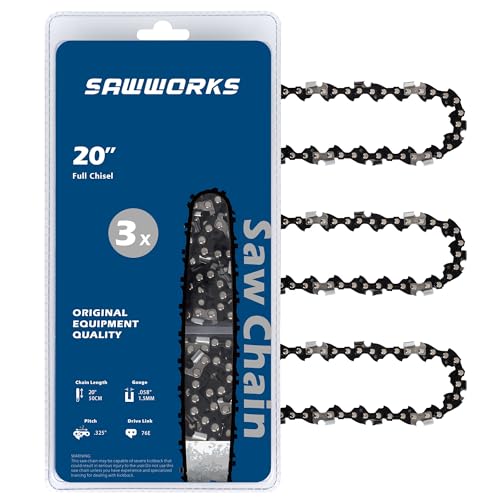 SawWorks 20" 76DL .325" .058"-GermanSteel *3PcsBest for big saws
 GSSHBR 18Inch 3/8 050 62 5PackBest 18 in value pack
Check that the new chain fits first
Most chain trouble starts before the saw is opened. A chain that does not match the guide bar will not seat in the groove, will not run safely, or will not fit at all. Four numbers have to match: bar length, pitch, gauge and drive link count. They are usually stamped on the side of the guide bar, and your owner's manual lists them too.
Our best chainsaw chain page covers these four numbers in more detail. The table below shows how they look on real listings, so you know what to expect when you read your own bar stamp.
| Bar length | Pitch | Gauge | Drive links | Example product |
|---|---|---|---|---|
| 10 in | 3/8 LP | .050 in | 40 | JINFFR 10in semi-chisel 5-pack |
| 14 in | 3/8 LP | .050 in | 52 | Fifchall 14in low-kickback 4-pack |
| 18 in | 3/8 LP | .050 in | 62 | KAKEI 18in semi-chisel 3-pack |
| 20 in | .325 | .058 in | 76 | SawWorks 20in full chisel 3-pack |
Safety and gear before you touch the saw
A chain is a row of sharp cutters, even when it is old and dull. Treat it that way the whole time you handle it.
Take these precautions before you start:
- Stop the engine and let it cool. For a gas saw, pull the spark plug cap so it cannot start.
- For a battery saw, remove the battery. For a corded saw, unplug it.
- Wear cut-resistant work gloves and handle the chain by the drive links, not by the cutters.
- Wear eye protection, because old chains can hold debris, oil and sawdust that flick off as you work.
- Set the saw on a flat, stable surface such as a workbench, so it cannot roll or tip.
Step-by-step: removing the old chain
The layout varies by brand, but nearly every saw follows the same order. Read your manual if a part looks different from what is described here.
- Make sure the chain brake is released. Pull the front hand guard back toward the handle. This lets the chain move freely and, on many saws, lets the side cover come off.
- Loosen the bar nuts. Use the wrench that came with the saw, or a socket of the right size. Loosen them but do not remove them yet if your saw has a captive design.
- Back off the chain tensioner. On many saws this is a screw beside the bar. Turning it releases tension so the chain goes slack.
- Lift off the side cover (the sprocket cover). Note how any small parts sit, such as the tensioner pin or a washer, so you can put them back the same way.
- Slide the guide bar and chain off the studs, then take the chain off the bar and sprocket.
- Clean the bar groove, the oil port and the area around the sprocket. Sawdust packed in these spots starves the new chain of oil.
Step-by-step: fitting the new chain
Take the new chain out of its pack. Many chains come coated in protective oil, which helps prevent corrosion in storage and is fine to leave on.
Check the direction. Hold the chain in a loop and look at the cutters on the top edge of the bar. They must point toward the tip of the bar, in the direction the chain travels. If the cutters face backward, the chain will not cut and the saw may be damaged.
Then fit the chain in this order:
- Drape the chain over the drive sprocket first, with the drive links sitting in the sprocket teeth.
- Feed the other end around the bar nose, with the drive links in the bar groove.
- Slide the bar onto the studs and line up the tension pin with its hole in the bar.
- Refit the side cover and finger-tighten the nuts only. Do not fully tighten yet.
- Keep the chain in the groove all the way around. If a section is hanging out, the chain is not seated.
Set the tension correctly
Tension is the step people most often get wrong. A chain that is too loose can jump off the bar. A chain that is too tight wears the bar, the chain and the sprocket quickly and can overheat.
With the nuts finger-tight, lift the bar nose slightly and turn the tensioner until the chain sits snug against the underside of the bar. Then tighten the nuts firmly while holding the bar nose up. A good check is that you can pull the chain around the bar by hand, wearing gloves, and that it snaps back into place when you let go.
New chains stretch a little during their first minutes of use. Run the saw briefly, stop it, let it cool, and check the tension again. Repeat the check after the first few cuts.
Changing a chain without tools, or on a small saw
Some saws have a tool-less design, with a large knob that releases the side cover and a wheel or dial for tension. If yours does, the steps above still apply, but you loosen and tighten the knob by hand. If your saw needs a wrench or screwdriver, there is no safe way around that. Do not use pliers or force on a worn nut.
Small and light saws, including 10 in and 12 in pole saws and compact battery models, often use a short chain with fewer drive links. For example, the 10 in chain in our data has 40 drive links, while the 14 in has 52. These chains are easier to lose track of, so hold the bar upright and keep the loop together as you fit it.
If a chain falls off a small saw, check the sprocket, bar groove and tension before you put it back. A chain that keeps slipping off may be the wrong size, or the bar may be worn.
Common mistakes to avoid
Fitting the chain backward is the top one, so always double check the cutter direction. Another is buying by bar length alone. Two chains can share a length but differ in pitch or gauge, and a gauge mismatch means the links will not sit in the groove properly.
Also keep a spare. Buying a multi-pack lets you swap in a fresh chain and sharpen the dull one later, which is why packs of 3 to 5 chains appear so often in our comparisons.
Frequently asked questions
How often should I change my chainsaw chain?
Change it when sharpening no longer restores a clean cut, when cutters are cracked or worn short, or when the chain is damaged by hitting dirt or metal. Dull chains produce fine dust instead of chips.
Can I put a longer chain on my saw?
No. The chain must match the bar's drive link count, pitch and gauge. A chain that fits one bar length will not work on another, so use the numbers stamped on your guide bar.
Why does my new chain keep coming off?
Usual causes are loose tension, a worn bar or sprocket, or a chain with the wrong pitch or gauge. Recheck the stamp on the bar and the tension after warming up.
Should I oil the chain after changing it?
Yes. Fill the bar and chain oil reservoir before use, and check that oil reaches the chain. A dry chain overheats and wears fast.