How to Change a Blade on a Corded Jigsaw
Unplug the saw, release the blade clamp (a lever or collar on tool-free saws, a hex wrench on others), pull out the old blade, and slide the new one in with the teeth facing forward until it seats fully. Then let the clamp lock, tug the blade gently to check it, and reconnect power. The whole job takes about a minute once you know your saw's clamp.
 Bosch JS470EBest top-handle Bosch
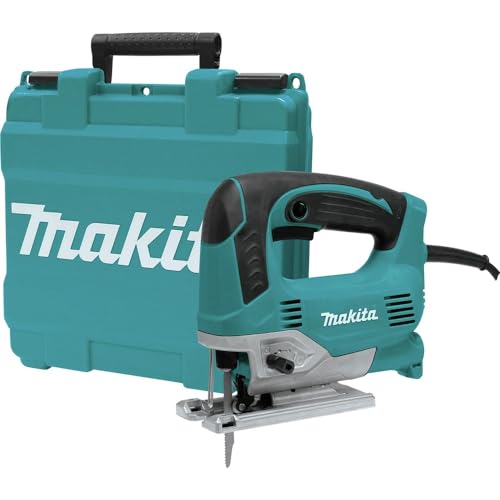 Makita JV0600K-RBest overall
 Bosch JS470EBBest barrel-grip control
Before you start: safety first
Always unplug a corded jigsaw before touching the blade. The cord is the one thing that guarantees the saw cannot start while your fingers are near the clamp. Switching it off is not enough, because a lock-on button or a bumped trigger can start the motor.
Blades also get hot after a long cut, and the teeth stay sharp even when worn. Let the blade cool, or use the ejection lever if your saw has one. Wear safety glasses whenever you work with the saw, since a loose or broken blade can fly out, and wear hearing protection for longer cuts.
What you need
Most blade changes need nothing more than the saw and a replacement blade. A few saws still use a hex wrench for the clamp screw, so keep that handy.
- The right replacement blade for your material and shank type
- Work gloves if the old blade is still warm or has burrs
- A hex wrench, only if your saw uses a clamp screw
- A flat, stable surface to rest the saw on, foot side down
- Safety glasses
Check your blade shank first
Jigsaw blades are made with different shank styles, and the saw's clamp only accepts certain ones. T-shank blades are the most common today. Some saws are fussy about it. The Bosch JS260, for example, has a multidirectional clamp for T-shank blades and does not accept U-shank blades. Bosch's JS470E and JS470EB also list a multidirectional clamp built for T-shank blades.
Check the manual or the markings near the clamp before you buy blades. A blade that does not match the clamp may seem to fit but can slip or wobble in the cut, which is both inaccurate and unsafe.
Step-by-step: swapping the blade
The exact release differs between models, so treat these steps as the general pattern and read your manual for the specifics. Brands such as DEWALT, Bosch and Makita each design their clamps a little differently, but the sequence is much the same.
- Unplug the saw and set it on a bench with the blade pointing away from you.
- Release the old blade. On a tool-free saw, this usually means lifting or rotating a lever or collar at the top of the blade holder. On a screw-type clamp, loosen the screw with the hex wrench.
- Remove the old blade. Some saws, like the Bosch models with a blade ejection lever, push the blade out so you do not have to touch it.
- Insert the new blade with the teeth facing the front of the saw, the same direction the saw cuts. Push it up into the holder until it stops.
- Let the lever or collar return to its locked position, or tighten the screw.
- Tug the blade lightly to make sure it is secure, and check that the back edge sits in the roller guide if your saw has one.
- Reconnect the power and run the saw briefly in open air, away from your body, to confirm the blade runs straight.
Tool-free clamps compared
If you change blades often, a tool-free clamp saves time and keeps a hex wrench from going missing. Here is how the blade-change features read on the saws in our best corded jigsaw comparison.
All of these list a tool-free change. The differences are in the extras around it, so check which one matches how you work.
| Saw | Blade change feature | Notes from the spec data |
|---|---|---|
| Bosch JS470E | Tool-less change with ejection lever | Multidirectional clamp for T-shank blades |
| Bosch JS260 | Tool-less change | T-shank only, no U-shank blades |
| Makita JV0600K-R | Tool-less change | Listed as a fast install and removal system |
| SKIL JS314901 | Tool-free blade clamp | Changes blades in seconds, per the listing |
| DEKOPRO DKPJGSD075C1-K1UL-GYAZ | Tool-free blade clamp | Kit includes a hex wrench and a mix of blades |
Choosing the right blade for the job
Changing blades is also how you match the saw to the work. In general, blades with larger teeth cut wood quickly, while finer teeth leave smoother edges and suit metal and plastic. Slow the speed dial down for metal and plastic, as our guide to the best corded jigsaw models explains.
Pair the blade with the orbital setting too. Higher orbit gives faster, rougher cuts in wood, and zero orbit suits clean curves and metal. If a cut wanders or burns, a worn blade is often the cause, so swap it before pushing harder.
Common problems and quick fixes
If the blade will not stay in, check that the shank type matches the clamp and that the clamp fully returned to its locked position. If it pops out mid-cut, stop, unplug the saw and reseat it.
If the blade feels loose after tightening, do not use it. Try a fresh blade, because a bent shank can stop the clamp from gripping properly. Clean sawdust out of the clamp opening as well, since packed dust can keep the blade from seating all the way.
Frequently asked questions
Which way do the teeth face?
For normal cutting, the teeth face forward, toward the front of the saw. The saw cuts on the upstroke, so the blade should be set to match the direction the saw moves forward.
How do I know when a blade needs replacing?
Slow cuts, burning, rough edges, or a blade that drifts off the line are the usual signs. Bent or missing teeth mean it should be swapped right away.
Can I reuse or sharpen jigsaw blades?
Most jigsaw blades are made to be replaced, not sharpened. You can reuse one that is still sharp and straight, but a dull or bent blade is best discarded.
Do I need to unplug the saw for every blade change?
Yes. Unplugging removes any risk of an accidental start, and it only takes a second.