How to Attach a Grease Gun to a Grease Fitting
Wipe the zerk fitting clean, push the grease gun coupler straight onto the fitting until it snaps or clamps on, then pump the handle slowly until fresh grease shows or the joint takes no more. With a locking coupler you flip the lever to clamp it, and flip it again to release. Do not push the plunger rod in by hand to move grease; the handle does that work.
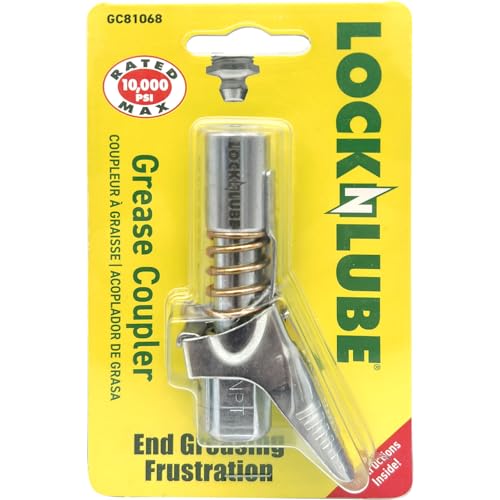 LockNLube GC81011Best overall
 LockNLube GXCLBest for recessed fittings
 Akeoil XUC-05Best 6-jaw grip
Attaching the gun, step by step
The job takes a minute once you know the order. The main idea is to keep the coupler square to the fitting and to clean everything first, so dirt does not get pushed into the joint.
Here is the basic routine for a standard hand-operated gun with a coupler on the end of the hose or barrel:
- Wipe the zerk fitting (the small nipple with a ball tip) with a clean rag. Dirt on the fitting goes straight into the bearing.
- Check that the gun is loaded and primed. Pump once or twice into a rag until grease comes out of the coupler with no sputtering.
- Line the coupler up so it sits straight on the fitting, not at an angle.
- Push the coupler firmly onto the fitting. A basic coupler snaps on over the ball. A locking coupler needs you to press or flip its lever so the jaws clamp down.
- Pump the handle slowly and steadily. Watch the joint, the boot, or the seal for signs that grease is moving.
- Stop when you see a little fresh grease at the edge of the joint, or when the handle gets firm and the joint will not take more.
- Release the coupler (lever on a locking style, a firm sideways rock on a basic one), then wipe the fitting and the area around it clean.
Do you push the plunger in on a grease gun?
Not while greasing. The plunger rod is the metal rod that sticks out of the back of many guns. You pull it back and lock it in its notch when you load a cartridge or fill the barrel, which pulls the follower away so you can work. Then you release it so the spring behind the follower can press on the grease.
After that, the lever or pump handle moves grease out of the head. You do not need to push the rod in by hand during normal use. If the rod is still locked back, the gun may not feed properly.
If the gun pumps but nothing comes out, air is probably trapped. Many guns have a small bleed valve near the head. Loosen it a little, pump until grease shows, then close it.
Basic coupler or locking coupler
The coupler is the part that does the gripping, and it matters more than most people expect. A worn or basic one can leak around the fitting and pop off under pressure. A locking coupler clamps on and stays put, so you can pump with both hands and release it with a lever.
Almost all grease guns use 1/8 in NPT threads at the outlet, so most couplers swap on easily. After that, the differences are pressure rating, reach, and how well the jaws hold.
Here is how the common styles compare in use:
| Style | How it attaches | Best for | Watch out for |
|---|---|---|---|
| Standard snap-on coupler | Pushes on and grips with small jaws | Easy, open fittings | Leaks and slips off when worn |
| Locking coupler | Lever clamps the jaws on the fitting | Two-handed pumping and cleaner work | Needs a clean fitting to seal well |
| Extra reach coupler | Longer body, same locking action | Shielded or recessed fittings | Longer body needs more clearance |
| 90 degree adapter | Threads onto the gun, then the coupler goes on the end | Tight spots near frames or guards | Extra joint to keep tight |
| Needle tip | Pushes into flush or hole-type fittings | Fittings with no ball | Not for standard zerks |
Choosing a coupler for your gun
If you grease often, a locking coupler is worth considering. Our best grease gun coupler page lists several side by side. The top pick, the LockNLube GC81011, is a rebuildable locking coupler rated to 10,000 psi with a 3.5 in length. It fits SAE and metric zerks and works with one hand through a thumb lever.
For recessed fittings on axles, U-joints and shielded driveshafts, the LockNLube GXCL extra reach model has a 5.5 in length and includes a rebuild kit. Several others on the page, including the Akeoil 6-jaw and the luckywagon model, are rated to 12,000 psi.
A higher rating is not needed for routine greasing. It simply gives more margin for stubborn or partly blocked fittings. If you are also shopping for the gun itself, see our best grease gun for the money comparison. Check the outlet thread so the coupler you pick will screw on.
If the coupler will not stay on or grease leaks
Most problems come from a handful of causes. Work through them in this order before replacing anything.
First, check the fitting. A bent, damaged or clogged zerk will not seal. Wipe it and try again. If the ball tip is crushed or the check ball is stuck, replace the zerk. They are inexpensive hardware items that thread out with a wrench.
Second, check the angle. A coupler pushed on crooked will leak at the edge. Pull it off and reseat it square. A 90 degree adapter or an extra reach coupler can help if you cannot get straight at the fitting.
Third, look at the coupler itself. Worn jaws or a cracked seal let grease escape and let the coupler slip. Rebuildable couplers let you swap the seal and jaws instead of replacing the whole piece. Also check that the coupler is tight on the gun threads.
Fourth, if grease comes out around the joint instead of going in, stop pumping. The fitting may be blocked, or the joint may already be full. Forcing it can blow out a seal.
Safety notes
Grease guns build real pressure, and that pressure can push grease through skin. Never point the coupler at your hand or any part of your body, and never test the gun by pressing a finger over the outlet. If grease is injected into your skin, get medical care right away, even if the wound looks small.
Wear safety glasses, because a coupler can pop off and spray grease. Gloves keep grease off your hands and help you spot leaks.
Lower equipment from lifts or jacks only after you finish. Never grease a machine that is running, and do not work under a vehicle held up only by a jack. Use stands. Keep your hands clear of moving parts such as PTO shafts and belts. For battery or air-powered guns, follow the maker's pressure and setup instructions.
A quick routine to keep
Wipe the fitting before and after. Add grease slowly, stopping when you see a bead of fresh grease or the handle firms up. Keep a rag in your pocket for stray drips, and cap the gun or coupler when you are done so dirt stays out.
If you do this regularly on mixed equipment, a locking coupler and a spare tip or adapter in the toolbox will save time.
Frequently asked questions
Can I use any grease gun on any zerk fitting?
Most standard grease guns fit standard zerks, whether SAE or metric. Flush-type or hole-style fittings may need a needle tip instead of a normal coupler.
How much grease should I add per fitting?
Follow the equipment manual first. As a general rule, a few slow pumps are enough on small joints, and you stop when a little fresh grease shows at the seal.
Why does my coupler pop off when I pump?
The usual causes are worn jaws, a crooked angle, a damaged fitting, or too much pressure from pumping fast. A locking coupler can help, as can slower pumping.
Is a zerk the same as a grease fitting?
Yes. Zerk is a common name for the small one-way grease fitting, and many people use the two terms for the same part.
Do I need to release pressure before removing the coupler?
A locking coupler can be released under pressure with its lever. With a basic coupler, stop pumping first and rock it off gently, then wipe away any grease.