How to Adjust Kitchen Cabinet Doors That Are Out of Line
Most crooked cabinet doors can be fixed in a few minutes with a Phillips screwdriver and small turns of the hinge adjustment screws. One screw moves the door left or right, another moves it in or out, and the mounting plate screws move it up or down. If a door keeps swinging open or a gap shows under the cabinet, the cause is usually hinge tension, a loose catch, or an uneven floor.
 Quicklock Cabinets QLRTABBest overall
 Quicklock Cabinets QLRTA-KSSMost cabinets in one set
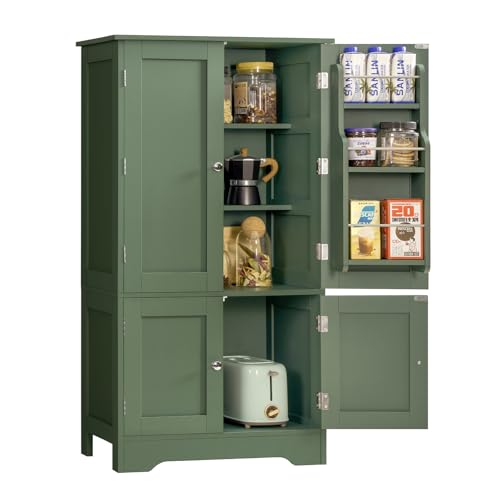 TEENFON Storage CabinetShallowest pantry storage
Start with a quick check
Before you turn any screws, open the door and look at the hinges. Most modern kitchen cabinets use concealed European-style hinges, the kind you see only from inside the box. These have small adjustment screws on the arm and a mounting plate fixed to the cabinet frame.
Also look for the simple problems first. A loose hinge screw is the most common reason a door sags. If the door is crooked because the screws have stripped out of the wood, adjusting will not hold, and you will need to repair the screw holes instead.
Gather these items:
- A Phillips or #2 screwdriver, hand style preferred over a power drill
- A small level or a straightedge
- Wood glue and toothpicks, in case a screw hole is stripped
- A friend to hold the door steady, for heavy doors
Know your hinge adjustments
Many cabinets today use six-way adjustable hinges. That name means the door can be moved in three directions, each with a fine adjustment. For example, the LUXEYARD White Shaker RTA Base Cabinet lists six-way hinges that allow up-and-down, side-to-side, and in-and-out adjustments to line up its two doors with even gaps. The Furinno drawer base and the ONESTOCK 18 in wall cabinet also list six-way adjustable hinges.
Each direction has its own screw. The table below shows the usual layout. Brands differ a little, so test each screw with a small turn first and watch which way the door moves.
| Problem you see | What to adjust | Typical action |
|---|---|---|
| Door leans left or right, gap uneven at the sides | Side-to-side screw on the hinge arm | Turn clockwise or counterclockwise in small steps, one hinge at a time |
| Door sits too far in or out, or does not close flat | Depth screw on the hinge arm | Turn to pull the door toward the box or push it away |
| Door is higher or lower than its neighbor | Mounting plate screws | Loosen slightly, slide the door up or down, then retighten |
| Top corner sticks out or bottom corner gap | Adjust both hinges in opposite amounts | Make a quarter turn on one hinge, then check again |
How to adjust a crooked door, step by step
Work slowly. A quarter turn of a screw can move a door by a visible amount, so small changes keep you from overshooting.
Follow these steps:
- Close the door and note which edge is out of line. Compare it with the doors next to it and with the cabinet frame.
- Open the door and find the adjustment screws on each hinge. Do not remove any screw. You are only loosening and tightening.
- Turn the side-to-side screw a quarter turn on the top hinge. Close the door and check the gap.
- Repeat on the bottom hinge so both hinges move the same amount. If you adjust only one, the door can twist.
- Use the depth screw if the door sits proud of its neighbor or will not close flat.
- For height, loosen the mounting plate screws a little, move the door up or down, and retighten firmly.
- Check the gaps again with the door closed. Aim for an even gap of about the same width all around, and stop when the door lines up with the doors beside it.
Why does my kitchen cabinet keep opening?
A door that drifts open is usually telling you about its catch or its alignment. Start with the catch. Many cabinets use a magnetic or roller catch that wears or shifts over time. If the door does not reach the catch, the catch cannot hold it.
Next, look at hinge tension. If the door is out of line, it may touch the frame at one corner and spring back. Use the depth screw to bring the door flat against the frame, and the catch can do its job again.
A cabinet box that is out of level can also let a door swing. If the cabinet leans forward, gravity pulls the door open. Check with a level, and shim or adjust the box if needed. Soft-close hinges, such as those listed on the Furinno and ONESTOCK cabinets, help in daily use because they pull the door shut at the end of its swing, though they still need correct alignment to work well.
Safety note: if you must loosen or move a wall cabinet to level it, empty it first and have a helper hold it. Wall cabinets must be fixed into studs, and a loaded cabinet can fall if its screws are removed.
Why is there a gap under kitchen cabinets?
A gap at the bottom of a base cabinet has a few common causes. Floors are rarely perfectly level, so the box may sit higher on one side. Base cabinets are also built with a recessed toe kick, the open space at the bottom that gives your feet room at the counter. That recess is normal, and it is usually covered with a trim strip.
A true gap appears when the cabinet sits on high spots in the floor, or when the toe kick trim was left off or has shifted. Look at the cabinet from the side with a level on top. If the box tilts, adjust the leveling legs if your cabinet has them, or add shims under the box and trim the shims flush.
For small gaps along the floor, flexible toe kick trim or a thin strip of molding hides the space. Do not pack the gap with caulk alone if the cabinet is rocking, because it will crack and the cabinet can still shift. Fix the level first, then hide the gap.
When adjusting is not enough
Some doors cannot be saved with a screwdriver. A warped door, a hinge with a bent arm, or screw holes that no longer grip all call for a different fix. For stripped holes, fill the hole with glue and a few toothpicks, let it dry, trim flush, and drive the screw in again. If the door itself is warped, replacing it is often better than fighting it.
If you are planning a new kitchen or replacing a few boxes, hinge type is worth checking. Our best kitchen cabinet page lists which models have soft-close and adjustable hinges, so you can align doors after installation. Plywood and hardwood boxes hold screws better than engineered wood, which matters if you will adjust or remove hinges over the years.
You can also compare box sizes on the same page. For example, base cabinets there are 24 in deep and 34.5 in tall, so you can plan a level run before you hang doors. See the rest of the kitchen cabinet comparison for widths, materials and weights.
Safety note: wear safety glasses if you drill new pilot holes or trim shims, and keep fingers clear of the hinge arm while the door is swinging.
Frequently asked questions
Which way do I turn a hinge screw to move a door left or right?
It depends on the hinge. A common pattern is counterclockwise to move the door left and clockwise to move it right, but test with a small turn and watch the door.
Do I need to take the door off to adjust it?
No. Concealed hinges are made so you can adjust them with the door on. Only remove the door if you are replacing a hinge or repairing a stripped screw hole.
How tight should the mounting plate screws be?
Snug and firm, but not forced. Overtightening can strip the hole, especially in softer boards, and the hinge will slip again.
Can I adjust drawer fronts the same way?
Often yes. Many drawer fronts have small adjustment screws or slotted holes, so check the inside of the drawer box before loosening anything.