How to Adjust Jointer Outfeed and Infeed Tables
Set the outfeed table so its surface sits exactly level with the highest point of the cutterhead's cutting edge, then make the infeed table parallel to it so a straightedge lies flat across both. Unplug the machine first, work with a reliable straightedge, and confirm the result with a test cut on scrap. Once the outfeed is right, the infeed only controls how much you remove per pass.
 CUTECH 401120HI-IFBest overall
 Jet JJ-6HHDXLongest 6 in tables
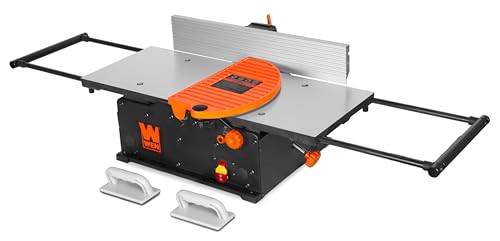 WEN JT1224HBest wide benchtop value
What each table does
The outfeed table is the reference. It supports the board after the cutterhead has trimmed it, so its height must match the cutting edge at the top of its swing. The infeed table is set lower than the outfeed by the amount you want to remove, and that gap is your depth of cut.
Most jointers on our comparison page cap the cut at 1/8 in per pass. The Powermatic 60HH is listed at 1/2 in. A light cut is also the best way to see whether your setup is true, because small errors show up quickly.
Safety first
Tables are adjusted with the cutterhead exposed, and the edges are sharp. Take a few minutes to make the machine safe before you touch anything.
- Unplug the jointer. For a hardwired or pedestal-switch machine, disconnect power at the source.
- Remove the fence and the cutterhead guard so you can see the whole cutterhead, and refit both before you cut.
- Wear gloves when you handle knives or inserts, and turn the cutterhead by hand only.
- Wear eye and hearing protection for the test cuts, and connect dust collection.
- Keep your hands off the cutterhead and use push blocks on the test cuts.
Gather what you need
You do not need much. A good straightedge is the most important item, because everything you measure depends on it. A machinist's straightedge is ideal, and a known-flat metal ruler of about 12 in can work if it is truly straight.
You will also need the hex keys or wrenches that came with your machine, a few scraps of hardwood for test cuts, and a light that shines across the table surface so you can spot gaps. Some owners add a dial indicator on a magnetic base, which makes small differences easier to read.
Step by step: set the outfeed table
The goal is to bring the outfeed table level with the cutting edge at top dead center. Work through the steps in order and recheck the first one after you finish.
If your machine has a spiral or helical head, the inserts are fixed in their seats, so you adjust the table to the inserts rather than the other way around. On a straight-knife machine, make sure the knives are set evenly first.
- Unplug the machine, remove the fence and guard, and clean pitch and dust off both tables.
- Lay the straightedge on the outfeed table so about an inch or two hangs over the cutterhead.
- Rotate the cutterhead by hand until an insert or knife reaches its highest point.
- Raise or lower the outfeed table until the cutting edge just touches the underside of the straightedge. It should be snug but not lift the straightedge.
- Check at the left, middle and right of the cutterhead, and test several inserts on a spiral or helical head.
- Lock the outfeed table adjustment, then recheck, since locking can shift the table slightly.
Make the infeed table parallel
Next, bring the infeed table up to the same height as the outfeed so the two surfaces form one flat plane. Lay the straightedge across both tables, spanning the cutterhead gap, and look for light underneath at either end.
Gaps under the straightedge usually mean the tables are not parallel front to back, or the table is twisted on its ways. Many jointers have gib screws or adjusting screws on the table ways for this. Follow your manual's instructions, because the locations vary by model.
Some designs help with this. For example, the CUTECH 12-inch model lists an extra guide post it calls elevation control to keep the tables parallel at different depths, and the Powermatic 60HH uses tables on dovetailed ways. These features reduce drift, but you should still check with a straightedge.
Test cut and fine-tune
Lower the infeed table a small amount, such as 1/16 in, and run a scrap board with a straight edge across the jointer. Feed it steadily with push blocks and keep your pressure over the outfeed table once the board is supported there. Then check what the result tells you.
Here is how to read the common problems:
| What you see | Likely cause | Fix |
|---|---|---|
| Dip or snipe at the end of the board | Outfeed table too low | Raise the outfeed slightly |
| Board stops cutting and tapers near the end | Outfeed table too high | Lower the outfeed slightly |
| Board rocks or edge is curved | Tables not parallel or twisted | Recheck with the straightedge and adjust the ways |
| Ridges along the cut | Uneven knives or a damaged insert | Reset the knives, or rotate or replace the insert |
Keep your tables true over time
Dust and pitch on the ways make adjustments stick and can throw measurements off, so wipe them down and lightly lubricate as your manual advises. Recheck the outfeed height whenever you change knives or rotate inserts, since small differences in seating change the cutting height.
Table length also matters for results. Longer tables hold a long board straighter, and our best jointer page lists table lengths from 23 in to 73 in. If you often struggle to keep long boards flat, compare the table lengths and cutterhead types in our jointer comparison before you rework your setup.
Frequently asked questions
Can I adjust the tables with the machine plugged in?
No. Always unplug it first. You will be turning the cutterhead by hand and working near sharp edges, so an accidental start is a serious risk.
Should the outfeed table be higher or lower than the cutterhead?
It should be level with the cutting edge at its highest point. Too high causes a taper, and too low causes snipe at the end of the board.
How often should I check jointer table alignment?
Check after you change knives or inserts, move the machine, or notice snipe, taper or a rocking board. A quick straightedge check before an important project is also reasonable.
Do benchtop jointers need the same adjustment?
Yes, the principle is the same. Adjustment points vary by model, so follow your manual for where the locks and screws are.