How Thick of Wood Can You Cut With a Jigsaw?
Most jigsaws cut softwood up to about 1.5 inches thick without trouble, and hardwood up to about 3/4 to 1 inch. Some saws are rated higher. For example, one DEKOPRO corded model lists a maximum board capacity of 100 mm, or about 4 inches. Thicker cuts are possible with a long blade and a slow feed, but accuracy drops quickly as the wood gets deeper.
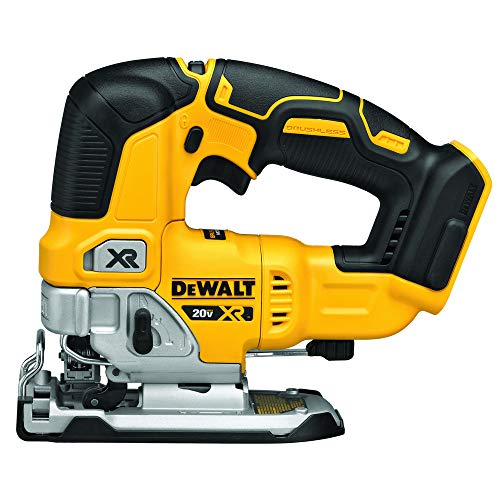 DEWALT DCS334BBest overall
 FLEX FX2231-ZFastest with long stroke
 DEKOPRO JigsawBest corded value
The short answer on thickness
Think of two numbers. The first is the rated maximum, which is the deepest cut the maker says the saw can make. The second is the practical limit, which is how thick a board you can cut while still following your line with a square edge.
The practical limit is almost always lower. As a rough guide, 1.5 inches is comfortable in softwood such as pine, and 3/4 inch to 1 inch is a reasonable target in dense hardwood such as oak or maple. Past that, you can often still get through the wood, but the blade will lean and the cut will wander.
Always check your saw's manual for its rated capacity. Published figures vary by model, and many listings do not state one at all.
What limits how thick a jigsaw can cut
Several parts of the saw work together to set the limit. Knowing them helps you judge whether a given job is realistic.
Stroke length is one factor. A longer stroke uses more of the blade on each pass, so it clears more wood per stroke. Several saws on our spec sheets list a 1 in stroke, including the FLEX FX2231-Z, the RIDGID R86345B and the Bosch JS470E.
Blade length is another. The blade has to be longer than the wood is thick, with room to spare at both ends of the stroke. A blade that barely clears the board will overheat and bend.
Motor power and speed matter too. Saws range from 3,000 SPM (strokes per minute) on the DEKOPRO corded models up to 3,500 SPM on the FLEX and Seesii cordless saws. The Bosch JS470E runs from 500 to 3,100 SPM. Higher speed helps in softwood, while a slower speed often suits dense hardwood so the blade does not burn.
Rough thickness guide by material
The table below gives general rules of thumb, not specifications for any one saw. Treat them as a starting point and adjust for your blade and your wood.
Keep in mind that wet, knotty or very dense wood cuts slower than the same thickness of dry, clear wood.
| Material | Comfortable range | Pushing it |
|---|---|---|
| Plywood and sheet goods | Up to 3/4 in | Stacked sheets, which tend to chip and wander |
| Softwood (pine, fir, cedar) | Up to 1.5 in | 1.5 to 2 in, with a long blade and slow feed |
| Hardwood (oak, maple, walnut) | Up to 3/4 in | 3/4 to 1 in, with a sharp blade and low orbit |
| Thick stock over 2 in | Not recommended | Consider a bandsaw or circular saw if you can |
Choosing the right blade for thick wood
The blade often matters more than the saw. For thick wood, pick a long, narrow-tooth-count blade made for fast wood cutting, since coarse teeth clear chips better. A blade with 10 to 12 teeth per inch suits gradual curves, and a finer blade of around 20 teeth per inch suits tight curves in solid wood, though the finer blade cuts more slowly.
Most modern saws take T-shank blades and let you swap them without tools. The DEWALT DCS334B, the RIDGID R86345B and the Bosch JS470E all list tool-free blade changes, which makes it easy to put in a fresh blade partway through a big job.
Replace a dull blade right away. Dull blades are a major cause of burning, bending and crooked cuts in thick stock.
Settings and technique for deeper cuts
Use these steps when you are cutting near the top of your saw's range.
Our best jigsaw for woodworking page explains orbital action in more detail. In short, a higher orbital setting cuts faster in softwood, while low or zero orbit gives cleaner results in hardwood and plywood. Most saws we list, such as the DEWALT, DEKOPRO, Seesii and Bosch models, offer 4 orbital settings, and the FLEX offers 3.
- Mark the line on both faces of the board, so you can check that the blade is staying square.
- Clamp the wood firmly, with the cut line clear of your bench.
- Choose a long, sharp blade rated for wood.
- Set orbital action high for fast softwood cuts, or low for hardwood and clean edges.
- Start the saw before the blade touches the wood, then let the saw do the work. Do not force it.
- Slow down on curves and in hardwood, and back out gently if the blade binds.
- Make relief cuts on tight curves so waste pieces fall away and the blade does not pinch.
Picking a saw if you cut thick stock often
If thick cuts are part of your regular work, look for a long stroke, good speed range and several orbital settings. Those traits show up on our jigsaw comparison, where you can line up stroke length, SPM and orbit side by side.
Corded saws give steady power for long bench sessions, while cordless saws are easier to carry around large panels. Pick the type that suits your workspace. Features such as an LED light, a dust blower and a vacuum port help you see the line, which matters more as the cut gets deeper.
Safety notes: wear safety glasses, because chips and broken blades can fly out. Wear hearing protection during long cuts, and a dust mask when cutting wood. Unplug a corded saw or remove the battery before changing a blade, and let the blade cool before you touch it. Keep both hands away from the blade path, and never reach under the workpiece while the saw is running.
Frequently asked questions
Can a jigsaw cut a 2x4?
Yes. A standard 2x4 is about 1.5 inches thick, which is within the range most jigsaws handle in softwood. Use a sharp wood blade and a steady feed.
Why does my jigsaw blade bend in thick wood?
The blade is flexing under side pressure, usually from pushing too hard, using a dull blade or cutting a curve too fast. Slow down, use a fresh blade and let the saw cut at its own pace.
Is a jigsaw a good choice for cutting thick hardwood?
It can work for short or curved cuts, but a bandsaw or circular saw gives straighter, faster results in thick hardwood. Use the jigsaw for shaping and cutouts.
Does a cordless jigsaw cut thinner wood than a corded one?
Not necessarily. Thickness depends more on the blade, stroke and speed than on the power source. Cordless saws can run out of charge during long cuts in dense wood, so keep a spare battery handy.