How Much Vacuum Should You Pull on Auto AC?
Pull the system down to at least 29 inHg on a standard gauge at sea level, which is as close to a full vacuum as a manifold gauge can show. If you have a micron gauge, aim for 500 microns or lower. Then shut the valves and make sure the reading holds, because a system that holds is both dry and leak-free.
 VIVOHOME VH1803Best overall
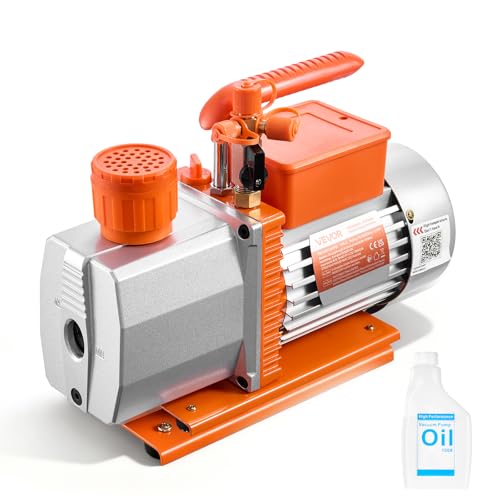 VEVOR 2RS-2Oil included, A2L listed
 SPECSTAR VH1694Lightest in the lineup
The short version: the number to aim for
There are two ways to read vacuum, and they give different levels of confidence. A standard manifold gauge shows vacuum in inches of mercury (inHg). At sea level, a good evacuation reads close to 29 to 30 inHg. A micron gauge is far more precise, and the common target is 500 microns or lower.
Most home mechanics only have the manifold gauge, so the practical goal is simple: get the needle as deep into the vacuum range as it will go, keep the pump running, and then do a hold test. The number matters, but the hold test is what proves the job is done.
Why a deep vacuum matters
A vacuum does two jobs. It removes air, and it boils off moisture. Water inside an A/C system is a problem because it can mix with refrigerant and oil, form acids, and freeze at the expansion device. Air is a problem because it cannot be compressed the way refrigerant can, so it raises pressures and hurts cooling.
Water boils at a lower temperature as pressure drops. Pulling a deep vacuum lets any moisture turn to vapor so the pump can carry it out. That is why a quick pull to a shallow reading is not enough. The pump needs time at depth to clear moisture, not just air.
The vacuum also works as a leak test. If the system cannot hold a vacuum, it will not hold refrigerant either.
Reading your gauge: inHg, microns and altitude
Air pressure falls as you gain elevation, so the same pump shows a shallower reading on a manifold gauge at altitude. As a rough guide, the reading drops by about 1 inHg for every 1,000 feet above sea level. If you work in the mountains, do not expect to see 29 inHg. Aim for the deepest reading your pump can reach and rely on the hold test.
Units also cause confusion. Some pump manuals list vacuum in pascals (Pa) instead of microns. As a conversion, 1 Pa is about 7.5 microns. That is why a pump listed at 0.2 Pa lines up with a 1.5 micron rating. Be careful with the word bar. A bar is a unit of positive pressure, not a measure of vacuum depth, so a pump spec in pascals or microns is the one to compare.
| Measure | What it tells you | Practical target |
|---|---|---|
| Manifold gauge (inHg) | Rough depth, limited precision | About 29 to 30 inHg at sea level |
| Micron gauge | Precise depth and dryness | 500 microns or lower |
| Pump vacuum rating | The deepest the pump can reach on its own | Lower is better |
| Hold test | Leak tightness | No meaningful rise after the valves are closed |
Step by step: evacuating a car A/C system
Work with the engine off and the system open and empty of refrigerant. Never vent refrigerant to the air. Have it recovered first if the system still has a charge.
- Connect the manifold gauge set to the low and high service ports, and connect the yellow center hose to the vacuum pump.
- Open both manifold valves and start the pump.
- Run the pump until the gauge reaches its deepest reading. Allow at least 30 minutes, and longer if the air is humid or the system was open for a while.
- Close both manifold valves, then turn off the pump.
- Watch the gauge for 10 to 15 minutes. If the needle climbs, there is a leak or leftover moisture. Find the leak or pull again.
- If the reading holds, you are ready to charge the system.
What your pump specs mean for the job
Two specs shape how the job goes. Flow rate in CFM sets how fast the pump clears air. The vacuum rating in microns shows how deep and dry it can leave the system. For a car, a compact pump around 5 CFM is usually enough, and a deeper rating gets you closer to the 500 micron target with margin. You can compare these side by side on our best vacuum pump for auto ac page.
Here is how a few pumps from that page line up on the numbers that matter for this job.
If your car uses R1234yf, check A2L compatibility before you buy. Our guide to a vacuum pump for auto A/C explains what to look for, including a sparkless motor and an A2L listing. A manifold gauge set that comes with the pump also saves you a separate purchase.
| Pump | Flow (CFM) | Vacuum rating (micron) | A2L | Gauge set |
|---|---|---|---|---|
| VIVOHOME VH1803 | 5 | 1.5 | Listed | Included |
| VEVOR 2RS-2 | 7 | 2.25 | Listed | Not included |
| SPECSTAR VH1694 | 7.2 | 1.5 | Not listed | Included |
| VIVOHOME VH321 | 5 | 2.25 | Not listed | Not included |
Safety notes
Wear safety glasses or goggles whenever you connect hoses or work near a pressurized system. Refrigerant can cause frostbite on contact with skin, so wear gloves too.
Keep the pump away from ignition sources when you work with A2L refrigerants such as R1234yf, which are mildly flammable. Use a pump that states A2L compatibility, and work in a ventilated space. Plug the pump into a properly grounded outlet and keep cords away from oil and water.
Keep hands, clothing and hair clear of the engine bay's belts and fans. Make sure the engine is off during evacuation. Some pumps are loud, so consider ear protection if you work in a closed garage.
Frequently asked questions
How long should I run the vacuum pump?
Plan on at least 30 minutes for a typical car system. Humid weather or a system that sat open may need longer. Time is not the goal, though. Watch the reading and finish with a hold test.
What if the vacuum will not hold?
A rising needle means a leak, or moisture still boiling off. Check fittings, service port caps and hose connections first. If the reading still climbs, pull again for longer, and have the system inspected for leaks before charging.
Can I use the same pump for R134a and R1234yf?
Often yes for the vacuum itself, but the pump should be rated for A2L refrigerants if you work on R1234yf cars. Check the spec sheet for a sparkless motor and an A2L listing, and confirm adapters and fittings match your car.
Do I need to change the pump oil?
Yes, regularly. Dirty oil limits how deep the pump can pull. Check the oil window before each use and replace the oil when it looks cloudy or discolored, following your pump maker's guidance.