How Much Transmission Fluid Do I Need to Fill It?
It depends on the job. A drain-and-fill from the pan usually replaces only part of the fluid, while a full system fill or flush takes more, often somewhere around 9 to 13 quarts for many automatics. Your owner's manual or service manual lists the exact refill capacity for your transmission, so use that number and not a general guess.
 FOUR UNCLES FU-6502Best overall
 Lustriix QDSDCYBTransmission oil on the list
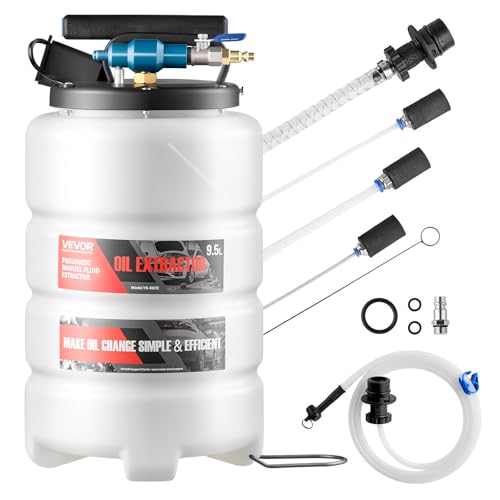 VEVOR YS-087CLong reach, big tank
The short version: quarts depend on the job
Most people asking this question want one number. There is no single number, because transmissions differ in size and because a "fill" can mean different things. Adding a pint to top off a low level is very different from refilling after a full fluid exchange.
As a rough guide, a complete automatic transmission fill is often in the range of 9 to 13 quarts, but that range is a general figure and not a spec for your car. Some small or older units hold less, and some heavy-duty truck units hold more. Manual transmissions and transfer cases vary widely too.
The safe plan is to find the capacity for your exact make, model, year and transmission code, buy a little more than the refill figure, and fill in steps while checking the level.
Why a pan drop uses less than a full fill
Most of the fluid in an automatic does not sit in the pan. It also fills the torque converter, the cooler lines, the valve body and internal passages. When you drop the pan and drain it, only the fluid in the pan comes out, and the rest stays inside.
That is why a simple pan drain and refill usually takes a smaller amount than the total capacity. The fluid left behind mixes with the new fluid, so the change is partial. Doing a pan drop more than once, with some driving in between, replaces more of the old fluid over time.
A full exchange or flush pushes out nearly all of the old fluid, so you refill close to the full system capacity. Plan your purchase around which method you are using.
Typical fill amounts by job
The table below shows how the amount changes with the task. These are general ranges to help you plan, not specifications. Always confirm against your own manual.
| Job | What is replaced | What to expect |
|---|---|---|
| Top off a low level | Only what is missing | A small amount, added a half quart at a time |
| Pan drop and refill | Fluid in the pan, plus a filter if fitted | A portion of total capacity |
| Drain plug and refill | Fluid in the pan only | A portion of total capacity |
| Full exchange or flush | Nearly all fluid | Close to full system capacity, often in the 9 to 13 quart range for many automatics |
| Manual transmission | Gear oil in the case | Varies widely, so check the manual |
How to find the exact amount for your vehicle
Start with the owner's manual. Look under capacities or specifications. Many manuals list a dry fill figure and a service refill figure, and these are not the same thing. The service refill is the one to use for a normal fluid change.
Also confirm the fluid type. Using the wrong fluid can damage a transmission even if you add the right amount.
- Check the owner's manual or a factory service manual for the capacity and fluid specification.
- Look at the label or tag on the transmission for a model or code if the manual lists several versions.
- Ask a parts counter to look up the fill amount using your VIN.
- Buy slightly more than the listed amount so you do not run short mid-job.
- Keep the empty bottles until the job is done so you can total what went in.
How to add fluid without overfilling
Too much fluid is as harmful as too little. Overfilled fluid can foam, which lowers pressure and can cause slipping and overheating. Fill in small steps.
Many transmissions are filled through the dipstick tube, and others use a fill port on the case. Cars without a dipstick often need the fluid pumped in through a fill plug, and a transmission fluid pump makes that much easier.
A good pace is to add about half a quart at a time near the end of the fill, then check the level. Early in a full refill you can add larger amounts, but slow down once you reach the listed capacity.
- Park on level ground and follow the manual's steps for engine state and fluid temperature.
- Pour the first portion in using a long funnel or a pump.
- Start the engine and shift through the gears if the manual says to, then check the level.
- Add small amounts and recheck until the level sits in the correct range.
- Check for leaks at the pan and plug once you are done.
When a fluid pump makes the job easier
Pouring into a long, angled dipstick tube is slow and messy. A pump that reaches the tube or a fill port helps, especially when there is no dipstick. Our best transmission fluid pump page compares tube length, tank size, power source and whether the maker lists transmission fluid.
For example, the BILITOOLS 8L Air Operated ATF Pump lists a 60 in main hose, 15 ATF adapters and a built-in pressure gauge, and it works as both a dispenser and an extractor. The VEVOR 9.5L model lists a 59 in main tube and names transmission fluid among its fluids. Many extractors are sold mainly for engine oil, so check that transmission fluid or ATF is named before you buy.
If you are comparing tank sizes, our transmission fluid pump comparison shows them side by side, which helps you judge how often you would stop to empty or refill the tank.
Safety notes
Transmission work has a few real hazards, so slow down and set up carefully.
Hot fluid can burn you. Let the vehicle cool before you open a drain plug or pan, unless the manual says to check the level at operating temperature, and then use care. If you lift the vehicle, use rated jack stands on solid ground and never work under a car held only by a jack. Wear safety glasses, because fluid can spray or drip into your eyes. Gloves help, since used fluid can irritate skin. Never use a pump on gasoline or other volatile fluids, and follow the maker's warnings about compatible fluids. If you use an air-powered pump, check the air fittings and do not exceed the stated pressure. Dispose of old fluid at a recycling center or a shop that accepts it.
Frequently asked questions
Can I mix different transmission fluids?
It is best not to. Use the fluid type listed for your transmission. Mixing types can change friction properties and may cause shifting problems.
How do I know if the level is right?
Follow the manual's check procedure, since many cars specify engine state, gear position and fluid temperature. Read the dipstick or the fill plug level only under those conditions.
Do I need a pump if my car has a dipstick?
Not always. A long funnel often works. A pump helps when the tube is hard to reach or when the car has no dipstick and uses a fill port.
What happens if I add too much?
Excess fluid can foam and cause slipping, overheating or leaks. If you overfill, remove the extra before driving.