How Much Refrigerant Does an HVAC System Need?
The correct amount is the factory charge printed on the outdoor unit's nameplate, adjusted for the length of your line set. As a rough planning figure only, home systems often hold about 2 to 4 pounds of refrigerant per ton of cooling, which puts a 3.5 ton unit near 7 to 14 pounds and a 5 ton unit near 10 to 20 pounds. Always use the nameplate and the manufacturer's charging instructions instead of a rule of thumb.
 YELLOW JACKET ASRCS-220LBest overall
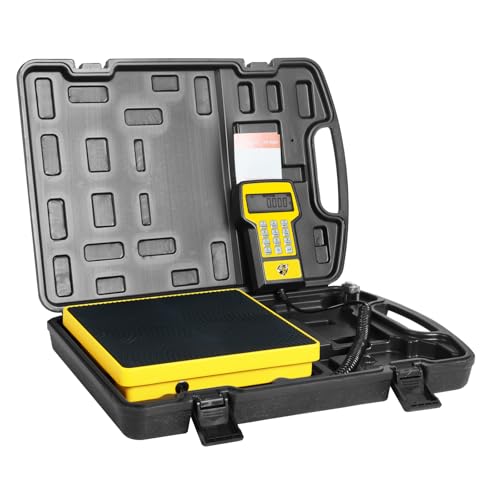 YELLOW JACKET ASRCS-220CProgrammable target weight
 Elitech LMC-100ALight 220 lb option
Start with the nameplate, not a rule of thumb
Every outdoor condensing unit or heat pump has a data plate on the cabinet. It lists the refrigerant type (such as R-410A or R-22) and the factory charge, usually in pounds and ounces or in kilograms. That number is the amount the manufacturer set for the outdoor unit, the indoor coil and a standard length of line set.
The factory charge is the best answer to how much refrigerant you need. Two 5 ton units from different makers can hold quite different amounts, because coil size, line set design and the metering device all change the charge.
If the plate is unreadable, look up the model number in the installation manual. Many manuals also list how much to add or remove for line sets longer or shorter than the standard length.
Rough amounts by system size
If you only need a ballpark for planning, a common rule of thumb says residential systems use about 2 to 4 pounds of refrigerant per ton of cooling capacity. The table below applies that range. It is a sanity check, not a charging target.
Notice how wide the ranges are. That spread is why a rule of thumb cannot replace the nameplate. A system that is far outside the range for its size is worth a closer look, though, since it may point to a misread plate or a wrong refrigerant.
| System size | Rough range (2 to 4 lb per ton) |
|---|---|
| 2 ton | 4 to 8 lb |
| 3 ton | 6 to 12 lb |
| 3.5 ton | 7 to 14 lb |
| 4 ton | 8 to 16 lb |
| 5 ton | 10 to 20 lb |
How to work out the charge for your system
Think of the total charge as the factory amount plus or minus a line set adjustment. Here is the usual order of work.
- Read the nameplate and note the refrigerant type and factory charge.
- Find the standard line set length in the installation manual, along with the manufacturer's adjustment for each extra foot of line.
- Measure the actual line set length between the indoor coil and the outdoor unit.
- Add the adjustment for any extra length, or subtract it if the run is shorter than standard.
- Confirm the result with the manufacturer's charging method, such as subcooling for systems with a TXV or superheat for fixed orifice systems.
How much refrigerant to add to a system that is low
Adding refrigerant is a different question from filling a system from empty. An air conditioner is a sealed loop, so it does not use up refrigerant. If it is low, there is a leak, and topping it off without a repair only delays the problem.
The safe approach is to find and fix the leak, recover the remaining charge, pull a deep vacuum, and then weigh in the exact factory charge. Guessing by pressure alone is unreliable, because pressures shift with outdoor temperature, indoor load and airflow.
If a system is only slightly low and a technician chooses to add charge, they should still verify the result with superheat or subcooling readings. Overcharging can raise pressures, strain the compressor and reduce cooling, so more is not better.
Weigh the charge instead of guessing
Weighing is the most dependable way to hit a target charge from empty. You set the refrigerant cylinder on a scale, zero it, and open the valve until the display drops by the amount you want. A good refrigerant scale makes this repeatable.
Three specs matter most. Capacity must cover the cylinder plus the refrigerant inside it. Resolution is the smallest step the display shows. Accuracy is given as a percent of reading. For example, the Yellow Jacket ASRCS-220L lists 220 lb capacity, 5 g resolution and 0.05% accuracy, while the Fieldpiece SR47 lists 252 lb capacity and 0.03% accuracy.
Programmable models can help on longer jobs. The Yellow Jacket ASRCS-220C lets you enter a charging value and beeps when it is reached, so you can close the valve at the right moment. If you are comparing options, our refrigerant scale comparison lays the specs side by side.
Whichever scale you use, keep the cylinder steady on the platform and avoid bumping it during the charge. A moving cylinder gives a moving reading.
Safety and legal basics
Refrigerant work carries real risks. Please read these points before touching a system.
In the US, buying and handling most refrigerants requires EPA Section 608 certification, and venting refrigerant to the air is illegal. If you are not certified, the right move is to hire a licensed HVAC technician.
- Turn off power at the disconnect and the breaker before opening any panel. Capacitors can hold a charge after power is off.
- Wear safety glasses and gloves. Liquid refrigerant can cause frostbite on contact with skin and eyes.
- Never heat a cylinder with a flame, and never fill a recovery cylinder past its rated limit.
- Work in a ventilated area. Refrigerant vapor can displace air in small, enclosed spaces.
- Use only the refrigerant listed on the nameplate. Mixing types can damage the system.
- Take care on rooftops and in attics, where footing and heat add fall and heat risks.
Frequently asked questions
How much refrigerant is in a 5 ton unit?
There is no single number. A common rule of thumb gives roughly 10 to 20 pounds, but the nameplate on your outdoor unit gives the real factory charge, and the line set length adjusts it.
How much refrigerant is in a 3.5 ton unit?
By the same rule of thumb, about 7 to 14 pounds. Check the data plate for the exact figure, since coil design and line set length change the total.
Can I just add refrigerant until the pressures look right?
That is not recommended. Pressures vary with temperature and airflow, and overcharging can harm the compressor. Use the manufacturer's method, such as subcooling or superheat, or weigh in the full charge after a repair.
Why does my system keep needing refrigerant?
A sealed system should not lose refrigerant, so repeated top-offs almost always mean a leak. Have a certified technician locate and repair it.