How Much PSI Do You Need to Spray a Car?
Most automotive spray guns need roughly 25 to 50 PSI at the gun inlet while the trigger is pulled. HVLP and LVLP guns sit at the lower end of that range, and conventional guns sit at the higher end. Your gun's manual gives the exact number, and your compressor must also supply enough airflow (CFM), not just pressure.
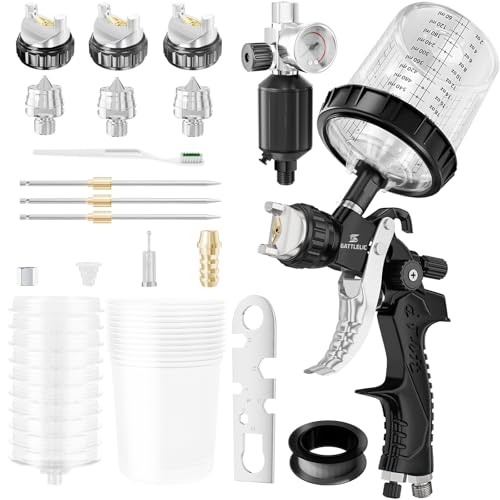 GATTLELIC GATT-HVLPBest overall
 BENTOHKLE A610Best for small compressors
 Fulchron FUL-2008-SCARLETMost nozzle sizes
The short version: set pressure at the gun, with the trigger pulled
The number that matters is the pressure at the gun inlet while air is flowing. A gauge on the compressor tank will read higher than what reaches the gun, because the hose, fittings and filters all drop pressure when air moves. A regulator at the gun, ideally with its own gauge, lets you set the true working pressure.
Most painters start at the pressure the gun maker recommends, spray a test panel, and adjust from there. Too little pressure gives coarse droplets and a bumpy, orange-peel texture. Too much pressure causes heavy overspray, dry edges and wasted paint.
Typical PSI by type of spray gun
Different gun designs use air differently. HVLP stands for high volume, low pressure. These guns move a lot of air but keep the pressure at the air cap low, often around 10 PSI, which cuts overspray. To get that at the cap, you usually feed the inlet more, so inlet settings are higher than the cap number.
The ranges below are general guidelines. Always follow your own gun's instructions first.
| Gun type | Typical inlet pressure while spraying | What to know |
|---|---|---|
| HVLP | About 25 to 40 PSI | Low pressure at the cap, high air volume, less overspray |
| LVLP | About 20 to 30 PSI | Uses less air, so it suits smaller compressors |
| Conventional | About 40 to 50 PSI | Atomizes well but wastes more paint as overspray |
What the guns on our comparison page list
Spray gun makers often list pressure in bar instead of PSI. One bar is about 14.5 PSI, so a listing of 2.5 to 3.5 bar works out to roughly 36 to 51 PSI. The guns on our best spray gun for car painting page show how much the numbers vary.
Here is what the published specs say for a few of them:
| Gun | Listed working pressure | Listed air use |
|---|---|---|
| GATTLELIC GATT-HVLP (1.4 mm tip) | 2.5 to 3.5 bar (about 36 to 51 PSI) | 9.71 CFM |
| KCNKCN H2008 HVLP | 2.5 to 3.5 bar (about 36 to 51 PSI) | 9.71 CFM |
| BENTOHKLE A610 LVLP | 2.0 to 3.5 bar (about 29 to 51 PSI) | 3.0 to 3.9 CFM |
| NEIKO 31213A HVLP (1.3 mm tip) | 40 PSI | 4.5 CFM |
| Fulchron HVLP kit | 2.5 to 3.5 bar (about 36 to 51 PSI) | Not listed |
PSI is only half the story: check your CFM
Pressure tells you how hard the air pushes. CFM (cubic feet per minute) tells you how much air the gun uses each minute. A compressor can reach 40 PSI easily and still fall short, because it cannot keep up with a thirsty gun. When that happens, the pressure sags mid-pass and the spray pattern changes in the middle of a panel.
Look at the gun's CFM rating and compare it with what your compressor delivers at the working pressure. The guns on our comparison page use from 4.5 to 15 CFM, which is a big spread. If your compressor is small, a low-air gun is the safer match. Our page notes that LVLP guns often use 3 to 4 CFM, and the BENTOHKLE A610 listing of 3.0 to 3.9 CFM fits that pattern.
A larger tank also helps. It gives you a reserve so the compressor motor cycles less often while you spray a long panel.
How to use a spray gun with an air compressor
Follow this order every time. It keeps the air clean and the pressure steady.
Before you start, read the manual for both the gun and the compressor.
- Drain the compressor tank to remove water. Moisture in the line causes fisheyes and spits in the paint.
- Connect a hose to the compressor, then add an air filter or water separator and a regulator near the gun. Many kits on our page include a regulator or filter-regulator.
- Check that the gun's inlet size matches your fittings. Several guns here use a 1/4 inch NPT inlet, so you may need a matching quick-connect.
- Strain and thin the paint as the paint maker directs, then fill the cup. Do not overfill.
- Set the regulator to the gun maker's suggested pressure while squeezing the trigger so you read the pressure under flow.
- Open the fluid knob and fan control as the manual suggests, then spray a test card or scrap panel.
- Adjust in small steps, about 2 to 3 PSI at a time, until the pattern is even and the paint lays down smoothly.
- Clean the gun right after spraying so paint does not harden in the passages.
Dialing in a good pattern
Hold the gun about 6 to 8 inches from the panel unless your gun says otherwise. For reference, the GATTLELIC listing gives a spraying distance of 170 to 240 mm, which is about 7 to 9 inches. Keep the gun square to the surface and move at a steady pace, overlapping each pass by about half.
Read the test panel. A rough, dimpled surface often means the paint is not breaking up finely enough, so try a little more pressure or thinner paint. Runs and heavy wet spots point to too much paint flow or a gun held too close. Dusty, dry edges and a lot of mist in the air usually mean the pressure is too high.
Tip size matters here too. Our guidance is that 1.3 to 1.4 mm tips suit basecoat and clear coat, while 1.7 to 2.0 mm tips suit primer. A bigger tip passes more paint and may need slightly different air settings, so retest after you change it. When you swap a nozzle, change the matching needle too, as several kit listings point out, to avoid leaks.
Safety notes before you spray
Automotive paints and thinners give off fumes that can harm your lungs. Work in a well ventilated space and wear a respirator rated for paint vapors, not a basic dust mask. Isocyanate hardeners in many clear coats call for particular care, so read the paint's safety data sheet.
Wear safety glasses or goggles, nitrile gloves and hearing protection, since compressors are loud. Keep ignition sources, including pilot lights and sparks from tools, away from solvent vapors.
Never exceed the maximum pressure rating on your hose, regulator, fittings or the gun itself. Release pressure from the tank and hose before disconnecting anything, and never point a spray gun or air line at skin.
Frequently asked questions
Can I spray a car with a small compressor?
Often yes, if you pick a low-air gun and work panel by panel. Compare the gun's CFM with your compressor's output at working pressure. Our page lists LVLP guns using about 3 to 4 CFM for smaller compressors.
Should I set PSI at the compressor or at the gun?
Set it at the gun, with air flowing. A regulator near the inlet shows the pressure the gun actually receives. The tank gauge reads higher because air loses pressure in the hose and fittings.
Does the same PSI work for primer and clear coat?
Not always. Thicker materials like primer may need different settings and a larger tip than thin basecoat or clear. Follow the paint maker's data sheet and test on scrap first.
Why does my paint look like orange peel?
Common causes are low pressure, paint that is too thick, a gun held too far away, or moving too fast. Adjust one thing at a time on a test panel to find the cause.
Do I need an air filter or water separator?
Yes, for car paint. Water and oil in the air line can ruin a finish. Drain the tank before each session and use a filter near the gun.