How Much Lighting Does a Kitchen Need?
Most kitchens do well with about 30 to 40 lumens per square foot for general ceiling light, plus extra task light over the counters. For a 150 square foot kitchen, that means roughly 4,500 to 6,000 lumens from the ceiling. Check lumens first, because wattage only tells you how much power a light uses.
 LUTEC XDD-7Best overall
 Brightever XD300-09Slimmest, most efficient fixture
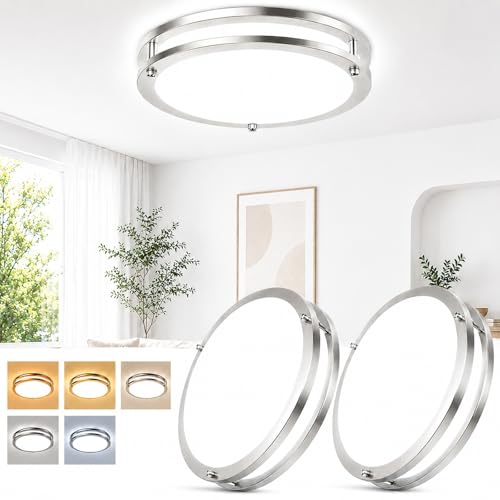 weddeg 63633008-03Most color-accurate light
Start with lumens, not watts
Lumens measure how much light a fixture puts out. Watts measure how much electricity it draws. With old incandescent bulbs the two moved together, so people shopped by watts. LEDs make far more light per watt, so a watt rating alone no longer tells you how bright a light will be.
A common rule of thumb for kitchens is 30 to 40 lumens per square foot for the general (ambient) light. Kitchens need more than a bedroom or living room because you are cutting, reading labels and handling hot pans. Treat the rule as a starting point and adjust for dark cabinets, a windowless room or a high ceiling.
Work out your number
Measure the length and width of the kitchen in feet and multiply them. Then multiply by 30 for a modest target or 40 for a bright one. Here is how that plays out for common sizes.
| Kitchen size | Approx. floor area | Ceiling lumens to aim for |
|---|---|---|
| Small galley or apartment | 100 sq ft | 3,000 to 4,000 |
| Average kitchen | 150 sq ft | 4,500 to 6,000 |
| Large kitchen | 200 sq ft | 6,000 to 8,000 |
| Open-plan kitchen zone | 250 sq ft | 7,500 to 10,000 |
Plan in layers
Ceiling light alone leaves shadows on the counter, because you stand between the fixture and your work. Good kitchens use more than one layer.
Think of the layers this way, and count each one toward your total light.
- Ambient light: ceiling fixtures that fill the room evenly. This is where the lumens-per-square-foot rule applies.
- Task light: strips or puck lights under wall cabinets that shine straight onto the counter, so your body does not block them.
- Accent or table light: a pendant or small fixture over an island or eating area, which can be dimmed for meals.
What wattage LED for a kitchen ceiling?
There is no single right wattage. Divide the lumens you need by the fixture's lumens per watt (efficacy). A more efficient light needs fewer watts for the same brightness.
Published specs show the spread. The LUTEC 13 in flush mount lists 4,200 lumens at 37W. The Brightever 12 in lists 3,200 lumens at 24W, an efficacy of 133.33 lm/W. The weddeg 13 in 2-pack lists 3,600 lumens at 36W per light. So 24W can out-shine a cheaper 36W light, which is why lumens matter more.
For screw-in bulbs, a traditional 60W bulb gives off roughly 800 lumens, and a similar LED does it with a fraction of the watts. Look for the lumens on the box and ignore the old watt equivalents.
How many ceiling lights do you need?
Take your lumen target and divide it by the lumens of one fixture. Round up, then spread the fixtures evenly so no corner sits dark.
For a 150 sq ft kitchen needing 4,500 to 6,000 lumens, one 4,200 lumen fixture falls a bit short on its own, so add under-cabinet light. Two 3,200 lumen fixtures give 6,400 lumens in total and cover the range. A 2-pack at 3,600 lumens each gives 7,200 lumens, which suits a kitchen of roughly 180 to 240 sq ft by the 30 to 40 rule.
Maker coverage ratings are a useful cross-check. The LUTEC lists 250 sq ft, but that figure is for rooms in general, so a kitchen at that size would still benefit from a second light or task lighting. Our best lighting for kitchen ceiling page lines up output, coverage and color settings side by side. If a coverage figure is missing, plan on two fixtures for a larger kitchen.
Pick the right color and accuracy
Color temperature changes how the room feels. Around 4000K to 5000K gives crisp light for prep and cleanup. Warmer 2700K or 3000K suits dinner. Many fixtures, including the three above, offer several settings chosen by a switch, and you usually set it before you mount the light.
CRI describes how true colors look, and a higher number is better. The weddeg 2-pack lists CRI 90 and the Lithonia 1x4 panel lists 80. A higher CRI helps you judge meat, produce and sauces. Dimming adds flexibility, but most fixtures need a compatible dimmer that is bought separately, and some do not dim at all.
Over a table or island, the fixture style matters as much as brightness. Our best lighting for over kitchen table comparison covers that zone.
Safety notes before you install
Turn off the circuit at the breaker, not just the wall switch, and confirm the power is off with a voltage tester. If you are not comfortable with wiring, hire a licensed electrician.
Use a stable ladder, ask a helper to hold the fixture, and wear safety glasses when working overhead, since dust and debris fall into your eyes. Kitchens add steam and splashes, so choose a damp-rated fixture near the stove or sink where the maker lists one, such as the Lithonia panel. Never exceed a fixture's maximum wattage, and use a dimmer that matches the fixture.
Frequently asked questions
Is brighter always better in a kitchen?
No. Too much light causes glare on shiny counters and makes the room feel harsh. A dimmer lets you go bright for prep and soft for meals.
Do I count under-cabinet lights in my lumen total?
Yes, they add to the total, and they help most because they light the counter directly. Many cooks use them to reduce how many ceiling lumens they need.
Will a darker kitchen need more light?
Usually yes. Dark cabinets and walls soak up light, so aim for the higher end of the 30 to 40 range.
Can one big fixture replace several small ones?
In a small kitchen, yes. In a larger or L-shaped room, two or more fixtures spread the light more evenly and cut down on shadows.