How Much Light Does a Living Room Need? Lumens, Watts and Layers
A good rule of thumb is 10 to 20 lumens per square foot, so a 250 sq ft living room needs roughly 2,500 to 5,000 lumens in total. Watts only tell you how much power a light draws, so shop by lumens and use watts to judge efficiency. Plan to spread that light across a few sources and add dimming so you can adjust it through the day.
 LUTEC XDD-7Best overall
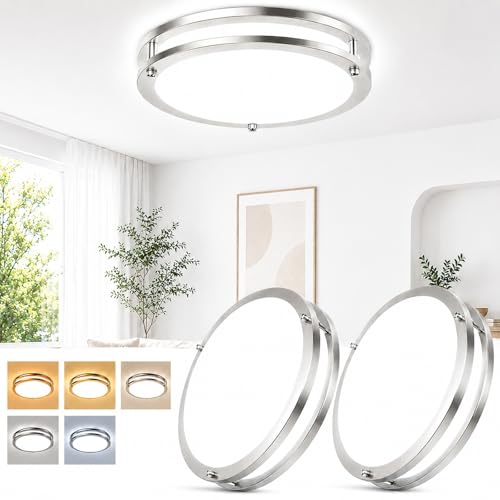 weddeg 63633008-03CRI 90 two-pack
 Brightever XD300-09Most efficient on the page
The quick math: lumens per square foot
Lumens measure how much visible light a fixture puts out. For a living room, a common rule of thumb is 10 to 20 lumens for every square foot of floor space. Multiply your room's area by those two numbers and you get a target range.
For example, a 15 ft by 20 ft room is 300 sq ft. At 10 to 20 lumens per square foot, that works out to about 3,000 to 6,000 lumens across all the lights in the room. This is a starting point, not a strict standard. Your own habits and room features will move the number up or down.
Lumen targets by room size
The table below applies the same 10 to 20 lumens per square foot rule to a few common sizes. Aim for the lower end if you like a soft, relaxed feel, and the higher end if you read, work or craft in the room.
These totals include every light source, such as ceiling fixtures, lamps and wall lights, not just the main ceiling light.
| Living room size | Low end (10 lm/sq ft) | High end (20 lm/sq ft) |
|---|---|---|
| 150 sq ft | 1,500 lm | 3,000 lm |
| 200 sq ft | 2,000 lm | 4,000 lm |
| 250 sq ft | 2,500 lm | 5,000 lm |
| 300 sq ft | 3,000 lm | 6,000 lm |
| 400 sq ft | 4,000 lm | 8,000 lm |
How many watts does a living room need?
This is where many shoppers get stuck. Watts measure power use, not brightness. With old incandescent bulbs, wattage and brightness moved together, which is why people still ask about watts. LEDs make more light from each watt, so a low-wattage LED can match a much higher-wattage old bulb.
The better number to compare is efficiency, meaning lumens per watt. Our spec data shows how much this varies. The LUTEC 13 in fixture draws 37 W for 4,200 lm, and the weddeg 13 in fixture draws 36 W for 3,600 lm. The Brightever 12 in panel lists 24 W for 3,200 lm, which is an efficacy of 133.33 lm/W.
So there is no single watt figure for a living room. Work out your lumen target first, then pick fixtures that reach it. Among fixtures with similar output, the one with the lower wattage will use less electricity.
Layer your light instead of relying on one fixture
Most living rooms feel better with several light sources than with one bright overhead light. Spreading your lumen budget around also reduces harsh shadows and glare on the TV.
A simple setup uses three layers:
- Ambient light: the general light from a ceiling fixture that fills the room evenly.
- Task light: a floor lamp by a reading chair or a table lamp beside the sofa for close work.
- Accent light: wall lights, picture lights or a small lamp that adds depth and highlights art or shelves.
Brightness control, color temperature and CRI
A living room does many jobs, from movie nights to homework to hosting. That makes dimming one of the most useful features to look for. Several fixtures on our best lighting for living room page dim from 5% or 10% up to 100%, although you often need to buy a compatible wall dimmer separately. A fixed-brightness panel such as the hykolity is not dimmable, so it suits utility spaces better than a living room.
Color temperature is the second control. Around 2700K to 3000K looks warm and relaxed for evenings. Cooler light at 5000K to 6500K looks crisp, which helps for cleaning or reading. Some fixtures use a switch inside that you set before mounting, while remote models let you change it at any time.
CRI, or color rendering index, shows how true colors look under the light. The weddeg two-pack lists a CRI of 90, which should show fabrics, wood and artwork more accurately than a lower rating.
Adjust for your room and your household
The rule of thumb assumes an average room. A few things can push you toward more light:
Dark paint, dark flooring and heavy curtains absorb light, so the room may need more lumens than the same space in pale colors. Tall ceilings spread light over a larger volume, and open-plan layouts that join the kitchen and dining area need extra output to cover the whole zone. Older eyes also generally need more light for reading, so plan for stronger task lamps.
On the other hand, a room with big windows and light walls may feel bright with less. Dimming lets you correct for these factors without replacing anything.
Always check the maker's coverage rating when one is listed. The LUTEC and weddeg fixtures are each rated for up to 250 sq ft. For larger rooms, the higher-output ring designs, such as the 8,000 lm and 10,400 lm models, may be worth a look. You can see them side by side on our living room lighting comparison.
Safety notes for installing or swapping lights
Hardwired ceiling fixtures connect to household wiring, so turn off the circuit at the breaker, not just the wall switch, before you touch anything. Confirm the power is off with a voltage tester.
Use a stable stepladder, keep it on a level floor and have someone steady it if you can. Wear safety glasses when working overhead, since dust and small parts can fall. If you are unsure about wiring, hire a licensed electrician.
Check the dimmer and fixture are compatible before installing them together. A mismatch can cause flicker or buzzing.
Frequently asked questions
Can a living room have too much light?
Yes. Too much unshaded light causes glare and makes the room feel harsh, especially for TV viewing. A dimmer and a mix of lamps help you tone it down.
Is one ceiling light enough for a living room?
It can work in a small room if it is bright enough and dimmable. Most rooms feel better with at least one or two lamps added for reading and softer evening light.
Does a higher wattage mean a brighter LED?
Not always. Efficiency varies between products, so two fixtures with the same wattage can produce different lumens. Compare the lumen rating directly.
What color temperature is best for a living room?
Warm light around 2700K to 3000K suits relaxing in the evening. Many people choose a fixture with a wider range so they can switch to cooler light for tasks.