How Much Ice Melt Do You Need for Your Driveway?
For most driveways, plan on roughly 2 to 4 ounces of ice melt per square yard (9 square feet), which works out to about 0.2 to 0.4 ounces per square foot. A single-car driveway usually needs around 3 to 7 pounds per application, and a two-car driveway about 6 to 11 pounds. Your bag label has the final say, because rates differ by product.
 Snow Joe AZ-50-EBBest overall
 Snow Joe AZ-BH-50Deep cold, large bag
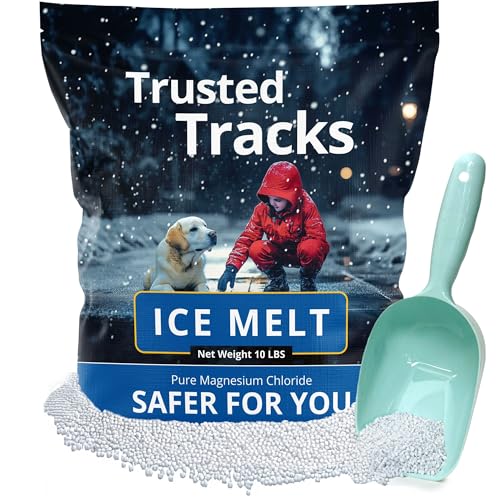 FIREKI ICEMELT-10-BAG-ALowest temperature rating
The quick formula
Start by measuring your driveway. Multiply length by width in feet to get square feet, then divide by 9 to get square yards. Most bag labels give their rate per square yard, so this conversion saves you from guessing.
A common rule of thumb for light ice is 2 to 4 ounces per square yard. Thicker, bonded ice calls for more, but a thick layer is better broken up with a shovel or scraper first. Ice melt works best as a thin, even layer, not a pile.
These numbers are general guidance, not published coverage data for any one product. Coverage per bag is often missing from listings, so we size by bag weight and treat the bag label as the final word.
Sample amounts by driveway size
The table below applies the 2 to 4 ounces per square yard range to common sizes. Your driveway may be shaped differently, so use it as a starting point and measure your own.
| Area | Size | Square feet | Approx. amount per application |
|---|---|---|---|
| Walkway | 3 ft x 30 ft | 90 | 1.3 to 2.5 lb |
| Single-car driveway | 12 ft x 20 ft | 240 | 3.3 to 6.7 lb |
| Two-car driveway | 20 ft x 20 ft | 400 | 5.6 to 11 lb |
| Long driveway | 12 ft x 50 ft | 600 | 8.3 to 16.7 lb |
Light ice or heavy ice?
Use the low end of the range for a light glaze or a dusting of snow that has been packed down. Use the high end for a thicker layer of ice or when temperatures are close to your product's limit.
Do not keep adding more because it looks thin. Extra product does not melt faster once there is enough to make brine, and it only leaves more residue and more to sweep up.
A few habits help you stay within the right amount:
- Shovel or plow loose snow first, so the ice melt works on the ice and not on the snow pile.
- Spread it before or at the start of a storm when you can. Some listings note that it works best when applied at the beginning of snowfall.
- Apply in an even layer, moving in one direction, then check for bare patches.
- Wait for the ice to loosen, then scrape or shovel it off. Reapply only to stubborn spots.
Check the temperature rating first
The amount only matters if the product can work in your weather. Every ice melt has a minimum temperature, and it does little once the air drops below that number. On our best ice melt comparison, the ratings run from -35°F to -2°F.
For example, the FIREKI magnesium chloride bags are rated down to -35°F, while Snow Joe's Blue Heat is rated to -25°F and the Enviro Blend to -10°F. The Safe Paw jug is rated to -2°F, so it suits milder winters better than deep cold.
If your lows often fall below your product's rating, using more will not fix it. Switch to a lower-rated product instead.
Pick a bag size that matches your driveway
Bag weight sets how many applications you get and how much you have to carry. On our spec sheet, bags range from 8 lb to 50 lb, with the 50 lb size listed for both Snow Joe products.
Using the table above, an 8 lb jug or a 10 lb pail covers roughly one application on a single-car or two-car driveway. That makes them a good fit for steps, short paths and small drives. A 50 lb bag gives roughly four to nine passes over a two-car driveway, but it is heavy to lift and store.
Form matters for spreading too. Pellets and granules pour evenly, and the AquaDoc listing says its pellets load into a spreader, which helps on a long driveway. A tinted product, like the green crystals in the Snow Joe Enviro Blend, lets you see where you have already spread. You can compare these details on one page in our ice melt comparison.
Safety and surface care
Wear gloves when you handle ice melt, and keep it away from your eyes. Some products can irritate skin, so wash your hands afterward. Store bags tightly closed, out of reach of children and pets.
Pet-safe, concrete-safe and plant-safe marks are maker claims from the listings, not independent lab results. If you have a new concrete driveway, check the label, because many makers advise waiting until concrete has fully cured. Sweep up leftovers once the ice is gone, and keep product off lawn beds.
Ice melt also makes surfaces slick as it works. Walk carefully while it does, and wear boots with good grip.
Frequently asked questions
Can I mix different ice melts?
It is best not to. Products differ in ingredients and ratings, so mixing them makes the result harder to predict. Use one product at a time and follow its label.
Do I put ice melt down before or after a storm?
Either can help. Applying a thin layer before or at the start of a storm can keep ice from bonding. After a storm, clear the snow first, then treat what is left.
Will a bag of ice melt last all winter?
That depends on your winter and your driveway size. Count your likely applications using the table, then add a spare bag so you do not run out mid-storm.
Can I use sand instead?
Sand adds grip but does not melt ice. It can help as a backup when it is too cold for your product to work.