How Many Garage Lights Do You Need for Good Coverage?
Most garages need roughly 50 to 75 lumens per square foot, so multiply your floor area by that range and divide by the lumens each fixture makes. A 20 by 20 foot two-car garage lands around 20,000 to 30,000 total lumens, which could be two bright screw-in fixtures or about a dozen linkable tubes. Add more light over benches, and keep the layout even so you avoid dark corners.
 POLARPRA JP-CKD-1Best overall
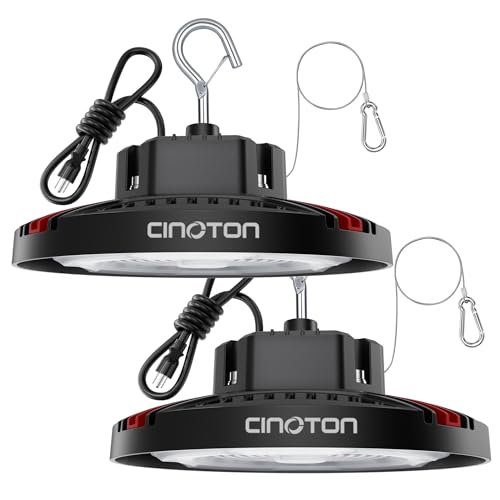 CINOTON KING-HR150EBrightest and most efficient
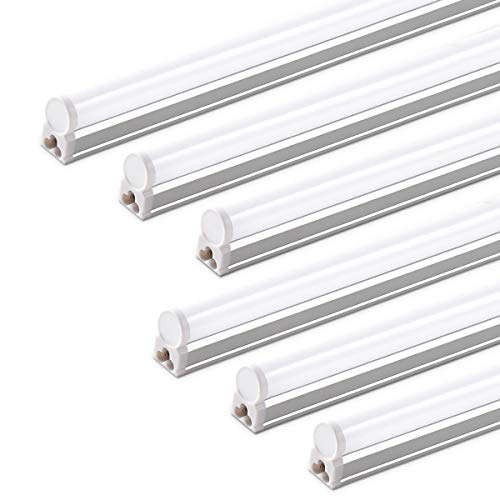 Barrina AAL20Truest colors, longest chain
Start with total lumens, not fixture count
The number of lights depends on how bright each one is. A single fixture can make anywhere from 2,200 lumens to 24,000 lumens in the 18 products on our spec sheet, so "four lights" can mean very different results. Work out the total light your space needs first, then pick fixtures to reach it.
A common rule of thumb for general garage lighting is 50 to 75 lumens per square foot. Multiply your length by your width to get square feet, then multiply by 50 and by 75. That gives you a low and a high target. Use the low end for a storage garage and the high end if you work on cars, projects or hobbies in there.
White or light-colored walls and ceilings bounce light around and help. Dark walls, bare concrete and tall ceilings soak it up, so lean toward the high end in those cases.
Quick sizing guide by garage size
Here are example targets using the 50 to 75 lumens per square foot rule. The garage dimensions are typical examples, so swap in your own measurements.
| Garage type | Example size | Floor area | Total lumens target |
|---|---|---|---|
| 1-car | 12 x 20 ft | 240 sq ft | 12,000 to 18,000 |
| 2-car | 20 x 20 ft | 400 sq ft | 20,000 to 30,000 |
| 3-car | 30 x 24 ft | 720 sq ft | 36,000 to 54,000 |
Turn the lumens target into a fixture count
Divide your target by the lumens per fixture. Round up, because a little extra light is easier to fix than too little. Our best garage lights page lists lumens for every product, so you can run this math on any model.
Here is how it works for a 400 square foot, two-car garage that needs 20,000 to 30,000 lumens, using published specs:
- POLARPRA 8-panel screw-in: 20,000 lm per fixture. One fixture reaches the low end, and two fixtures cover the high end with room to spare.
- Aoretic 6+1 panel: 18,000 lm per fixture. Two fixtures give 36,000 lm, which is plenty for this size.
- CINOTON UFO high bay: 24,000 lm per fixture. One covers the low end, and two reach the top of the range.
- Meiqils 3-panel screw-in: 8,000 lm per fixture. You would need three to four fixtures to land in the range.
- Barrina T5 4 ft tube: 2,200 lm each. You would need about 10 to 14 tubes, which means two packs of six.
Placement matters as much as count
Total lumens only help if the light reaches the places you work. One very bright fixture in the middle can leave shadows behind shelves, cars and open doors. Several smaller fixtures spread across the ceiling usually give more even coverage than one or two big ones.
Screw-in panel lights hang from a single point and have adjustable panels, so you can angle light toward corners. Linkable tubes, like the Barrina, which links up to 8 units per run, work well in rows. Place rows over the sides of a parked car and over the workbench rather than straight down the middle.
Tall ceilings spread light over a larger area, so the floor receives less. If your ceiling is much higher than a standard 8 foot garage, favor the upper end of your lumens range.
How many garage lights can go on one circuit?
Electrical limits are about watts and amps, not the number of fixtures. A standard 15 amp, 120 volt circuit is rated for 1,800 watts, and a common practice is to keep steady loads to about 80 percent of that, or 1,440 watts. A 20 amp circuit allows more. Check your breaker label to see which you have.
LED lights draw little power for the light they make. On our spec sheet, the Barrina tube lists 20 W, and the POLARPRA lists 200 W for 20,000 lumens. Even a dozen 20 W tubes would use about 240 W. Two 200 W screw-in fixtures would use about 400 W.
The bigger risk is everything else on that circuit. Garage circuits often also feed outlets for a freezer, garage door opener, chargers or power tools. A table saw or compressor can use most of a circuit by itself. If you plan to run tools, ask an electrician whether the lights should be on a separate circuit.
Many garages have the ceiling light and outlets on one shared circuit, so add up the watts of everything you expect to run at once before you add more fixtures.
Can you have too much light in a garage?
Yes, though it is less common than too little. Too much light, or light in the wrong place, causes glare on shiny paint, glass and tool surfaces. Bright bare fixtures at eye level or near the garage door can make it hard to see.
Brightness also is not the same as quality. Color temperature, listed in kelvins, changes the feel of the light. Several products on our page list 6500K, a cool daylight look, while the CINOTON lists 5000K. Both are common for work areas, so choose what looks comfortable to you.
Color rendering matters when you match paint or read wire colors. Only eight of the 18 products list a CRI, and those range from 80 to 85. If a maker does not publish CRI, treat color accuracy as unknown.
To avoid glare, aim panels toward walls and work areas rather than at eye level, and consider a dimmer or a switch that lets you turn off some fixtures when you do not need full brightness.
Safety and installation checks
Lighting is a simple upgrade, but a few precautions are worth taking.
Turn off the breaker, not just the wall switch, before you change a socket or wire anything. Use a sturdy ladder placed on level ground, and have a helper if the fixture is bulky or you are working above a car. Wear safety glasses when you drill into a ceiling, because dust and debris fall straight down.
Screw-in fixtures need a standard E26/E27 socket, and they hang their full weight from it. Make sure the socket and any pull chain or old fixture are in good shape and rated for the load. Heavier units add stress at that one point, so a safety chain is a good idea where one is included.
Look for an ETL or UL listing, which means a recognized lab has certified the fixture to electrical safety standards. Several screw-in lights on our spec sheet list no certification or FCC only. For a fixture running overhead for hours, certification is worth prioritizing over a few extra lumens. If you need help comparing, see our garage light comparison for certification listed by product.
Frequently asked questions
Should I use more small lights or fewer big ones?
More small fixtures spread light more evenly and cut shadows. Fewer big fixtures are quicker to install but can leave dark corners unless they have adjustable panels.
Do I need extra light over a workbench?
Usually yes. A fixed ceiling layout lights the room, but a dedicated light over the bench cuts shadows from your own body. Add a linkable tube or a second fixture there.
Does a higher wattage always mean a brighter light?
No. Compare lumens, not watts. Efficiency varies, and the CINOTON lists 24,000 lm at 160 W while the POLARPRA lists 20,000 lm at 200 W.
Will tall ceilings change how many lights I need?
Yes. Light spreads out and weakens by the time it reaches the floor, so tall ceilings often call for the high end of the lumens range or extra fixtures.